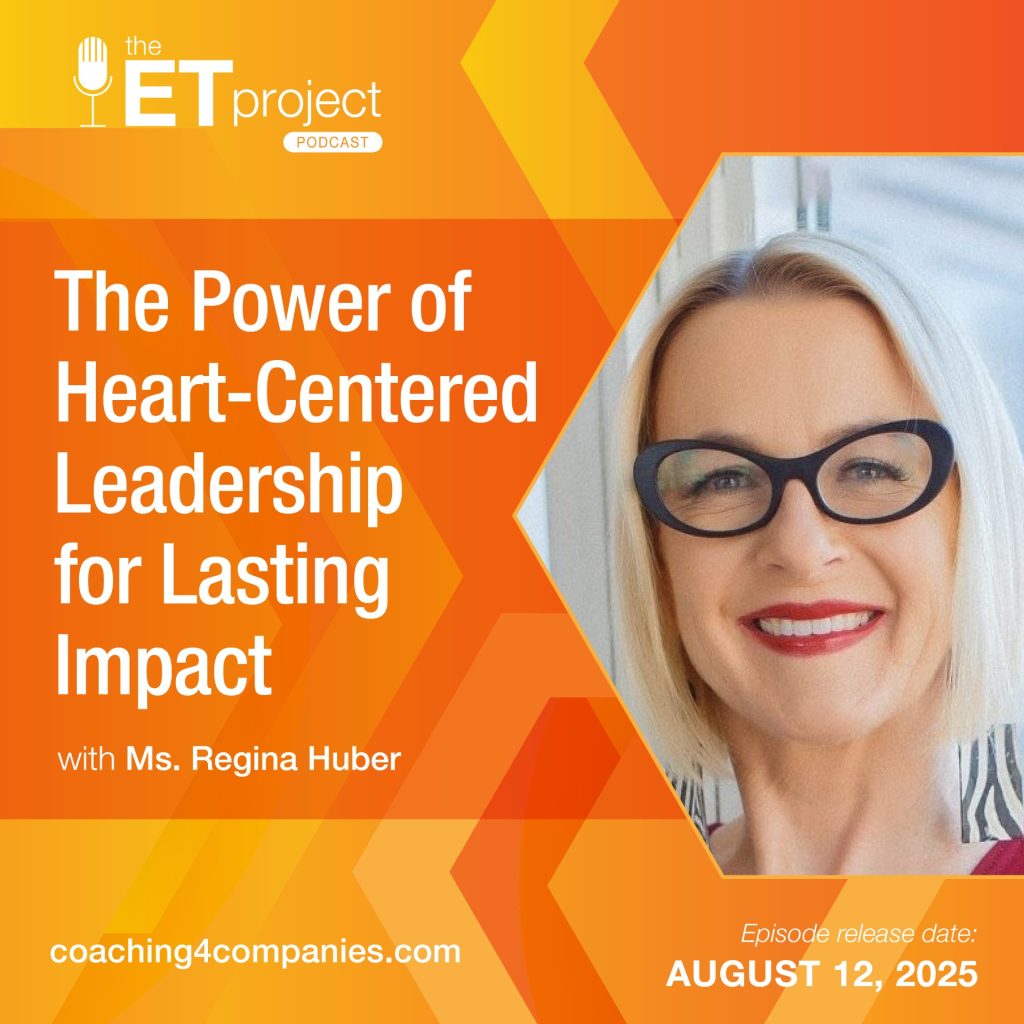
WAYNE BROWN: Hello, I’m your host Wayne Brown and welcome to the ET Project. We’re delighted to be delivering this podcast for executive talent all over the world whom we’re affectionately referring to as ‘Team ET.’ Today, we’ve traveled to Lyon in France to chat with transformational leadership coach, international inspirational speaker and author Regina Huber. As the founder and CEO of the coaching, speaking and training business Transform Your Performance, Regina drives bold, heart-centered leadership. Through her holistic coaching approach, she helps clients become thriving leaders by upleveling their leadership of self and others to reach their next career goal and team-building results. Regina’s eclectic multicultural background across five continents started in Germany and includes leadership roles at Boston Consulting Group across Europe, South America and the US. Having also owned businesses in Argentina, Brazil and the US, she speaks five languages, coaching and facilitating workshops in English, German, Spanish and Portuguese. To support her clients’ success and fulfillment as leaders in their career and life, Regina has created five proprietary coaching frameworks and listeners will hear us discuss these at length as well as other methodologies during the conversation. Regina is the author of ‘Speak up, Stand out and Shine’ and the 2024-released book, ‘Living My Freakin’ Amazing Life,’ the latter is what we dive deep into during this episode. In the past Regina was the TV show host of What’s Your Spark? And is presently host of the RISE TO LEAD podcast. Over the years she’s spoken at events and taught workshops in the US, Africa, Latin America, Asia, Middle East and Australia. As Regina states, she has a huge passion for travel and dance, both of which have taught her priceless lessons for business leadership and executive presence. Everything she does is in the service of freedom and she loves inspiring others to express their unique brilliance as visionary leaders and to live a freakin’ amazing life. Team, if you wish to learn how to be brimming with an authentic version of yourself throughout your adventure, a version that brings you and others joy and performance, then I suggest you get yourself comfortable and tuned in for this insightful and wide-ranging conversation.
INTRO: Welcome to the ET project, a podcast for those executive talents determined to release their true potential and create an impact. Join our veteran coach and mentor, Wayne Brown, as we unpack an exciting future together.
WAYNE BROWN: Hello team, welcome to today’s episode where we’re going to explore, I want to say bold leadership, which may be an understatement once you meet the guest, definitely an authentic self-expression and what it truly means to live a freakin’ amazing life and you’ll understand more about that comment when we get into the conversation. Our guest has journeyed from a small village in Germany to leadership roles across five countries, turning setbacks into springboards for not only transformation but even liberation. She’s a multicultural leadership coach, international speaker and author, and blends a multiple of modalities to help leaders thrive. Please help me welcome the inspiring Regina Huber, the founder of Transform Your Performance, as well as host of the RISE TO LEAD podcast. Regina, welcome to the ET project.
REGINA HUBER: Thank you so much, Wayne, for having me on and I’m so glad to be here, super honored. And hopefully, it will be a very inspiring conversation, I think, based on our pre-call, it should be.
WAYNE BROWN: I didn’t mention during the introduction, and I only realized in listening to your book, is that dance is such a big part of your life. What was the initial trigger that took you into that area and has taken center stage, it seems, throughout most of your career?
REGINA HUBER: You know, I didn’t grow up with dance, really, I mean, there was some folkloric dance. I grew up in a tiny little village on a farm in Germany. At the time, there was no internet, there was TV. So, there were occasional dance contests, but it was all very limited. I remember I also liked watching figure skating, although I never did it myself, and I didn’t really like ice skating myself, but I liked watching it; the ice is too hard to fall on.
WAYNE BROWN: Yes.
[00:05:00]
REGINA HUBER: It was probably already in me somehow and if we study what or who we really are, and that we are consciousness and all these things, then it makes sense. Later on, as I moved to Munich, that was my first bigger city I moved to, that’s when I discovered Latin dancing, I did quite a bit of that. Then of course, I moved to Madrid, so, there was more of that. And then there was Argentine tango. Later, I translated over 10 books on tango and, yeah, work travel, you know. Also, I did some Spanish dancing too, as well, not too much, but a little bit of flamenco, a little bit of Sevillanas. And then as I traveled to the different countries and moved to the different countries, I discovered new options and so, my preferences changed over time, currently… well, I should mention in Brazil, of course, it was like heaven for dancing to me. And then currently, my preferred dances are from several different African countries, such as Sabar from Senegal, and Ndombolo from Congo, and some other examples. And I have discovered that I have learned so much from dance, not just for teamwork and for business, but also for leadership, and so, I wrote quite a few articles about that.
WAYNE BROWN: You often say everything you do is in the service of freedom, which is a really powerful statement, of course. But can you unpack that a little bit? What does freedom in this context mean for you?
REGINA HUBER: Yeah, so freedom to me is extremely important. It’s not just about living where I want to live and moving around and all that, this external freedom. It’s also the freedom that comes from within. And a lot of people talk about freedom as freedom from, like freedom from, I don’t know, freedom from sickness, freedom from poverty, freedom from anxiety, whatever it is. And to me, it’s really about the freedom to, the freedom to create what I want to create, the freedom to express what I want to express in this life and the freedom to live and to lead as I want to live and lead. So, this is what freedom is about to me. And when we really come into presence, that’s when we can access our inner freedom. You know, it’s so important now, Wayne, because we feel, a lot of us probably feel a bit oppressed right now because there’s so much control going on, it’s becoming more and more obvious. That presence is a place where we can come to and find that inner freedom again. And it’s actually not even a place, presence is what we are because we are consciousness. So, you know, it’s a different way of saying that, but we often forget about it and we forget that we can access our inner power and we can connect with it and it’s already there.
WAYNE BROWN: When you talk about transformational coaching, even liberational coaching or being liberated, that it’s a derivative from this freedom that you’re referring to.
REGINA HUBER: Right. And it’s also the freedom to be authentic, for example, as a leader, right? So, lead in your way. Yes, there are certain principles all leaders might want to respect, such as respect, actually. But then we are all unique for a reason and we need unique leadership and leaders. And when you are able to bring that out, that’s when your leadership actually becomes more powerful, more natural, more effortless and more effective. And that’s also… that has to do also with that freedom and that liberation. So, transformation is really nice, but our end goal is really that liberation. We all will potentially or probably stay on this path of transformation because it really never ends. However, we can get very close to liberation if we do it in a way that is self-aware, that is not afraid of going to the depth of transformation.
WAYNE BROWN: I was thinking it can almost be a parallel path in my mind that we can be liberated while we continue to transform.
[00:10:00]
WAYNE BROWN: So, we can be liberated in certain areas and continue to transform in other areas, perhaps. Very interesting.
REGINA HUBER: Right.
WAYNE BROWN: I have to ask you to list, if you can, just very quickly, how many different cities have you lived in? Because it’s quite extraordinary.
REGINA HUBER: Right. I will answer that question in just a second. But I did want to add something that I think is very important. So, liberation and freedom is also about responsibility in a sense of risk, the ability to respond, that’s what responsibility means. And also, in the sense of we are creating our own reality, so that responsibility, that gives us that freedom in the end. But as long as we don’t assume responsibility, we are not free because we are victims of circumstances. So, I just quickly wanted to add that with your permission.
WAYNE BROWN: Absolutely fine. And we could talk for the whole conversation around that topic because responsibility, accountability, commitment are all big topics that we talk about a lot as well. You have a choice, right? And you make a choice for every situation you find yourself in. And if you take responsibility, you’ll make a choice in a different way than if you play the victim. And I know you talk about that in your book as well.
REGINA HUBER: Right. So, about the city. So, I lived, of course, in our little village, which I just came back from, I just was visiting family, it originally had 10 houses when I grew up there, now it has grown a bit. But yeah, so the first city I moved to at 19 was Munich, I stayed there about seven years. What’s interesting is that most of my stays have, for the longest time, were either seven years or three and a half years, it’s interesting. And from there, I moved to Madrid, I stayed there another seven years. Then I went to Sao Paulo for a shorter period of time, about a half year at the time, still with the Boston Consulting Group that I worked at, at that time. I helped open offices in Lisbon and Sao Paulo for the Boston Consulting Group. So, I traveled to Lisbon a lot while I lived in Madrid, weekly for years, actually. Then, let me think, I moved back to Munich, from there, I moved to Buenos Aires, Argentina. The crisis hit so the company I was working for as an external consultant could no longer pay me, it was a startup. And that’s when BCG hired me back for their San Francisco office. I stayed there also three and a half years. Then I moved back to Buenos Aires, I opened my own bed and breakfast there. So, that’s my first owned business. Then I moved to Rio de Janeiro and also opened a business and from there to New York City. I also have lived and still have my residence in Miami Beach, Florida. And now I split my time between Lyon, France, and Miami. And it’s just been amazing. I’ve spent quite a few months in Johannesburg, although on different visits, maybe a total of six, seven months. And then some other places where I’ve spent a month or two, like Kampala, Kigali; but these are shorter stays.
WAYNE BROWN: It’s quite extraordinary. And just listening to the different locations, many diverse cultures across all of those locations, I’m wondering how much that has influenced your whole philosophy around leadership, around helping others to thrive, has it had a big impact?
REGINA HUBER: It definitely has. It has helped me open my own horizon to become more open-minded, to probably also more quickly understand other people’s different perspectives, and to bring understanding and respect to those perspectives. It has taught me a whole lot about adaptability while staying true to myself. And this is very, very important, it’s not about absorbing just anything, it’s about using discernment about what we want to take on from a culture, from an environment, and whatnot. So, what makes sense to us? What is useful?
[00:15:00]
REGINA HUBER: What’s valuable? And what not so much. That is always that harmony that we want to reach between adaptability and authenticity. And you asked about leadership, actually, I haven’t answered that part of your question yet, so, adaptability is of course a leadership trait, and authenticity, too, these are desired leadership traits, at least from my point of view. So, in that sense, it has helped me a lot, and also to compare different leadership styles and find some validity in certain elements, and then again use discernment to see, okay, this works more in this environment, this works more in that environment. And at the same time, there are principles that I believe work everywhere. Principles like co-creation, like true inclusivity, not the DEI pseudo-inclusivity, that oftentimes is more going in a direction of division, I’m not saying that the fundament of it is like that, but how it’s implemented oftentimes. So, it’s that seeing every single individual and taking them into account. I believe also that heart-centered leadership, for example, works everywhere, people just don’t always dare to go there, because they think it’s soft, it’s weak, but it’s not. It’s actually very courageous, and especially as not a lot of leaders dare to go there, it requires maybe a little bit of extra effort in the beginning.
WAYNE BROWN: That’s an interesting comment, because what jumped out to me in the book is that you appear to be very human-centric and I’m guessing that heart-centered approach you have attracts people to you and vice versa, would that be a fair comment?
REGINA HUBER: Yeah, and what’s also true is Wayne, I organically have always attracted, in terms of one-on-one coaching clients, I’ve organically attracted very diverse clients from diverse backgrounds. I wasn’t intentionally targeting or looking for them. It’s just how it has been, and that is also very interesting of course for me because I thrive in change. It’s not something everybody thrives in, but I do. Of course, every single person is already different, but also then when you get different cultural backgrounds, it makes it even more exciting, in my opinion.
WAYNE BROWN: I’m on board with you. I’d like to talk a little bit about several of the trademark models or methods that you’ve developed, but the first one that I wanted to understand myself more was the quantum human design. I hadn’t heard of that before speaking with you, I wonder if you could introduce that a little bit for me, please.
REGINA HUBER: Yeah, and there are different opinions about all these different systems and methodologies and personality tests and whatever they are, it’s one of them. To me, I love it because it has given me new insights about myself after already doing a lot of self-awareness work. For example, I found how I can make my decisions in a better way through this methodology, and people that I have used it with they have all of a sudden felt confirmed in who they are, because they thought for the longest time, oh, there’s something not quite right with me or something wrong with me, maybe because I’m this way or that way, and they’ve found a reason sometimes in that methodology. Now, I’m not using this all the time, it’s up to everybody if they want to get a reading. The underlying methodology is human design, and there’s a lady who has developed this, who actually worked with the founder for a long time before developing this into the next version, which he called quantum human design. And that’s how I came to this, so I studied it to a certain extent, there are certainly more studies that I could have done in that sense because it’s very complex.
[00:20:00]
WAYNE BROWN: Yes.
REGINA HUBER: However, it’s just one of the methodologies that I’ve added onto my own frameworks.
WAYNE BROWN: So, you’ve touched on self-awareness, you use another term as well, self-empowerment, which is somewhat of a core theme that I noticed within your work, what does that really mean for you?
REGINA HUBER: First of all, I always say no one can empower you but yourself, because your power is already inside of you. No one can place it into you. So, you’ve got to remember this because that, again, is freedom. It is that you no longer are dependent on other people now. Of course, yes, as a coach or maybe also as a mentor, I can guide you to find and connect with that power inside of you, but I cannot place it into you. I cannot empower you, you’ve got to make that decision. And that’s why I don’t really use the word empower except the word self-empower. So, I use it a lot also in the context of a self-empowering mindset. And we talked about it a little bit before. It’s that mindset that you are the creator of your reality, you’re not the victim. And if you see something in your reality that you do not like, then that’s a reflection of something that you create or that is in you. And you might not do this intentionally, of course, we all have those experiences. It’s not about, oh, I did something wrong. It’s about becoming aware that this is a reflection and then changing whatever needs to change in you. And sometimes that’s through action, of course, yes, too. But sometimes it’s internal work, like for example, transmuting stuck emotions, which is what a lot of people never do, and it keeps them stuck forever. And I used to work so much, Wayne, on limiting beliefs in the past, and I miss this piece a little bit. I have studied a lot of holistic modalities, they addressed it, but not always head on. So, that’s something that I have been doing much more intentionally and much more intensely in the last even year. It is not always pleasant because for the transmutation or the dissolving to happen, we need to feel those emotions and always want to feel sadness, anger, or fear, we do anyway, but then we suppress it and that’s how it gets stuck and undigested. And that’s what keeps a lot of people stuck. And these are just examples, but there are many ways of practicing that self-empowering mindset. But I think this is something profound that is really worth doing. And as we’re doing this, though, Wayne, this is the other thing why a lot of people shy away from it, because they notice that more comes up as they start on that path. And when they get really serious about it, more obstacles, and they’re not really obstacles, more opportunities to transmute come up along the way. Because if you have made the decision to really get it all out of the way, then you’re creating yourself, you’re creating those opportunities for yourself.
WAYNE BROWN: You have a number of proprietary frameworks that you developed for coaching, do those frameworks help you with this particular self-empowerment aspect?
REGINA HUBER: Absolutely. So, the first framework I ever developed was Powerful Leadership Transformation, this is mainly for self-leadership, although it will translate to your team because you will show up in a different way, so it’s automatic. And you can also, whatever you learn through this process, transmit to your team, of course. And one of the pillars of that is indeed a self-empowering mindset and heart-set. Now, there’s another framework which is called New-Paradigm Leadership that is more team-oriented. But of course, it also includes this element to some extent in one of the four main puzzle pieces. The T.h.r.i.v.i.n.g. Leader Formula is what is the basis for my one-on-one coaching work with my clients.
[00:25:00]
REGINA HUBER: It covers, I believe, all the important aspects of leadership and they’re all listed on my website on the frameworks page of transformyourperformance.com, you can look it up there, it has quite a few items there. And we will cover what is most relevant and most important for the client, we might not cover everything in one program, depending on how long somebody decides to work with me, but we touch on the items that are most relevant at that time. And then again, they interact; it’s like a ripple effect.
WAYNE BROWN: So, you’ve covered three, I think, so far. Another one is The Unique Assets Framework.
REGINA HUBER: Yes. It’s something that I developed quickly for a specific presentation that I did last year for a STANY conference in New York City at the New York Stock Exchange. And I developed something that I wanted to present there because it was for a specific audience, it was out of women’s breakfast, although there were also men present. And it’s really about harnessing what I call unique assets, I’ve always called these unique assets, even before, and how to go about really uncovering them first. So, know, own, and show your value in one sentence, is what this is about.
WAYNE BROWN: Right.
REGINA HUBER: It’s about really going through that process of self-reflection, creating an inventory of all your unique strengths and those assets, as I call them, and then prioritizing them, evaluating them. How can you use them in your career or in your business? And how do you then also talk about them, but most importantly, not talk about them, but embody them?
WAYNE BROWN: The last one, Negotiate Your Dream Salary.
REGINA HUBER: Yeah, this is a smaller network for a specific purpose. So, I created an online course around how to negotiate your dream salary, because a lot of people, not my clients, needed that. And we didn’t want to use all their sessions for this one topic, although we would also go in depth with some particular aspects of it in a coaching session.
WAYNE BROWN: I also read another term, conversational intelligence. What does that mean exactly?
REGINA HUBER: Yeah, conversational intelligence is another methodology that I studied, and it’s not of my authorship. So, I studied it, there are specific ways of studying this methodology as a coach, and that’s what I did. And I added this because it wasn’t really covered in my initial framework, powerful leadership transformation, where I thought more about presence, about the energy aspect of presence, the body aspect of presence and the self-empowering mindset and heart set, how to uncover your distinctive uniqueness and all these things. But the conversational aspect wasn’t really covered in depth there. So, I thought this was really useful because conversational intelligence is about that verbal communication piece. And it’s about having the language to navigate more successfully through team conversations, through negotiation, any type of meeting really. It’s also a tool to build trust or rather, I should say, many tools included in that methodology to build trust and to just build your team in a meaningful way. And also, actually trust between other teams, so not just within your own team. It’s about using very inclusive language at the same time, so it has a lot of elements.
WAYNE BROWN: Where did your knowledge or access to all these different frameworks stem from? Was this through your own personal experiences throughout your career or is it through clients, working with the clients or a combination?
REGINA HUBER: Yeah. It’s a combination for sure, because when I was promoted into my first leadership role at the age of 27 in Madrid, where I had just moved to like 10 months earlier and learned the language, I had zero relevant experience; I had no leadership background, no studies, no nothing.
[00:30:00]
REGINA HUBER: And I was unexpectedly promoted into this role, so I had to candidate for it. I was suggested as one of the candidates, however, I was not the only candidate, there were some external candidates as well who actually did have leadership experience, and I got the job. And at that point, I just needed to make the best of it. I think what helped me was that I came to the role with a, call it maybe a pure intention, and transparency; that’s just who I am. I like to be transparent in my communication, not hiding things from people. And so that also has to do with authenticity, of course. And I think people noticed what my intentions were and they honored those. And that’s also why sometimes they were maybe a little bit more forgiving. And so, I grew into this role. I actually have done most of the things in my life by… I’ve learned most of the things by doing, I think. Just like my businesses, I mean, had I ever owned a bed and breakfast before? No. Had I ever owned a business in Argentina before? No. I just said, “okay, I’m just going to do this now and I’ll learn as I move along.” And I learned a lot, about corruption, dealing with corrupt authorities and all the stuff that we don’t necessarily want to learn as well.
WAYNE BROWN: You talk a lot about all of those experiences in your book, which I haven’t introduced, it’s called Living My Freakin’ Amazing Life, what was the inspiration for writing the book? Why put the book out?
REGINA HUBER: Yeah. So, the idea came a while back because people were often saying, “why don’t you write a book about your life?” I said, “well, a book about my life. Who is interested in my life?” So, I was struggling a little bit with finding the right focus in the past and then when I finally found it, that’s when I resumed my initial notes that I had already jotted down and my recordings. And I started writing seriously, so to speak. So, the book is called LIVING MY FREAKING AMAZING LIFE; Create the Life That’s Perfect for YOU- Anywhere in the World. So, it’s really for the reader. It describes some of the highlights of my eclectic journey on five continents so far. And it’s really meant to inspire people to create a life that fits them and who they are and honor the wisdom that they have gained along the way so that then they can also live their dreams, hopefully. So, your life may look totally different to my dream life, but it’s everybody’s right to have their own dream. So, this is meant not as an inspiration for you to travel necessarily, but as an inspiration for you to create a life that’s right for you and alignment with who you are, with what you truly desire, not what you think you desire or think you should desire or according to other people’s expectations. And it’s also an encouragement to feel fully alive because I have seen so many people live passively, they just allow themselves to be swept along and it’s almost as if you’re riding on someone else’s way, right? Or walking on someone else’s path and that’s not what feels good in the long run. And that’s what I believe is also one of the main causes of the so-called midlife crisis.
WAYNE BROWN: As you look back over now, anything that you would add to the book that you left out or maybe you edited out?
REGINA HUBER: No, not really. However, a notebook is already on my mind. What it also did is, of course, and you hinted on this earlier, is it helped me in a way close a chapter, a long chapter. There are different chapters, of course, within the chapter, but also writing is a healing process and writing is also a self-awareness process. It gave me even more self-awareness and it gave me the opportunity to transmute some of those emotions that were also related to those experiences.
[00:35:00]
REGINA HUBER: And to say, okay, now a new chapter of my life is starting and I can now use this newly gained awareness, this newly gained… yeah, let’s just call it self-empowerment and create the next phase even more consciously.
WAYNE BROWN: One of the things that align very nicely to me with my own work is we’re doing a lot of research at the moment on staying relevant and I think what the book demonstrates about your own life is the constant reinvention of who you were in different aspects, in different countries, in different stages. How do you continuously reinvent yourself? I mean, the book is not just a fairy tale, there were setbacks, there were many challenges, but you seemed to have continually reinvented. How do you approach that? Like, when you receive a setback, what’s the mindset at that stage?
REGINA HUBER: Well, again, you know, I didn’t do that naturally from the beginning, I have to admit, but it’s really about stepping out of victim mode and into a self-empowering mindset and assuming responsibility, not guilt, not self-resentment, that’s totally different, that is not something that serves us. What serves us is responsibility, which is the ability to respond and to really analyze, okay, what could I have done differently, but also, just really what do I need to change internally so I do not recreate a similar experience? Because everybody who is listening is familiar with what we usually call pattern. But all these patterns they are reflection in the external world, in our, or call it hologram if you prefer, that of something that’s going on inside of us. And there’s not, again, there’s no judgment to this, what I’m saying here, because we don’t create a disaster, a so-called disaster, nothing is really a disaster. But anyway, we don’t create an experience that we perceive as a disaster intentionally, of course not. We do it unconsciously and that’s what we want to get behind of so that we can create more consciously, more masterfully, and also see the opportunity in each of those experiences, I don’t call it adversity so much anymore. Now, the one thing, Wayne, I would probably change a few things in terms of terminology in the book now, because we always evolve. I’m very conscious usually about the words I use. For example, I never use terms like work-life balance, which makes zero sense to me. So, I’m usually careful about the words I use, that’s why I sometimes also hesitate when I speak, because I want to use the term that sounds true for me, or to me. But here’s the thing, we all evolve along the way, and so what can we learn from those experiences? You mentioned wisdom. Yes, it is that wisdom, your wisdom is unique to you, no one else has that wisdom. And you store it, in my opinion, you store it in your heart. And that’s one of the aspects of what I call a heart set. Because it’s that wisdom also that we use for decisions, especially decisions that are extremely important to us; life-changing decisions. We oftentimes make the best decisions for something that is very personal to us in our heart and not so much in our logical mind, because there’s not always logic to going after a desire you have. When I left my well-paying job in San Francisco behind, my leadership role, to move to Buenos Aires and pack up and create a new business, I didn’t even know exactly what it was going to be, that didn’t make sense to a lot of people. But I had the desire and I wanted to do this, and I knew this was right for me.
[00:40:00]
REGINA HUBER: So, I think wisdom is also, again, a very complex concept, because on the one hand, it’s what we learn in practical terms, and on the other hand it is what we trust that we can do, and that is the intuition and the wisdom.
WAYNE BROWN: Where is the best place that they can find the book?
REGINA HUBER: Well, the book is on Amazon, and my other book is also there, you will find both. My other book is called Speak Up, Stand Out & Shine, a completely different content, it’s more about how to prepare for challenging speaking situations. It was written already in 2016. Both books are on Amazon. And you can also find them on my website, the central place for everything, transformyourperformance.com, there’s a book page because I’ve also co-authored a few other books that are featured there as well.
WAYNE BROWN: Thank you. And is there, let’s just say, one specific message you would like people to take away from the book?
REGINA HUBER: Well, from the book, there’s nothing wrong with you, you just have different experiences than other people. And it’s okay to be weird, there’s nothing wrong with being weird, if you feel sometimes like you’re weird, well, that’s maybe a good thing. So, use it as you would say, probably, Wayne, your superpower. Also, another great way of opening up possibilities is to ask questions that don’t necessarily require an answer. For example, what else is possible? Now you open up possibilities, you open up a new space for yourself through questions. And then you have the right to define freedom on your own terms. So, maybe after this podcast, take 10 minutes to write down what freedom really means to you, means to you as a leader, as an entrepreneur, whatever your role is as a human being, is it creativity? Whatever it is. Is it location? Is it a combination of several different things? I think when you gain clarity on what that really means, you are already a step further into your freedom.
WAYNE BROWN: Very good. You also host a podcast called RISE TO LEAD, what’s the theme behind this? Is this a leadership podcast or what’s the purpose?
REGINA HUBER: Yeah, again, it is about leadership of others and leadership of self because they go together and the leadership of self is the most important piece of leadership, in my opinion. So yes, we focus a lot on heart-centered, bold leadership, but of course, sometimes I also bring in other topics that are complimentary and I like to keep it quite diverse for the topics I cover.
WAYNE BROWN: Where can people go to follow you, to connect with you, what’s the best means?
REGINA HUBER: The best place I think is to come to my website, transformyourperformance.com. I’m on several social media platforms. There’s also another way you can find all the links, it’s called transformyourperformance.com/sociallinks, you might want to add that also to the description for people to connect with me or follow me depending on the platform.
WAYNE BROWN: Regina, a great conversation, an excellent book, thank you for bringing that to the world as well as being with us today.
REGINA HUBER: Thank you so much for having me on. Thanks to everyone listening, it has been such a pleasure.
OUTRO: Thank you for joining us on the ET project, a show for executive talent development, until next time, check out our site for free videos, eBooks, webinars, and blogs at ‘coaching4companies.com.’
[END OF TRANSCRIPT]