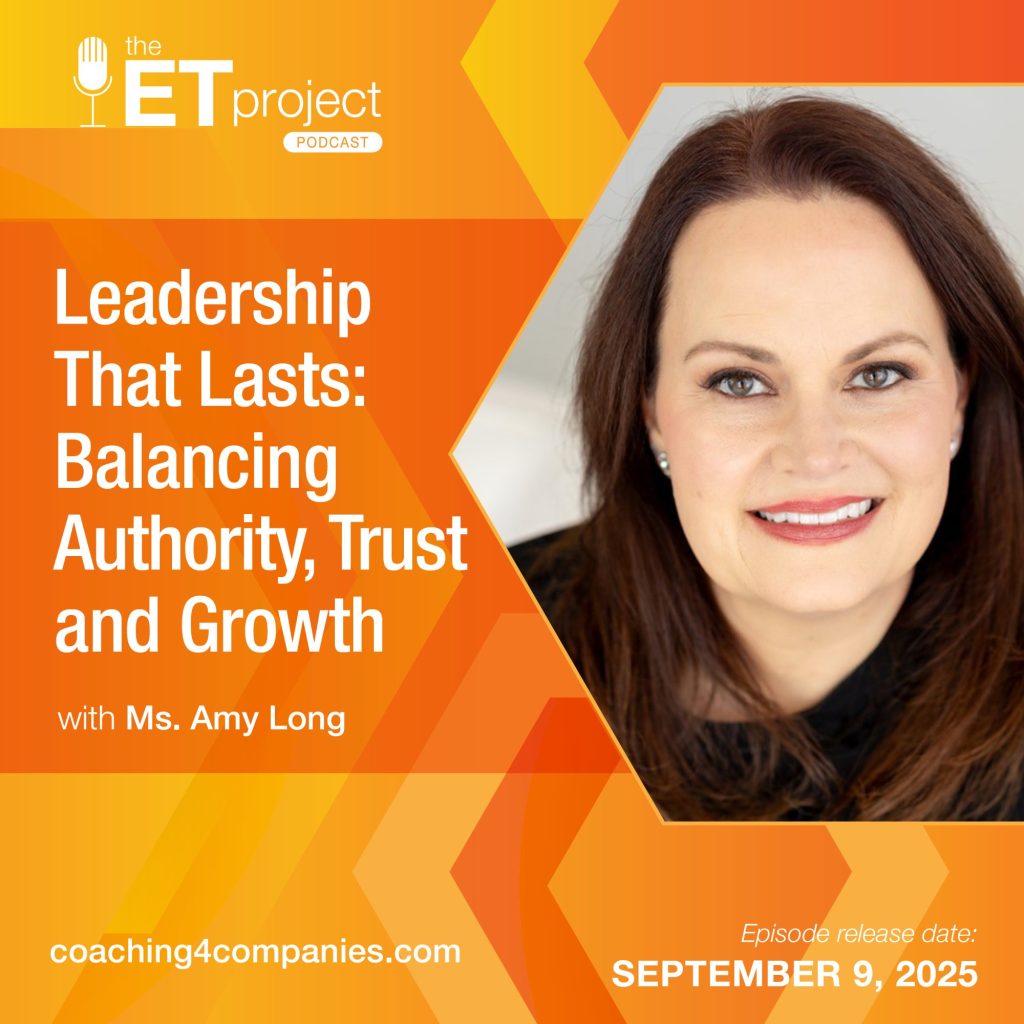
WAYNE BROWN: Hello, I’m your host, Wayne Brown, and welcome to the ET project. We’re delighted to be delivering this podcast for executive talent all over the world whom we’re affectionately referring to as ‘Team ET.’ Today, we’re in Oklahoma, chatting with Amy Long. Amy is a leadership coach and founder of CLOU by Amy, a boutique coaching business for leaders committed to leading with precision to achieve their ultimate goal. Through her signature approach, Amy helps clients identify their unique leadership styles and create actionable steps towards leading at the highest level. With a background as an attorney and a corporate leader, Amy brings a wealth of experience in managing teams, solving complex problems, and leading with empathy and assertiveness. Her international experiences in Switzerland, China, and France have shaped her adaptable and open-minded approach to coaching. Passionate about helping clients lead intentionally, Amy simplifies challenges and inspires progress through her philosophy of ‘baby bird steps,’ and you’ll hear us chat more about that topic during the conversation. In June 2025, Amy released the book, ‘The Subtle Art of Leadership: Build Trust and Inspire Action with Small, Strategic Moves. Lead with Clarity, Confidence, and Care.’ And we’ll spend the majority of our time together reviewing the insights and wisdom covered throughout that book. Team, we’re never too old or too knowledgeable to stop learning, and Amy certainly offers the opportunity to sit back and consider areas in our own leadership practice where we might be able to make some subtle changes.
INTRO: Welcome to the ET project, a podcast for those executive talents determined to release their true potential and create an impact. Join our veteran coach and mentor, Wayne Brown, as we unpack an exciting future together.
WAYNE BROWN: Hello team, welcome to this week’s episode of the ET project. I’m confident that many of you know there’s a stark difference between 20th century and 21st century leaders. For starters, leadership today isn’t about having all the answers, I’m sure you’ve learned that lesson, and it’s also not about being the loudest in the room. More often, it’s about the quiet choices, the small intentional moves that build trust, make space, and let people thrive. And yet so many leaders that we work with still feel stuck, overwhelmed, over-giving perhaps, under-supported, and trying harder instead of leading differently. So that’s where our guest today comes in. Amy Long is a leadership coach, a former attorney, and international corporate leader who has recently published a book titled; ‘The Subtle Art of Leadership: Build Trust and Inspire Action with Small, Strategic Moves.’ Welcome to the ET Project.
AMY LONG: Hi. Good to be here, I’m excited to be here. Thank you so much.
WAYNE BROWN: As always, perhaps we’ll start with a little bit of your background. As I mentioned, attorney, corporate leader, what was the initial draw for you into law, and then why did you do it?
AMY LONG: Well, I initially went into law because I was interested in a career in U.S. intelligence, and I knew that lawyers was a really common background, but then I ended up volunteering as an assistant public defender, as a legal intern for the public defender’s office, and I really fell in love with that role. So, I spent several years there as an assistant public defender, and then I remembered, you know, hey, maybe I want to go back and look into this path of the intelligence world. I did move forward with that, and I received a conditional appointment into the FBI as a special agent, but that coincided with a time in my life where things were not so that I wanted to leave my home state anymore once everything fell in place. So, I withdrew my application, and then I had to start over. And I said to myself, I guess I’ll try being an attorney in private practice. And so, I went to work for a small insurance defense firm, and I worked there, and then I ended up working for a bankruptcy law firm.
WAYNE BROWN: You have traveled around the world, different countries from what I understand, Switzerland, China, and France. How have those experiences, if at all, shaped your perspective, your view on the work that you’re doing today?
AMY LONG: Well, so all three of my trips were prior to being 25 years old, or actually 26. And what that did was shape me early without realizing it as a leader in understanding differences, and that not everything is the way that I perceive it or the way that I’m used to.
[00:05:00]
AMY LONG: And I lived abroad in Switzerland, I lived a year in France, and I did a summer program in China going through four different cities. And it was just amazing to see as you went through all these different places. I spent the longest time in France, so, mainly there I would say that was a different way of life, getting used to doing things differently, and what that does for your resilience and ability to move forward on a daily basis and understand that things aren’t one way.
WAYNE BROWN: Yeah, very true. Was there a turning point for you in your career that helped you realize that you wanted to step away from corporate roles and start your own organization, your own business?
AMY LONG: Yes. I decided in 2023 that I wanted to build something for myself. And I actually started out doing a small business that I no longer run that was geared towards something I’m not doing now, but I did spend a year doing that, and that was more product-based. And then I decided after reflection, what can I do that is more based on my decades of experience through being a lawyer in various roles and through corporate leadership? And that’s when I decided I wanted to do this, I want to build something on my own, that was the number one thing, was I wanted to build something for myself. And that was what was important to me.
WAYNE BROWN: And how is the journey so far?
AMY LONG: It is a journey. It’s full of ups and downs. But that’s the great part is because… there’s so much learning, and I don’t know if you’ve heard this before, but when you start to say, “I feel like time is going by so fast,” studies have shown that that comes from feeling like life becomes rote and you’re just doing the same things over and over again. Well, I’m not doing that anymore, I’m doing everything right now. So, learning how to set up the DNS settings on a website, wow, man, when I figured that out, I was like, can I get a certificate for this? Because I can’t believe I even understand to be able to converse. And so that brings me to one thing I would talk about with leaders and when you’re training and coaching people is I don’t think of learning on a spectrum that goes like from left to right, I think of it more as a sphere that starts in the middle and moves outwardly. And at that very beginning, that very core is just being able to converse about what you’re doing. Because when you first meet someone, well, you always want to meet someone where they are, but when you first begin to work with someone, you have to figure out can they dialogue with you about what skills you’re trying to transfer, what you’re trying to teach them and share with them. And then you have to be able to find their language so that you can dialogue with them to begin, then they can dialogue with you.
WAYNE BROWN: Yeah, very true
AMY LONG: That was a bit of a tangent, but.
WAYNE BROWN: No, I was going to say, “welcome to the digital marketing world.” It’s a different world than when I grew up and I can assure you, I can sympathize with the… I won’t say struggle, I’ll say challenge, the challenge of creating business in the world of today. I read somewhere that you said leaders don’t want more hacks, they want more time, was there a moment in your own leadership journey when you felt completely overwhelmed?
AMY LONG: I think there are multiple different moments where you feel that way and you know that if you’re going to keep functioning and be a leader for your team, that you’ve got to be able to take care of yourself. And so, you have to just step back and have that moment where you say, “okay, I have to let some of these things go.” Because you need that time for yourself in order to decompress and then be able to come back refreshed the next day for the next project so that people can continue to count on you.
WAYNE BROWN: Yeah. Yeah. Very true. Another thing I heard somewhere or read somewhere, you talk about ‘baby bird steps,’ I love that expression. Where does that phrase come from and is it part of this journey that you’re experiencing at the moment?
[00:10:00]
AMY LONG: Yes. So, ‘baby bird steps,’ I coined that really off the cuff. One of the last corporate worlds I was in, we were building a big team and I was in charge of a department and there was so much to do that there was a lot of excitement and there was a lot of possibilities. And every day I would hear people wanting to be excited doing these steps and I would say, “no, we need to slow down because we want to maintain the momentum and we have a lot to do.” And I just off the cuff said, “we’re going to take baby bird steps,” because everyone has heard the term ‘baby steps’ and I don’t discredit ‘baby steps,’ but ‘baby steps’ is almost something that you hear and you’re like, “yeah, I’ve heard that before.” So, it really doesn’t stop you in your tracks anymore, but ‘baby bird steps,’ well, what’s that? That’s new. And so, it’s very tiny and it’s meant to really stop you in your tracks and say, “listen, if we can break things down into their smallest parts, then we can maintain our energy, we can maintain our momentum, we can maintain our focus and then we can keep the steam rolling,” so to speak.
WAYNE BROWN: Right. Well, that’s a nice segue into the book, so let’s sort of pivot a little bit and move into the book, wind out with the book. What was the drive behind writing the book and releasing it at this moment?
AMY LONG: Well, I always wanted to write a book and then I came to have the opportunity, I heard about writing a book and I decided I want to tell my stories, I want to share what I know and this is the perfect time right now on my journey building this business for me to put some of my thoughts down to paper and to be able to share what I consider are, you could also say, leadership cornerstones throughout the book.
WAYNE BROWN: Yeah. Insights.
AMY LONG: Insights.
WAYNE BROWN: I’ve been following you on LinkedIn for a while and I see that you’ve been releasing different insights over the course since the book has been released, I guess, and yeah, very, very nice to read, nice tips, nice reminders. So again, the title of the book is ‘The Subtle Art of Leadership.’ It has a longer subtitle, but ‘The Subtle Art of Leadership.’ It’s not loud, not flashy, is the message that I took from it. So, what inspired that frame for the book?
AMY LONG: Well, I think that when I looked at everything that I put into the book, the core word there is subtle, it’s not just leadership, but that core word of subtle and that it’s an art. So, looking at things on being decisive, I’m very big on forward-thinking and being intentional and those go into, there’s an art to it. This is not just something random and then there’s something subtle to it. Like we mentioned, it’s not loud and it’s not meant to just totally captivate and hit someone over the head, it’s something more subtle because it’s small things. It’s back even to the ‘baby bird steps.’ It’s small things every day. It’s small things where you help people, you empower them in small moments every day that build over the process of their career or their time with you, things that they’re going to take away when they’re no longer with you.
WAYNE BROWN: Yeah
AMY LONG: It’s the subtle, the small moments that you build yourself as a leader, where you’re able to do different things, whether it’s letting go, doing something new that’s uncomfortable, and then it’s just the subtle pieces that are involved in your daily routine, your processes, the tasks, tackling those in a subtle way.
WAYNE BROWN: Right. Then becoming a legacy, so to speak…
AMY LONG: Yes
WAYNE BROWN: Of you as a leader long after you’re gone, yeah. I mentioned at the beginning that leadership in the 21st century is not about having all the answers, and I know I read in the book you were talking about early on in your career, you thought that’s what it was about. When did you first make the realization that this is not going to work that way?
AMY LONG: Well, so my very first job as a leader, I was actually 19-years-old, and I worked in a hardware store, and I was just straight out of the gate, a supervisor, and doing what seemed like you were supposed to do.
[00:15:00]
AMY LONG: And that was as if you were supposed to have the answers, and I figured out that wasn’t, because there wasn’t a lot of gelling, it was more of just rote things were happening. I ended up moving on, and there was college and law school in between that, and in law school I had a mentor that told me, it’s okay if you don’t know everything as long as you just admit that, and it’s okay, you know, don’t sweat the small stuff, it’s all small stuff. So, when I was a public defender, I was a team leader, and at that point I had a couple of lawyers and some interns that worked, and we had a large docket, we had a lot of people, we might have 60 clients in a day, and there was no choice. When you have that kind of volume, there’s no choice but to become ultra-transparent and say, “I can’t do this all myself. I have to rely on someone else and who is here to help me.” And really that’s it, it is going through that experience and having that high volume, there was absolutely no way I could do things with the kind of integrity and the way things needed to be done, keeping it all to myself, and thinking that I had all of the answers, there was absolutely no way.
WAYNE BROWN: So true. And the subtitle of your book is very accurate to the content within the book, and one of the portions of the subtitle is about trust. And I think you say it’s the only currency that buys time. It’s a powerful idea, can you share a little bit more about that?
AMY LONG: Well, trust is what really buys time because when you are able to trust people that work with you and for you, that is the actual way you can get your time back. And if you don’t trust anyone, then you’re not going to be able to let anything go and people aren’t going to be able to help you. And that really is just the core of it. And to take that further, it’s real deep trust. It’s not just delegating responsibility; it’s delegating authority and responsibility. So, giving some kind of authority, which signals trust, that’s where you’re going to get real ownership and that’s where you can actually take something off your plate and you no longer are worrying about it. Because there has been times where you can observe, or I know I’ve observed, people have been assigned work, but they don’t have the authority to make at least some decisions. So, it comes back to the leader and the leader is going to have to review everything, make all these decisions. So that’s how I see trust, it is the number one thing that actually gives leaders time back.
WAYNE BROWN: Correct. You’ve nailed so many important aspects of leadership, you’re talking about trust, which is definitely core, central to the whole process. Delegation is often something that leaders struggle with in the first place, but when they do start to delegate, as you said, they delegate, but they still hold onto it, they still want to keep the control and they don’t give the authority with it. So, I think that’s a very important message for everyone listening. And that in turn then requires that transparency, it requires the leaders to be able to say, hang up, I don’t have all those answers. This is something I’m offering you the opportunity to try and work on but if you need my assistance, let’s come and talk about it. But you’re free to play with this and make of it what you can, type of thing. So, I think that’s a powerful lesson within itself.
AMY LONG: Well, and there are a couple additional points to that, it doesn’t have to be black and white, give all authority or no authority. There are so many things that when you slow down and just reflect, okay, well, you can come up with maybe some thresholds on your decision. If there’s going to be five steps, can they make the full authority on the first two or can they make decisions up to a dollar amount? Find something to be able to establish some level of authority. And then as human beings, I think when you reflect and think about it, the more authority that I have, that you have, the more ownership I’m all of a sudden taking and accountability. And I know personally I would hear a lot of complaints about people who say, well, they won’t take accountability or ownership.
[00:20:00]
AMY LONG: Do they know what it means? Do they have authority to? Or have you just given them tasks? And, you know, responsibility with no authority equals no ownership.
WAYNE BROWN: Again, such a powerful insight in that simple statement, but for many people, very, very difficult to embody as a leader and to actually put into practice as part of your own toolkit. We often work with our people and say, you expect your team to have commitment, but do they even know what that means? What are they committing to? What does that commitment look like in your eyes? And do they hold that same perspective around what they’re doing? And that then leads to the ownership and the accountability discussions. So, I think we’re very much on point with all of this discussion. Another insight that I very much like is around performance problems, and you say that it’s not necessarily about confidence, quite often it’s about the communication and about the mismatch in the communication. Can you give an example of how you’ve seen that play out?
AMY LONG: Well, we’ve talked briefly about it in a couple of ways, delegation and you said commitment, something I commonly hear is ownership. People won’t take ownership for things and the exact same thing, what does ownership mean? Because if you don’t have clarity on that from the beginning, they’re not going to meet your expectation. And then at the end, you’re going to write them down for poor performance, really did they understand what you wanted? And the same back to delegation, what steps are involved? Something really common, there’s actually two that I see where there’s two common challenges with the delegation. It’s super common for leaders to tell who, give the who, you do this, please work on this for me. And maybe a loose deadline, they don’t often distinguish, I meant by a certain day versus a certain number of days. But what’s missed commonly is where does this fit in with the rest of the priorities? So, I call that ‘The Where.’ And then also, what steps have to be completed your way as the leader and what steps do they have some freedom on? Because if that’s not discussed in the beginning, you’re going to be out of alignment, they’re going to just naturally take a step that they didn’t realize you wanted your way. And then it becomes poor performance when that’s not the issue at all, it’s just lack of clarity, lack of clear expectations. So, it’s about spending that time up front and getting into the habit.
WAYNE BROWN: One of the things that jumped out to me also from the book was talking about adapting your own leadership style to how others learn. And I come out of the learning field, so this one sort of jumped off page to me, what do you mean by that?
AMY LONG: Well, what I mean by that is people learn through reading, people learn through hearing, lecture, people learn through writing things down, people learn through doing things. And there’s someone in all of those categories. I know personally for me, the number one way is reading, I will retain so much more versus listening to a lecture and the longer someone is trying to give me directions, the less I hear. And I found that out when working with people over the years, you might have a team meeting and share a message and then you go back and two days later, someone is in my office saying, you know, a supervisor saying, what gives, you know, it’s like they weren’t even listening. No, they were listening, but that’s not how they receive the information the best way. And so certain information, while it may seem like overkill, you want to say it to where someone can hear it, you want to share it on an email. I had a supervisor come to me one-on-one one time and say, I really need things sent in an email because when we go through leaders’ meeting, I just don’t always retain it and I want to meet the expectations. So, can we work on putting some of this down more detailed in an email sense? So, of course.
[00:25:00]
AMY LONG: And then also giving people opportunities as best you can to do things, to learn that way, take those small steps and learn by doing.
WAYNE BROWN: Mm-hmm. One of the things that I imagine our listeners are thinking at the moment is, you know, all of these things are valid, they’re all very logical, but they take a lot of effort. How do I avoid the burnout? I mean, I’m already overworked, I’ve got so much to do, you want me to spend all this extra time focusing on the team, how do we do that cohesively without burning out ourself?
AMY LONG: For starters, you don’t try to do everything at once. And you want to get to know your people and try to raise up your observation level, be conservative. So, if you have someone making a lot of mistakes, ask yourself why. And try to find out if it’s because how they’re receiving the information, maybe they’re just someone that needs information a different way than others. But then you don’t always have to explain and share information in all these different methods. You can select, this information is so important, I’m going to send an email, then we’re going to have a meeting, and then I’m going to be available to speak to people one-on-one. And what comes to my mind so much is processes. Processes and procedures, the way to get things done. Personally, I don’t think there’s any way to avoid writing those down. I know lately it’s really big to make videos and show people how to do things. But I’m telling you, you have your learners out there who are craving to read because they remember the information better. They may even want to print documents off and highlight them and write on them, people still do those things. So, you spend that time and then you can make higher level…
WAYNE BROWN: [Inaudible 00:27:10]
AMY LONG: Well, me too. Let me give this one last point to that. Look who is on your team that can help you share those types of messages, you don’t need to do that all yourself, there’s definitely someone on your team who likes making training videos and likes writing processes and procedures, leverage that.
WAYNE BROWN: Again, it comes back to good communication in the beginning. Understanding your team, as you’ve said, take the time to understand how best they internalize messages and understand things and maybe have that conversation at the very beginning of your leadership journey with the team. We’re going to be sharing a lot of information and there’s going to be a lot of backwards and forwards, how does everyone prefer to receive this feedback or input? Might be a good starting point, yeah.
AMY LONG: Well, and you really just kind of find it out as you go, the one who ends up in your office or always asks to maybe give you a quick call on Zoom, that person needs to talk about it to process what you want. It’s just about kind of picking up on those clues. The person that listens and then is quiet, they want to go back and read it and think about it. So, it’s just about picking up on information like that because sometimes you might ask a person that, how do you prefer, and they’re like, “I don’t know, what do you mean?” So, you just have to kind of learn as you go.
WAYNE BROWN: Right. I’m very much on board, as I mentioned, I’ve been following your LinkedIn for a while and one of the insights that you’ve recently written about, number eight, I think, was you said your default style might be holding back your team. So, when I read that, I thought, mh, that’s a bit of a tough pill to swallow. I’m this God-given leader and it’s me that’s wrong here. So, how can leaders identify that their own subconscious bias perhaps isn’t working or it’s creating this potential bottleneck?
AMY LONG: Well, I think it just comes through a lot of reflection and looking at the performance of the team, how are things going? And then reflecting on you, your own day, I mean, are you worn out? Are you out of time? Are you constantly not taking a lunch? Then there’s something that you are doing, maybe something you’re holding on to, is your default style to just do everything yourself, to get a bare-bones something in place, whether it’s an email or a process or a spreadsheet, is your default to start everything?
AMY LONG: There’s something going on there. And so, what I would say is it’s just through reflection of looking through what result is it that you want? What is telling you that something is off? And then just looking towards yourself and your daily actions.
WAYNE BROWN: And you suggest that leadership starts with listening harder than actually verbalizing. I mean, we all talk about being better listeners, but is there a practical way that leaders can shift to that mode of operation, being a better listener?
AMY LONG: To me, the best thing you can do to be a better listener is listen but then put some time between your response and you’re going to have to kind of gauge what you’re talking about there. Sometimes it might be something where you say, “I need to process this and think about this,” because that’s when you’re actually going to take that information in and hear what someone has said. And then depending on the person, I’m not good at taking notes and really listening intently looking someone in the eye. So, I have to try to avoid that, but then I need to come back maybe and ask some more questions to make sure I understood everything. So, I think a lot of it is about learning things about yourself as who you are, how you listen. And number one is making sure that you’re listening to hear what they’re saying, you’re not waiting for when they’re done. Just a practical tip, this is something I kind of do for myself, is if you have something that you really feel like you’re going to lose and you need to get out, just say, “hold that thought for a moment,” and just write it down, “okay, I’m back with you.” We’re all human, everyone has sat through a conversation and want to do that. So don’t be afraid to just be human, instead of you’re not listening because you’re trying so hard to hold that thought in your head.
WAYNE BROWN: Before, I think it was, correct me if I’m wrong, but you talked about micromanaging versus empowering, is there a strategic move that a leader can make, maybe this week, maybe instead of tasks for the audience, is there something they can do this week that they can let go of without losing control, losing accountability to be able to empower their team?
AMY LONG: I think it goes back to a recap of several things that we’ve already talked about. My method on ‘baby bird steps,’ so, the whole point of that is finding something small and then what I talk about with delegation, focusing not just on responsibility, but on giving some authority as well and not seeing authority as yes, no, all or nothing, thinking of it as a spectrum and finding thresholds within that authority. And then I think that you just couple those things together and you empower people when you allow them to do some things on their own without needing you. And when you properly delegate from the beginning, clearly all the things that are important I have a whole who, how, where, what, when, why, and were you reasonable, I’ve got seven steps. So, when you have all of those in there and you’ve touched on those, you should have pretty good clarity from the beginning. So, some people might feel like it’s micromanaging to pass through seven gates, if you will, but that’s what’s going to prevent you from trying to put some in the underperformance box later on down the line or feel like you’re micromanaging because you have to take everything back and fix it and do it on your own.
WAYNE BROWN: Yeah. And I’m guessing the seven gates may not be applicable to every individual team member, but the better you know your team, sometimes you will be able to skip over some of those steps because you’ll know that they already have that under control or they don’t need that information or management.
WAYNE BROWN: One of the things that our conversation highlights and we haven’t spoken about, I don’t want to say avoiding, because that’s kind of what conflict is, but we haven’t spoken about conflict. As a leader, it’s part of our baggage or our toolkit, our journey, if you like. Everyone is unique and conflict for me is almost inevitable, is there a way that we can look at it and turn it on its head and see it as a catalyst, perhaps? A catalyst for your own leadership growth in learning how to deal with conflict?
AMY LONG: Well, I would say that conflict, if you can turn it on its head, is always about understanding someone else’s perception. There’s always more… like I’ll say perception is not reality. Lots of people say perception is reality, no, perception is perception. And when there’s two different perceptions, that’s when often you come up with a conflict. And so, if we’re going to learn something from that and use it as a catalyst, a conflict is when you can step back, take that moment where you can reflect and say, “oh, is this right? Is this my way or is this my perception?” Because something is going on here and someone else obviously has another perception and then trying to find where do you need to meet in the middle in order to resolve the conflict.
WAYNE BROWN: If we look at leadership as a whole and we think about sharing something with our listeners that they can take away, is there one leadership habit that you feel every new manager would benefit by if they took away and started working on it today?
AMY LONG: I actually have two and they’re probably almost so simple that you think, “that’s it?” The number one thing is to be transparent and just say, “I don’t know.” Just get really comfortable saying that, “I don’t have all the answers.” Make sure you follow that up with, “but I’ll find out,” if that’s your responsibility and you figure that out. And the second thing is to meet people where they are, and that is figuring out where are they at in the conversation, in the task, in their role, where do they want to go? Because everyone even if they have similar titles, everyone is in a different place and everyone has a different long-term. And if you do those things, then when people are no longer with you, then they’re going to be able to look back and feel like you impacted and had a legacy on their life rather than, we’re just their boss. Because to meet someone where they are, you’re caring.
WAYNE BROWN: You’ve had the opportunity to work across different industries and in particular with a different generation of the workforce, I’m guessing. I’m at the tail end of the baby boom generation, but as we all know, we’ve now got the alpha generation moving towards the workforce, so we’ve got this huge dynamic, is there any surprising aspects of leadership that you’ve been taught by the younger generation? I’m not saying you’re old, but is there anything by the younger generation that really surprised you as a leader?
AMY LONG: I wouldn’t pin it on a generation, what I would say more is simply I’m older than a lot of other people that are younger than me that are leaders, and what I have learned from them is that the older you get, and this is my perception, you can’t help but start to have limiting beliefs about how things work because of experiences that you’ve gone through in life, “oh, we shouldn’t try it that way,” “oh, it’s going to take this long,” “oh, this is not going to work,” and you don’t even know. And the younger you are, in my experience, the less of those you have and the more fearless you are. Now, the great combo is the fearlessness and the wisdom, but that’s what I see, so I wouldn’t really say that’s in the generations, I would just say it’s more of… that’s kind of what I’ve been learning over this last year, working with different people and building this business that are much younger than me. It’s like, “wow, why did I think this needed to take so long?” And it’s because you can’t help it, but you’re basing it off of prior experiences and the younger generation, well, they haven’t been through all that yet.
AMY LONG: Now, sometimes they could hear our thoughts and maybe slow down on some things, but I don’t know if that answers your question.
WAYNE BROWN: Yeah, very nicely, agreed. We talk a lot about curiosity, and I think curiosity fits nicely within that sandwich as well, so, yeah. I like what you’re saying, though, because I have a young daughter, and she teaches me that lesson pretty much daily, that just because I have a lot of experience in different areas, it doesn’t mean I’m always correct, and I need to be more open to the possibility that there’s other ways of things being done. And as she reminds me, I like to remind her about being curious. She often says, “hmm, we’re all very curious on this topic, eh?”
AMY LONG: I love that.
WAYNE BROWN: Yeah. If we were to project a little bit ahead, I’m deep into my research on longevity at the moment, so I like to ask, I guess, some form of longevity questions, so here’s yours; if we were to project forward maybe five years or so, do you have a hope for the book? What is it that you hope people will take away after reading through the book, hopefully applying some of the wisdom that you’ve included in it?
AMY LONG: Well, my number one hope for someone reading the book is that they gain confidence and see that none of us have it all, we don’t have all the answers, it’s about being more subtle, just transparent down to earth, and that you can build confidence through doing these small actions and doing things in a practical sense, and that they would have more confidence in their journey and understand no one knows it all. There’s not going to be a point in which they stop learning and feel like they have it all figured out, but you can get to a point where you start to feel more confident in yourself and your decisions and as a leader.
WAYNE BROWN: Where can people follow you, connect with you, access the book?
AMY LONG: The book is available on Amazon and you can find it under ‘The Subtle Art of Leadership.’ I do have thesubtleartofleadership.com, which you can go there, it takes you also to Amazon. You can find me on LinkedIn and also on X.
WAYNE BROWN: Amy, great connecting with you, I enjoyed the conversation.
AMY LONG: Thank you so much, Wayne.
OUTRO: Thank you for joining us on the ET project, a show for executive talent development, until next time, check out our site for free videos, eBooks, webinars, and blogs at ‘coaching4companies.com.’
[END OF TRANSCRIPT]