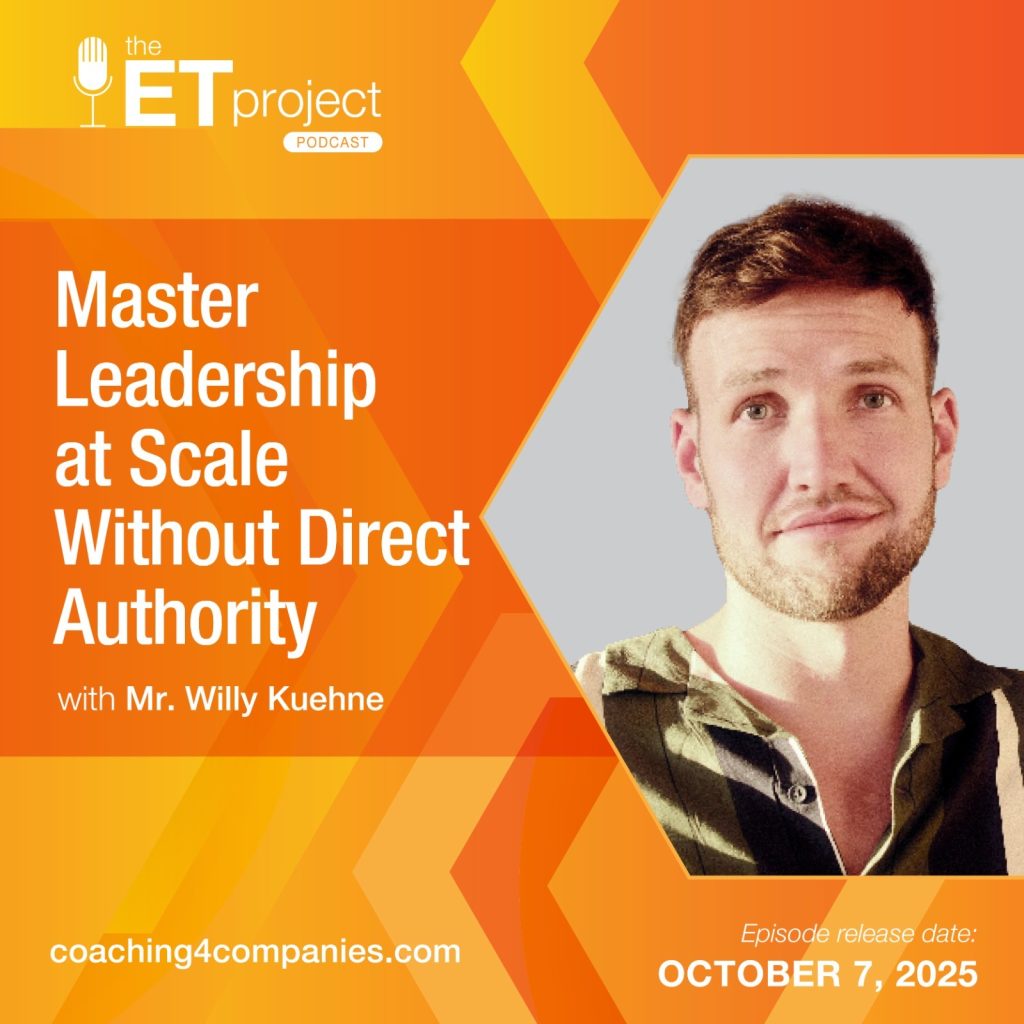
WAYNE BROWN: Hello, I’m your host, Wayne Brown, and welcome to the ET project. We’re delighted to be delivering this podcast for executive talent all over the world, whom we’re affectionately referring to as ‘Team ET.’ Today’s guest is Willy Kuhne, and our chat finds us in Lisbon, Portugal. Willy is an operational and sales leader with 15+ years of experience, and at Google he leads vendor ops across Europe, Middle East and Africa, driving half billion in annual revenue through rhythm, structure, and his standard of consistency. He has also co-founded Nortehaus, a slow-designed retreat in Canada, where he explores how thoughtful hospitality helps people pause and reconnect. As Willy highlights, on the subject of ways of achieving leadership consistency for high-performing teams, there’s a strong body of research and thought leadership in organizational psychology, leadership development, and team performance. Leadership consistency is often cited as the cornerstone of psychological safety, trust, and high performance in teams. Willy has taken his own experience and merged it with these studies to establish his own unique blend of leading via a three-layered pyramid. And as you’ll hear during the conversation, Willy continues to apply and refine this leadership style, adapting where necessary, to become an effective influencer, often without authority and always managing stakeholders at scale. All of these powerful methods are discussed at length during our conversation. Team, you will quickly observe the degree of clarity and inner confidence that Willy brings to the table, and it offers us a glimpse to the value his human-centric approach brings, even though he’s engaged with one of today’s leading global technology powerhouses, I know you’re going to enjoy this conversation.
INTRO: Welcome to the ET project, a podcast for those executive talents determined to release their true potential and create an impact. Join our veteran coach and mentor, Wayne Brown, as we unpack an exciting future together.
WAYNE BROWN: Hello, team, and welcome to the start of a new quarter. I’m guessing as leaders, you probably know what it feels like to be overwhelmed in your position, whether it’s through complexity, competing demands, the weight of expectations, perhaps even doing it all without the level of authority to act. What’s interesting is some people seem to move through that chaos with a sense of confidence, creating order without controlling everything, being able to clarify what matters. They don’t just seem to manage teams, they shape the environment where people know what’s expected, how to contribute, and why it all matters. So, in today’s conversation, it’s about how that kind of leadership is built, not through title or force, but through rhythm, intention, and even consistency. It’s about designing systems that scale, yes, but it’s also about staying grounded in the human side of work, even when the stakes are high and the distances, as you’ll hear shortly, are quite vast. It’s about leading with clarity, not with control. So please help me to welcome a leader who lives this balance, Willy Kuhne, welcome to the ET project, nice to be able to finally connect.
WILLY KUHNE: I’m very excited to be here to talk about leadership, and also nice to meet your audience, though I do not see them, but, hello, nice to be here.
WAYNE BROWN: You’ve lived and worked across multiple continents, right? From Germany, you spent time studying in the US at some stage, I believe, or at least with the universities in the US. You spent time in Canada and the Philippines, now you’re in Portugal, Ecuador, of course, what is it about the global, mobile type of lifestyle that appeals to you the most?
WILLY KUHNE: That’s a good question, I think, I grew up in East Germany, coming out of East Germany, turning into Germany, and of course I was very little, so a lot of the stuff that my grandparents and my parents talked about as they experienced life, I didn’t experience it that way, but I saw a lot of change, a lot of Western culture that all of a sudden swamped into Germany, into the Eastern part of Germany, where there was a restaurant, there was a McDonald’s, and so you could see an early globalization that I just sort of grew up with, though tucked away in some Eastern German city.
[00:05:00]
WILLY KUHNE: Initially, I thought of my career was just like any other German, sorry I’m being stereotypical, but you know, you go to school, you get married, you buy a house, you plant a tree, you raise your kids, and you die. I thought that was what I’m going to do at some point in time, and for some reason, school didn’t stick to me very well. So, my mom was a teacher in elementary school, and she wanted to make sure that my grades were good, but my grades were not that good and I couldn’t really get them up. I would always figure out if I do the bare minimum, I could get the bare minimum passing result, but that also led to some struggles in some other school topics and so, ultimately, I was on the brink of failing in ninth grade, and a friend of mine asked, “hey, do you want to go for an exchange in the US?” And I was like, “that sounds like a brilliant idea, I don’t speak any English, I don’t know what to do, let’s do it.” And it was like this leap of faith, like someone telling me on the back, let’s do it, you’re unhappy here, your school is failing, you likely have to repeat 10th grade, chemistry, Latin, English, all in shambles, and so I went for an exchange, and I went to the US, and had to learn how to adapt, and build, that was the first time, like if you’re going to the gym, and you have never done pull-ups, and it’s the first time you’re trying to do a pull-up, by the time you can do one, there’s a lot of work that you have to do to strengthen that muscle, and for me, that was the first time I experienced that in the US, and ultimately, I think I got really good at that, because I moved to a bunch of different places in the world, and I knew exactly how to build that muscle every single time from experience. In the US, I stayed much longer though, I did a… I’m just doing it one more time, I did a neat stint back in the day where I was supposed to go home after my one year I had been an exchange student, and you know how it is, you’re in high school, I enjoyed the practicality of the school system, you would go have calculus math, then you would go to TV production, then you would go to a gym class, but that was not the gym that I had in Germany where you need to do gymnastics and jump over stuff, no, I had like a weightlifting class in high school, and I was like, “this is amazing, and my brain is being activated in different compartments, and I love it,” and then I also found my first girlfriend there, so ultimately I was like, “this is great, I’m gonna stay.” And so, I transferred all my grades from Germany, and did the stint of doing my 12th grade, and finishing high school in the US, I was staying with my host family at that time, who I cannot thank enough for what they did, how they helped me, this is something that I will never forget, and hopefully I get to repay to someone else in the future. But yeah, it was a very different journey, and in 12th grade I was sitting in 9th grade English as a senior, and I was the tallest, and the most advanced, and oldest in the 9th grade class, and everybody around me in America, was like, “what is this guy doing in my 9th grade English class?” and I was like, “yes, I’m learning,” good times.
WAYNE BROWN: Yeah. Now, how has the experience, I mean, if we put it all together, we talk about all the different locations and the different markets, how has that influenced your leadership style over the years?
WILLY KUHNE: So, this is the first big bucket, because I think in order to do these moves and to do these moves consistently, meaning driving them into a place where you succeed in a different place, and you’ve lived abroad so you know the drill, I think you have to have a huge amount of self-awareness, and you have to have certain standards that you obey and when I talk about the standard of consistency, which is the framework that I use to run and drive high performance in sales teams, the first pillar of that is what I call ‘Standards,’ and that means you have to know yourself, you have to know your team, you have to have certain standards that you live by, be clear on your values, and an experience like that really shapes you, because initially, the biggest battle you have when you move somewhere is the battle with yourself, initially. So, the honeymoon phase, I love it here, what a fantastic experience, and then three or four months kick in, and you be like, “ah, crap, I’m stuck here for a while, so I need to figure that out.” So that battle begins, and it’s a moment of self-reflection, then you mingle with people, you build networks, this is also part of the building, you getting to know peeps, and then ultimately, you have to be very clear on your own standards and values that you bring into that new experience and where you want to go.
WAYNE BROWN: Well, you co-founded a retreat in Canada, I’d love to learn a little bit more about all of that if you don’t mind.
[00:10:00]
WILLY KUHNE: So that came much later in my journey throughout the world. When we landed many years later, this was in 2018, I landed in Canada, with Google at that time too, to be a partner lead for our media and entertainment industry. So, I used to have a beautiful job of working with Disney, Warner Brothers, Sony Pictures, we were part of the team that supported the marketing efforts for the release of ‘The Lion King’ remake and the… or the live action movie, I should say, otherwise I’ll get slapped on my hands. That’s how we moved to Canada, it was an amazing job, amazing people in the industry, I had a fantastic time, and the job was high-paced, media and entertainment is extremely high-paced. So, it would not be unusual that on a Friday, when in a lot of other jobs people are winding down at six, you would get a ticketing request that would say, “hey, my movie is not…” or “my advertisement is not running on YouTube because it has a little bit of a blood splatter here and blood splatter there.” Obviously, that is against policy violation, so you would have to go on and take a ticketing system. I remember people, like, here in the US, this trailer is running, why is it not running in Canada? And by the time we were done, it was like 8:00, 8.30, and then on Monday, we need to reevaluate the marketing efforts that we had, did they benefit the studios, did it drive success? And you do that for 80 to 85, 86 movies a year, that starts to drag at some point in time. My wife’s brother was a huge inspiration for that retreat that we built, because he does it as his core job, and he has, in the distance, you can see that if you run a small Airbnb boutique retail business, you can be very successful with that. He has done an amazing job at building a strong brand, he has this core vision, but he manages a lot of the things that also I enjoy, which is the entire brand building. So, we decided, okay, we have, from our careers, fortunately enough, we have spare cash left over, we want to invest that, I can dump it all on the stock market and hope for good returns or we can build something that aligns also with our values, and so we wanted to build a place where we can slow down and retreat, so we bought a little bit of land back in the Canadian woods, and we wanted to build a modern-shaped cabin for ourselves. So, we designed it, built it through COVID, lots of headaches, and just before we could enjoy it, I got a job offer to move to Portugal. So, we had to do a full… not 360, call it a 180, we had to do a full 180, not abandon the project, but we moved over here and we partnered with an amazing property management company out in Canada and turned it into a hospitality retreat where we want people and guests who go there to feel the hospitality, to feel the serenity, to feel the slow aspect of life as we wanted for ourselves. When I started at Google in 2013, I started at the second lowest level in the company, so Google has a level system, level one to level nine, and I started as a level two account strategist. My hope was to one day get promoted and I would call my career at Google very successful; this was my low ambition starting out at Google, I was like, “this is great,” because you have to understand, I never thought I would work at Google. I never thought I had… I thought I needed the Yale degree and a Stanford degree to make that happen; it turns out that my university degree was enough and my sales experience was enough, so, I got a job as an account strategist and I worked my way up throughout the two years and actually, I did get that promotion. And Google is a company where you shape your career proactively. So, you don’t wait for someone to be like, “Willy, you’ve done a fantastic job, I think you should go to the Philippines and you can do even better there,” no, that doesn’t happen. What happens is you go into an internal job board and you decide, okay, this seems like an opportunity I want to pursue, you apply internally, you tell your story, you mesmerize in the interviews and if you get that job… So, it’s like a job interview within the company. So, it’s not like that much of a given, you have to fight for that and you have to build your narrative in order to get that done. And so, I was just promoted, I just came back from a trip to Bali with my friends. So, I was like, I’ve never been to Asia, it’s my first exposure in Asia, I went to Bali, I was like, the whole Asia must be like this, completely blind to the world and I decided I need to go and experience more of that part of the world, so, that was the door-opening.
[00:15:00]
WILLY KUHNE: And I found a job that was the agency lead, so you have to understand I’m a senior account strategist and I’m applying for a role that is an agency lead role for GroupM. So, if you’re familiar with the global agency network, GroupM is an agency under WPP, one of the larger agency or the largest agency network, I actually don’t know right now in the world. And they had an opening for an agency lead in Pakistan, serviced out of Singapore. And I was like, “what an adventure of a lifetime, this is going to be my journey of a lifetime before I one day settled back in Europe.” And I applied for it and for some reason, at that stage at Google, we were still expanding in APAC. They wanted me for the interview, I was like, wow, I just got promoted, I’m here for an interview, agency lead Pakistan, serviced out of Singapore, final round with the agency director of APAC, now it’s a multi-billion-dollar role, I don’t think that person would speak to me as an L3 anymore, but back in the day, something happened and the person was like, “yeah, look, I appreciate your ambition, I appreciate your productivity, I don’t think that role is for you.” It was like, okay, end of story, try again. I had gotten very far, but it didn’t work out and then a couple of days later, I get a message from the agency, it was like, “okay, I like the way that you interviewed, I like your philosophy and your idea, I may have something for you where you fit.” And was like, “there’s a role that has been in the Philippines, it has been vacant for 18 months and we need to build an agency team, an agency team that services all of our agency relationships and sales that we have so that we can unlock customer and client success.” And I was like, “all right, let’s interview.” The interviews went well, I got offered the job, when I saw the pay of the job, I was like… and this is also a really good lesson, I was like… I had to give up 50% of my pay of what I was making as a very junior employee in Dublin to move to the Philippines. So, my thought was like, okay, you move to different places, you get paid more, right? You move out of roles, you get paid more, no, I got paid significantly less, and in order to sustain my lifestyle, I had to take out some stocks, but it’s one of those pieces of my life where I’m like, “you take two or three steps backward and it will catapult you forward.” And at that time was my hope, but I took that risk. And in the Philippines, instead of just being an agency lead, as there was no one, I needed to step up and be the head of agency for the entire country, reporting to the country manager of the Philippines at that time. And I needed to build relationships with every C-level, make sure that we put systems intact, structure intact. And then I remembered back and over my career and moving into different places, that served me well. And so, this is where slowly but surely the system that we’re talking about came to be where, okay, cool, level one, I’m actually on my standards, what are my standards? I want to communicate proactively. I want to make sure that when I go out to the customer, I give them the very best of the company and the very best of myself. Number three, I’m going to make sure that I keep developing myself and my team. And number four, I want to make sure that I have a growth mindset, but also remain adaptable to the situation because I have no idea where I am and what am I supposed to do.
WAYNE BROWN: Right.
WILLY KUHNE: Part one of the standards. Part two of the standards, who am I? Well, I’m really, I’m an outspoken positive leader, I think the glass is half-full, not half-empty. I hopefully bring a lot of excitement and charisma to my conversations and I’m going to make sure that all the agencies when I’m done with this are my friends, that’s who I am. And number three is blind spot at that time, who are the agency C-levels? I never met them. So, I need to meet them, I need to build that relationship, let’s move sales aside, let’s focus on who are you, how have you come into this position? What do you value in life? How are your kids, your family, and how can I help you best? So that was the baseline. I was figuring out how to build that relationship with the people. I reached out to some agency C-levels on LinkedIn and I made sure that we introduced ourselves to build that relationship. All right, part one. Part two was new to me because I’m a very junior employee at that time, I was swimming in the deep end of the pool. Part two is how do you instill structure? It could be what your objective is, when you go to the Philippines, you create that relationship, and you grow the business for us. It’s not like they sent me there for free, obviously, there is an intention there where we grow Google’s influence of the advertising aspect in the industry. So, I needed to figure out, okay, the structure that we have is we have no one for 18 months, so, it’s pretty easy to build structure, but you’ve got to do it systematically.
[00:20:00]
WILLY KUHNE: Meaning you’ve got to create frequent meetings with the agency C-levels, frequent meetings with key personnel of those agencies, account directors, and so on, and you’ve got to build the rhythm of communication, newsletters that you have to put into place, and make sure that you have certain activation dates that are very clear; when do you go into deal negotiations? When do you want to close those deals? And how do you communicate this and how do you bring in stakeholders? Very early on, you need to put that structure into place, which takes time, because from my opinion, I can know myself, I can know my standards, but if I don’t know the other people, I don’t know what best structure suits them. So that’s why it was really important to get that right on the standard level, so then to build the structure on top. Okay, now I’m done with this. The long story is, there’s still one part of the pyramid missing, the long story is, that really shaped me as a leader, because I went from being told what to do, to running an entire program by myself that was extremely high-stakes, and we needed to negotiate for the market in the Philippines, pretty high stakes deals at that time, that I know how to do, but at Google at that point in time I hadn’t done.
WAYNE BROWN: What was your age at that time, when you first took on the job?
WILLY KUHNE: So, I started Google quite early, at the age of 23, not the earliest, but I hustled through, I’m not a fan of the hustle culture, but yet I hustled through university and I hustled through my master’s, mainly because in the US I did the trimester thing, I didn’t take summer off, I wanted to make sure… I didn’t have much money, so I needed to make sure that I benefit off the in-state tuition cost as an out-of-state or foreign student during the summer, and so I did that, and I was able to takes my Master’s on it, and so I started at Google at 23, and in the Philippines, I negotiated with really experienced veterans of the industry there at the age of 26.
WAYNE BROWN: A very interesting journey up to that point. I mean, there are so many things that I’m hearing along the way as you’re developing your leadership style. So, you’re talking about self-awareness, you’re talking about social awareness, working with other people, you’re talking about putting processes, systems, structure in place, for somebody young in leadership this may sound logical for an old person like myself, but for a younger person this is not so much… or not so readily learnable. Did you have any mentors or was there a process that you were following somewhere in the background? How did you get these insights in the first place?
WILLY KUHNE: I have been exposed to extremely strong leaders, and I haven’t had much mentorship in my life in that sense, but I’ve been exposed to strong leaders, and you could compare it to mentorship, but when you’re in a junior role and your boss is the country manager of a market and you have one-on-ones, that does feel like a sense of mentorship, even though those one-on-ones are performance of business related, you do pick up ideas and pieces. The second bit is the company invested a lot in us. So, if you think then on this last bit of the pyramid, this idea of sharpening, I was fortunate enough that Google invested a lot into my personal development and my personal learning. And so, sharpening, I always refer to as building a culture of learning, and I worked in teams that are psychologically safe, and I’m throwing a lot of business lingo in here, but this benefits a lot because you were able to transparently exchange ideas and grow with each other, but at the same time, the company invested with you. So, all of that trickles down and throughout my career, I had leaders who were very good in one of those pyramid pieces that I’ve talked about, and I had one leader, which is in my role now, who unfortunately left our team, who was really good in all three of those things at the same time. And you start tying it together, everybody has probably a different philosophy, different framework; I would argue that most of you who are listening to this podcast follow this pyramid in one way or another, you may call it differently or it’s pillarless or whatever, but I think good leaders are self-aware, I think good leaders know how to build structure and good leaders care for their team, which is the idea of, can I help you develop and throughout my career I’ve seen that everywhere in my job. And this is something that I’m grateful for, and I’m very grateful for Google that obviously they invested heavily into our self-development and self-awareness.
[00:25:00]
WAYNE BROWN: The pyramid, I call it the Three-S pyramid, I don’t actually have a title for it, but the Three-S is standards, structure and sharpening. Does this then help you provide the consistency as a leader to enable the performance of the high-performing teams? Is that how the whole process works?
WILLY KUHNE: Yeah. So, this helps me go back and now dissect the performance of the SaaS teams, so I can go back and be like, “okay, here we are…” I’m just making this up, “you are 10 percentage points behind targets, I’ve seen that this was the same case last quarter, is it a standard problem?” Are people unclear? What is the basic expectation of the job? Are people unclear who you are as a leader? Are you an authentic leader or are you just sitting there telling people what to do? Or are you sitting there and telling people what to do, but people like that and they follow that? That’s also fine. It’s not about judging the leadership, making sure that, are you clear on the standards and are the people clear and can they follow you in whatever standard you have set?
WAYNE BROWN: Yeah.
WILLY KUHNE: Number one, if that is okay, check the box, let’s move on, are there issues in the structure? Typically, yes, you find issues in the structure, there’s breakdowns of communication, there is withholding of information, so nothing cascades transparently. Even at the beginning of my career at Google, I had leaders who everything was cascaded from the top down, nothing was filtered, and everything landed on my table. And I’m like, “what am I supposed to do with this?” Or I was like, “can you pull this data? Can you pull this data?” And everything was like, “will you do it?” I don’t know if that’s the best. So, how communication flows, how the rhythm of the business flows, do we have regular team meetings? What do we discuss in those team meetings? Am I hiring the right people? Am I onboarding good people? All of that stuff falls in ‘Structure’ for me. And if you build that out, you can likely find issues where we are having performance gaps, for example, where these performance gaps can come from. And so, we can start addressing that within the structure, which is easier to do. Structure is always easier to fix in my opinion, than standards, because standards you have to change people’s perception and their awareness and what they think of themselves, it is a longer process and much more painful, and you need really good feedback culture from my opinion to get that done, structure is easier to fix. So, if it’s a standard issue, not good. And then the last bit, you can dissect and it’s like, do we have a culture of learning? Are people developing, are we giving people space to grow or are we withholding people? It can also obviously drive performance gaps and then what also falls for me into ‘Sharpening’ is the idea of, I was alluding to this earlier, about the psychological safety. And so, if teams are not psychologically safe, obviously that breaks down the entire pyramid as well. So, it’s true for me to dissect and look at where are the issues, but also vice versa, I don’t like to just look at issues all the time. When a team is doing really well, it’s like a rich part of this, I know this pyramid is working, but really part of this is working really well and what are you doing as a leader within that pyramid that set you apart from everybody else? And that’s also a really interesting part.
WAYNE BROWN: I’m visualizing it as you’re talking about it. And I can imagine within the confines of an organizational structure, I can see how this should work very nicely, right? So, you provide that framework. How do you then deal with the ambiguity that comes in with more complexity as you broaden your leadership focus? So, I know in your case now you’re based in Lisbon, but your focus is quite broad. So how do you maintain that three-layer approach when you have this very complex network that you have to manage, does that create an extra challenge?
WILLY KUHNE: Yeah, of course. It becomes more complex, but I typically don’t shy away from the pyramids. So, now when I talk with senior leaders, now I have directors that I talk to that manage team needs, that manage sellers, and they do that more across different markets and different programs that I manage for Google.
[00:30:00]
WILLY KUHNE: So, I utilize this framework still very much at the same level in those interactions to make sure, like, is this is not working for you? And I try to figure out, okay, it seems like you have an issue here in part of the onboarding or an issue in how we derive insights, communicate insights so that we can make them actionable as part of the structure. I can still use it to dissect that performance and then I can look at it, which is also interesting, I can then zoom out and look still through the lens of the three S’s and the macro lens of the organization. So, I can say organizationally, yes, we have markets that are doing better than others or programs that are doing better than others, but overall, I think people are clear on the standards that we drive here, we can improve some of the structural elements that we have here, for example, how we communicate equally transparently across the teams, maybe there’s an opportunity there. And I generally see that we have a strong culture where people actually want to develop and grow. Overall, I think we’re moving in the right place, a couple of things we want to improve and then you zoom back in and be like, okay, these are the markets to work with, where we have some of those fundamental challenges. So, I used it to zoom in, zoom out, and I don’t shy away from the three S’s, my thoughts.
WAYNE BROWN: I can imagine one of the challenges that comes up, and I know this is something we spoke about before, but, ‘influence without authority,’ there’s a title as such, but within that context of what you’ve just mentioned, I’m guessing that you don’t have direct authority over many of the people that you are having to influence, how do you cope with that and how do you deal with that? And does the Three-S pyramid still standfast?
WILLY KUHNE: Yeah, it becomes more of a consulting conversation, to be honest. So, no, there’s no authority there. Now, I manage for us our outsourcing arm and our vendor operations. So, I can’t go and I don’t want to go to our partners and be like, “you need to do this and that and that.” I think that, A, will get me slapped on the wrist, co-employment issues and the whole deal. So, we don’t go there, but it comes up within a conversation. So, the three S’s still very much apply to that, whether you build your own team, whether you run your own team as I’ve done in the past, or you’re leading with authority. You say, “look, what do you think about the standards that we run in the organization? What do you think works well? What do you think does not work well?” Open-ended questions that lead to answers and that lead to discussion points. What you need for those conversations to be effective, even if you’re leading with authority, it is a high amount of psychological safety. If you go in and be like, “I am your customer…” because if we’re partner with vendors, I’m essentially the customer that buys that service, “you need to do this, this and that and I expect this to be done by tomorrow and please deliver it,” then that doesn’t build psychological safety, that’s a customer, vendor relationship and you expect deliverables. What I want is a conversation, I want to understand what’s going well, and I want to understand how I can help you. And if you want to bring me in to help, absolutely. And if you don’t want to feel like this is a topic where you want to bring me in, that’s also fine. I make sure that everything that I talk about gets translated into this framework of the three S’s and I can then… it probably is like, oh, we really have big challenges in this aspect, am I bringing those in here? Then it gets translated into where does that fit in the three S’s and then I can do something with that and ask questions. So that’s the consistent process that I have for myself.
WAYNE BROWN: Yeah. But what I’m hearing there is you have a considerable sense of clarity around the approach and the framework that you’ve built, which probably enables you to be more relaxed and more transparent and have that dialogue. Whereas many leaders who are going on the defensive and think, I need this person to do what I need him to do, why, I not sure, but I just need them to work under my guidance. It sounds like you have that inner confidence that with that clarity and you know where we need to get to, you’re able to share that with the people you’re working with, with your clients, with your agents, whomever it might be.
WILLY KUHNE: Yeah. And I am fundamentally convinced that that system works because I’ve seen it work so many times over the years and seen it work with people that understand in one form or another, but they understand the principles of self-awareness structure and the learning culture.
[00:35:00]
WILLY KUHNE: You understand those in principle and you’re able to translate your best into that, I’ve seen teams perform really well. And what I’ve also seen is that most people, they don’t fail from a lack of ambition, when they fail it’s from a lack of rhythm or clarity. And I interpret my job as a leader to support teams, managers, directories with as much clarity and infrastructure as I can, give them a system to operate in so that they can shine and deliver the best work. Not to look over their back and be like, “what are you doing? Are you doing this right? Are you doing that right?” No, I want to give them a system that they can own, run and execute themselves.
WAYNE BROWN: Right. You mentioned a phrase or a term when we first spoke, and I only captured a part of it, so you can expand on it if you don’t mind it, ‘stakeholders at scale,’ it sounds like a very powerful phrase, can you explain it? ‘Stakeholders at scale.’
WILLY KUHNE: Yeah, this is essentially my job, ‘stakeholders at scale,’ I think about the different partners that I work with, vendor partners that I work with, within the vendors, I have different stakeholders, I have… I’m working with, now I have to get my math right, three, four directors, one head of business, 11, 12, plus team leads, then I have internal revenue operations counterparts that I work with, I have product stakeholders that I need to report to, I have people who ask me about what is the customer satisfaction that we’d be delivering with our operation. So, it becomes a massive thing that I can tap into many different stakeholders for something completely different and it’s something also to manage. So, how do you manage that? Clarity. So, you go back to what are your own standards? For my sales teams, I want them to work proactively with integrity, I want them to do the right job, I want them to work with customer focus at the heart and I live by that too. Meaning, I value integrity, I value proactive communication, I value customer centricity. How do I value customer centricity? It’s like, if you need my help, I jump into a call, I want to make sure we get this right with the customer, I’ll be there, I lead by example if I have to, no problem. Even though we have a vendor relationship, for example, I can still jump into the phone calls, these are still our Google customers. And so, I’ll be there if I need to be there. Then I might be on my own structure. Once a month, I dive into our customer-centric reporting, I make sure that, okay, what is the feedback our customers are saying? I see some red flags, I communicate this proactively to stakeholder A who manages that, but I also communicate this to stakeholder B and C because they run the business on our vendor side. So, you see that the complexity still very much operates within this model of having different stakeholders. You probably don’t need that much of a learning culture in the sharpening piece, but you do need also psychological safety with those stakeholders, which you build then through knowing the people and knowing yourself as you go to the meeting. So, the whole framework still very much applies to also that, but I don’t want to be like, “think about this framework day and night.” It’s also not what I do, it just lives in the back of my head and I make sure that I hold myself accountable for when I’m with different stakeholders and control my controllables within the means of the framework.
WAYNE BROWN: One of the interesting things that’s coming up to me in this conversation, here’s somebody working at Google talking about leadership in a very human-centric way and we haven’t yet introduced technology into the conversation. If we think about technology, whether it’s AI or other forms, how much is that part of the leadership role that you’re playing and how much does it influence your people?
WILLY KUHNE: Yeah, great question Wayne. This is the big thing I think all of us leaders need to figure out, how to integrate AI. Look, I think AI is going to absolutely help us get that done, I think… it exists, it won’t go away and my job is to make sure that we integrate it. I want to make sure that everyone has equal access to the idea of how do we prompt, how do we use those tools to make our jobs easier. Often, we’ll say in a meeting, like, “great that you’re taking meeting notes, use the Gemini function and have Gemini take those meeting notes for you, there’s no point in you manually writing this down.”
[00:40:00]
WILLY KUHNE: “Great that you wrote this long email, put it into Gemini, condense it.” So, a lot of the stuff though that we do with AI, yes, you can do strategic thinking, yes, you can build sales plans with AI, it is also what I do. But I think most of the stuff comes down to communication, right? Yes, we can do videos and we can do images and a lot of cool stuff with it, but in the end also think about ChatGPT and other language models, they can help us in improving our language and our communication, this is how I utilize it. Be sharper, be quicker, less time on writing this super-complex directory email that needs to be written in a certain way, just run through the notes and put this into a couple of paragraphs for me so we can send it out. And I would expect everyone to feel that same autonomy and authority to use the tools the same way that I do them. And anyone has questions, I’ll be more than happy to show them how that works. I won’t shield anybody from the technology, I want you to embrace it and be as good as you can and hopefully you have enough psychological safety, you have enough of the sharpening mindset that you share what works for you so that we can all work together.
WAYNE BROWN: Do you ever see it getting to a point where it starts to impact leaders’ functionality or importance?
WILLY KUHNE: As long as we are still able to, a couple of things, strategic thinking, critical thinking, try not to outsource that very much, I think there’s a lot of benefit in… like, think yourself, you have so many data points, similar to AI, it has so many data points, but I think the human opinion and the human thought that you can bring it to a discussion and a meaningful discussion still holds a lot of value, so, that’s one. And don’t outsource your humanness to AI, right? So, I think this is why this entire conversation, you can completely scrape the three S’s if you want to. But for me, if you take stuff out of leadership, it’s how you deal with humans, that’s what leadership is all about, it is bringing humans along on the path and making sure that we together get it done. I’m all for AI and I’m a big fan of it, but I’m also a big believer in the human spirit. So, I know there’s other leaders out there who think machines will be better than anything, but look, I’m a human, I’m pro-human, I want everything to be done by humans as much as we can. And so, embrace it, but be human with each other.
WAYNE BROWN: If you could leave the audience with one, let’s say leadership principle, maybe not the right word, but one sort of guidance about something you’ve learned through your experience and you were talking to some younger leaders, is there one thing that you would leave with them that you would recommend they try and embody?
WILLY KUHNE: Yeah, I think if you want to drive consistency and you want to drive high performance, you have to start with yourself, that’s the, for me as a leader, that’s the starting point. It’s very easy to get sucked into the day to day of business. But what I can encourage everyone to do is spend some time with yourself, with who you are, do a Gallup’s StrengthsFinder assessment, do a discovery assessment, just try to figure out what are your strengths? What are your weaknesses? What can you work on? It sounds very basic, but trust me, I know so many people who get pulled into leadership positions, they find themselves there overnight and they had never had the time to figure out who they are. Maybe they have a conversation, but they don’t use data points and stuff to discuss that. I think that’s a crucial point to start. And once you understand who you are and you have the self-awareness to reflect on that in engagements that you have, one-on-one team meetings, and you see what works and what doesn’t work, you can start to slowly build a structure on top of that and ultimately figure out how to build psychological safety and develop a team. But I’m a firm believer that it starts with yourself and… here’s a fun bit, because we talked about AI, you can also use AI to ask questions about yourself and do a little bit of introspective work versus paying a bunch of tools to do that. So, it could also be a good starting point, but start somewhere, I think that someone has to do that themself.
WAYNE BROWN: Are you happy for people to connect with you and continue the conversation?
WILLY KUHNE: Yeah, absolutely. I write a little bit on Substack and I also have… I copy paste the articles on Medium, so, please don’t sue me for this, but there’s only that much unique content I can write.
[00:45:00]
WILLY KUHNE: And most of the stuff that I talked about you can find on my channel, so, I have a website called Wiku, that’s my name, wiku.studio, and if you want to connect, you can connect with me there.
WAYNE BROWN: Willy, a fascinating conversation, thanks for being on the ET project.
WILLY KUHNE: Thank you for having me, it was a pleasure talking to you, Wayne.
OUTRO: Thank you for joining us on the ET project, a show for executive talent development, until next time, check out our site for free videos, eBooks, webinars, and blogs at ‘coaching4companies.com.’
[END OF TRANSCRIPT]