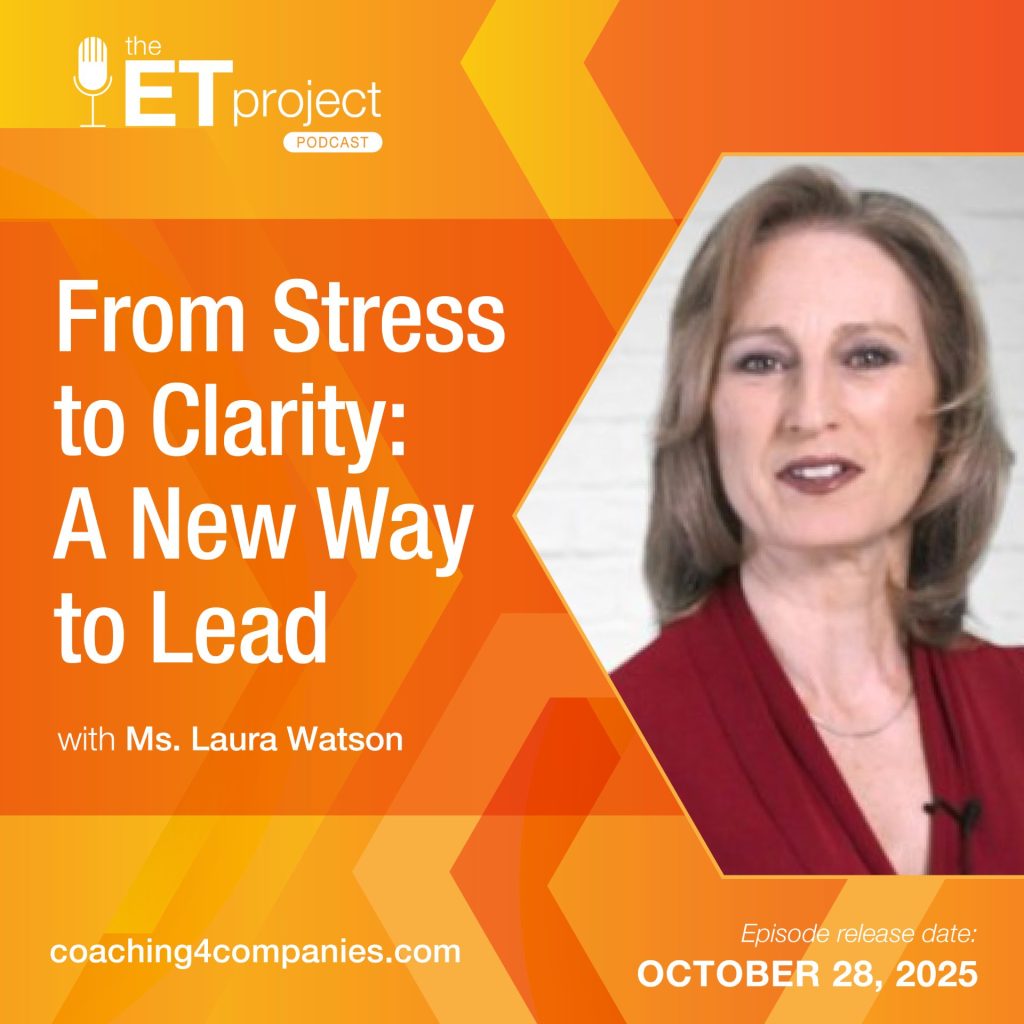
WAYNE BROWN: Hello, I’m your host Wayne Brown and welcome to the ET project. We’re delighted to be delivering this podcast for executive talent all over the world whom we’re affectionately referring to as ‘Team ET.’ Today we’re meeting up with Laura Watson the founder and lead business coach at Venture Coaching International in Calgary, Alberta. And with over 25 years of counseling and coaching experience, she helps business owners and executives across North America to improve their personal communication and leadership effectiveness. Laura graduated with an MSW from the University of Calgary and she received her coaching certification from Coach U and the International Coach Federation. Her expertise and commitment to personal mastery were recognized by the Calgary Association of Professional Coaches and the Universal Women’s Network. Laura tailors her coaching programs to meet individual needs and she’s an expert at bridging theory and practice so clients get focused, improve productivity and take their personal and business leadership to the next level. When Laura is not in the boardroom, you’ll find her in the ballroom, she’s a 2023 World Country Dance Champion passionate about taking her dance skills to the next level. Team, our conversation today broaches the subject of psychedelics and as Laura says in her e-book on the topic, and I’m quoting here; “so, you are psychedelic curious? That’s great, I commend you for being open-minded, I believe that education and informed decision-making is important and the resources in this e-book will help people understand the possibility, the science, the risks and the potential value of participating.” However, she strongly stresses that personal conversation is always required to ensure these medicines are a right fit for you. Team, perhaps you’ve heard about some of the mental health breakthroughs people are experiencing from this form of treatment and wondered what it’s all about, if so, then this episode today will help unravel some of your questions and shine a light on the possibility of fast tracking a solution.
INTRO: Welcome to the ET project, a podcast for those executive talents determined to release their true potential and create an impact. Join our veteran coach and mentor, Wayne Brown, as we unpack an exciting future together.
WAYNE BROWN: Hello, team. Today, we’re exploring a topic that’s undergoing quite a dramatic transformation, at least that’s the way I see it, it’s the conversation around psychedelics. And it’s moving from the fringes to somewhere of the mainstream and even in the world of life-performing executives where they’re looking at these substances no longer just for recreation but as a powerful tool that helps to break through the mental barriers even in harness creativity and clarity. And here to guide us through this somewhat complex topic, as well as promising lands, fair if I have to say, we’re joined by coach and educator Laura Watson. Laura, welcome to the ET project, great to have you on.
LAURA WATSON: Thanks very much for having me, Wayne. It’s great to be here today.
WAYNE BROWN: I’m quite excited to explore this, it’s a fascinating topic based on the research that I’ve been doing. But I have to start with a disclosure; I’m coming to this conversation as a complete novice, I’m not a doctor, I have no background either academically or personally in psychedelics. So, I’m going to be asking questions that I hope our listeners would ask and I’m really looking to you for your guidance through our discussion today. So, many people…
LAURA WATSON: Absolutely, fire away, I’ll do the best I can to answer your questions.
WAYNE BROWN: Well, to that point, I mean, many people probably know you as a business or a leadership coach which makes the deep dive into this subject somewhat interesting, what is the connection that you have through your coaching work and your expertise in the realm of psychedelic medicine?
LAURA WATSON: Oh, a great question. So, in my work with business leaders, executive leaders, I’ve always worked with them around understanding core issues to what’s going on in their sort of life in leadership.
WAYNE BROWN: Right.
LAURA WATSON: Now, people they’re under a lot of stress, for example, their communication skills are lacking, they’re being very reactive and often their reactivity is just based on stress, sometimes it’s based on assumptions or stories that they’re making up and sometimes they’re even based on core wounds that maybe they’re aware of
[00:05:00]
LAURA WATSON: And I realize I’m starting to sound a little therapeutic here, but core wounds that maybe they’ve experienced earlier in their life that never got healed. So, there’s a whole variety of things that can contribute to their ability to lead themselves and others effectively. And so, I’ve always seen those issues as symptoms to a core issue. So, I’ve always tried to uncover the core. And what I discovered in psychedelics is there’s a core under the core. So, what I thought were core issues like limiting beliefs and core wounding, for example, there’s still core but there’s a layer underneath that that few of us have access to. And so, what the psychedelics do is they give us access to something we didn’t have access to before and which gives us an opportunity to build self-awareness, an opportunity to heal some of those core wounds, look at things from a completely different perspective, open up possibility in our thinking. So, that’s really the link that I see and that I’m bringing forward by integrating these tools into my coaching practice.
WAYNE BROWN: Perhaps, a good starting point here is trying to define exactly what we’re referring to when we talk about psychedelic medicine, what’s the application, the purpose of bringing this into the medical sense?
LAURA WATSON: Well, and before we talk about application, I think the first part of your question which is what are we talking about with this overarching term called psychedelics.
WAYNE BROWN: Yeah.
LAURA WATSON: Because like yourself when I was first introduced to this, I thought mushrooms, I thought LSD, and I had the same baggage, I grew up with the TV commercials, “this is your brain on drugs,” and you’re watching an egg frying in a pan. And I had never touched any of this stuff, it was taboo, off-limits, it was not within the realm of anything I ever thought that I would be engaged in, that was counterculture bad, all that taboo stuff. Now, I’m in a way different place. But let’s talk first of all about the categories of psychedelics, there are three primary categories; the first category is your classics, your classics are things like your magic mushrooms, the LSD, for example. And those types of substances are what’s called nonspecific amplifiers. So, think about whatever is going on inside you, they kind of amplify it. And that’s where people… and you hear the term, sort of ‘bad trip’ sometimes, because if you are… and people might say, “ooh, I tried mushrooms once and it made me anxious.” Well, it didn’t actually make you anxious, what happened was it amplified anxiety that was already there. So, there’s that classification of psychedelics which are your classics. Then there’s a second category called your empathogens and entactogens; your empathogens are psychedelics like MDMA, the street name for MDMA is ecstasy, there’s another one 3-MMC and these types of medicines are heart-opening medicines, they’re empathy-opening medicines; because what they do is they work on the serotonin receptors in our brain and what they do is they turn off the judgment center in our brain that sits inside the amygdala. So, inside the amygdala which is a kind of this little walnut in the back of our brain, we have this default mode network and it’s where our inner critic lives and that inner critic plays a very important role, he’s there to keep us safe, and say, “Whoa! Whoa! Don’t do that.” Which way back in our caveman days was really helpful, because it prevented us from getting eaten by a lion. But now the amygdala and that default mode network and that inner critic can hold us back because of perceived fears.
[00:10:00]
LAURA WATSON: So, these medicines are an opportunity and a tool for turning that off temporarily and when we turn the judgment and that filter off temporarily, new possibility and creativity opens up in our thinking; that’s our second classification. The third classification of psychedelics are the dissociatives. And so, those are things like ketamine and ketamine clinics have been sort of popping up everywhere. And ketamine kind of takes us out to the universe in a really extreme way. And for people who have experienced trauma, like big T trauma, for example, postpartum trauma, those, it gives an opportunity to disconnect from self while having someone lead you through a guided conversation again to be able to open up new pathways of thinking and opportunities. And that’s another element that I find fascinating about the psychedelics is, it’s not just the psychedelic experience itself that’s powerful, the other fascinating piece about this is, there’s… that it opens up this window of time in our brain where new neural pathways can literally get rewired. So, people for example with brain injuries, they’re using psychedelic-assisted therapies and experiences that are actually helping them rewire their brain and get functionality back that they lost in their brain injury. So, it’s a fascinating field with all kinds of applications in addition to the application that you were mentioning, which is performance enhancement.
WAYNE BROWN: What I was really struck by when we first came together and we started talking was, I’ve been coaching for a long time and mentoring for a long time, I’ve never heard of combining the application of psychedelics into my coaching. So, I’m really curious, how do you bring this particular medical application into your coaching? I mean, is there a process? How do clients come to you and say, “hey, I have a need, I need to talk about psychedelics.”
LAURA WATSON: Well, it’s a careful conversation, that’s for sure, and my role is to guide people. So, it’s really a one-on-one type of conversation, is this a tool that could be a fit for them? And I’m here to guide them in their decision process, I’m not here to say, “yeah, absolutely you got to do this and let’s get on with it.” I’m there as their guide. So, I’ve done a lot of research and learning in this area, I’ve been gathering some educational materials and resources in this area so that I can educate people and help them make informed decisions if this is something that they think that they want to step into. But obviously it’s a very careful conversation to have, it’s illegal still in many locations and states. And so, that’s an important consideration. So, I am really here as an information provider to help them realize that it is a possibility and if they’re going to pursue it, how do they pursue it carefully and thoughtfully.
WAYNE BROWN: Well, I think that’s an interesting point in itself, is that in many places depending on which particular psychedelic medicine you’re using, it’s still illegal, right? So, it is something that you do in a clinical setting rather than something you would try recreationally hoping for that outcome, right?
LAURA WATSON: Yeah. I mean, there has definitely been recreational use out there, there’s ceremonial use and you can go to retreats in various countries and participate in this sort of thing and there’s a movement happening to find a middle ground because there is psychedelic-assisted therapy now. So, you can work with a psychotherapist who has received special training, special certification, special licensing from their government to be able to provide these kinds of tools.
[00:15:00]
LAURA WATSON: Those resources are available typically to people in a more extreme circumstances, as far as they’re experiencing PTSD, they have treatment-resistant depression, anxiety, they have to demonstrate that other treatment modalities have not worked for them, they have to get special permission to use these tools and work with people in very special settings in order to make that happen, but it is a possibility.
WAYNE BROWN: Okay. I mean, some of the safety protocols I’ve read about sounds quite interesting, have you had much experience with those or with the application yourself?
LAURA WATSON: Well, there definitely have to be safety protocols in place, people for example if they’re on medications of some kind, you have to be mindful of whether or not the particular psychedelic medicines are going to conflict with medications you may already be taking. And there’s people out there with expertise in that area who can provide consultation on that, so, make sure that… again, if this is something that you want to pursue, you want to make sure it’s not going to conflict with any other medications that you’re already on, it makes sense to have a consult with your doctor to say, “I’m considering this,” if your doctor is familiar with these types of medicines and they may be able to provide consultation about potential conflicts or not and if they’re not educated in this area then there certainly are people out there who can provide that kind of consultation.
WAYNE BROWN: Right. Well, when I was looking at your website as a starting point to understand more about your practice and what you do, you have an e-book on the psychedelic topic, and I was quite intrigued by the number of discussion points or the number of different platforms where people are talking about this application, what’s the current research revealing? Like, if we look at 2024, 2025 is it now being more of a medically-accepted application or solution, is that the general trajectory that we’re finding this is moving in?
LAURA WATSON: That’s definitely… yes, it’s all in evolution, it’s gaining… research is happening, it was all shut down in the 70s, there was all kinds of research happening into the benefits of these medicines and if you actually look at the history, these medicines have been used for thousands of years and it was all shut down in the 70s by the Nixon government in the States, all the research stopped, everything. And yes, it has just been in the past 20 years that this has been revisited and very specific clinical trials have been followed and put in place and so research is happening with great outcomes happening for people with PTSD, anxiety, depression, even MS. So, yes, the research is underway, it’s happening. And if you… there’s a great resource actually, it’s a newsletter called ‘Tricycle Day’ that’s put out from the States that’s a great information resource for what’s happening, and the research studies that are being done, the different states in the United States that are having this conversation in their local governments and starting to pass legislation that is allowing for this. So, it’s definitely in a Renaissance, the goal in the community is to get it out of the medical community and to make it accessible to the everyday person with guidance. But it is a goal within the psychedelic community that they’re powerful medicines that need to be treated with respect and carefully but they don’t have to be necessarily used in a medical setting. And so, the goal of the people doing this work is to get it mainstream.
[00:20:00]
WAYNE BROWN: I can imagine there’s multiple phases of impact from the psychedelic treatment, if I think about somebody who takes drugs, they have that immediate short-term awakening, if you like, or opening up, is there a longer-term process here that plays out through the application of psychedelics?
LAURA WATSON: Well, I think it’s important for people to understand that psychedelics are not ‘the thing,’ psychedelics are door-opener tools.
WAYNE BROWN: Right
LAURA WATSON: So, we can gain great insights from an experience, we can experience some healing from core wounds that we were talking about earlier, but they’re not a magic bullet that fix everything fixes everything. So, that’s why guided experiences are so important so that you have someone there to help you with your mindset going into the experience, make sure you’re in a very positive mindset, you’re going in with clear intention about what you want to accomplish in a particular journey, if you will, and then debriefing that experience afterwards. But where the real transformation takes place is in the integration afterwards. So, you open the door and the experience, but you got to walk through the door and then take those insights and bring them into your everyday life. And so, that’s where I’m combining it with the coaching. So, if someone has one of these experiences then I understand the experience, I can help them in their preparation beforehand and then coaching is all about their integration afterwards so that they get the full value of that experience.
WAYNE BROWN: Some of the things you say as a result of your clients working in this process is it having an impact greater than what you’d experienced outside of the psychedelic medicine?
LAURA WATSON: Well, yeah, absolutely. So, I was coaching husband and wife, they had separate businesses and so I coached them individually and they’ve been married for 30 years, he has ADHD, he struggles with focus, he had a habit, for lack of a better term, of when something gets… an avoidance habit, I’m going to call it, when something feels challenging, his approach was to kind of hide, try to ignore it, abdicate the issue off to somebody else and never really own it and take it on; that’s a problem for a business owner, that doesn’t create for some very good dynamics in your company. And so, he ended up having a journey, and he was transformed, in my conversations with his wife afterwards she said that he was a different man, that he… in one of the big… he was more positive, optimistic, but what the biggest change for him was he took ownership of his life and he took ownership of his business in a very different way. So, he was in business for 15 years, I had coached him for a couple of years at that point and through all of the, I’m gonna call it ‘talk therapy’ but, you know, coaching is a conversation, he had made incremental changes that were good and going in the right direction and then he had a journey that just took him leaps and bounds in his progress. And that’s what people are finding in the clinical settings and in more traditional therapy settings, is you can do talk therapy for years and then you can have a single psychedelic experience and the issue that you’re dealing with is just gone, just gone; and that’s what I think is so compelling
[00:25:00]
LAURA WATSON: I’m reminded actually one of the resources in my e-book is the Netflix series called ‘How To Change Your Mind.’ Michael Pollan wrote a book with that title, he’s interviewed in that series, I found that series absolutely fascinating. And he shares a story of a gentleman who was suffering with OCD, obsessive-compulsive disorder, and it was crippling him, he was so severe, he couldn’t get through it, he couldn’t be productive in any way during his day because his OCD was so bad. And he had struggled with that for years and done therapy and everything else, he ended up using psychedelics and it took away the OCD, he could function.
WAYNE BROWN: Right.
LAURA WATSON: And not just function but live a normal life, again, after just a single journey. So, for something to have that much power so fast, again, I think it’s just an incredible tool that we can’t ignore.
WAYNE BROWN: You just highlighted an important point there and I’m wondering, how mainstream is it cost-wise. Like, is it affordable to have the treatment? Is this something that we would have to save for to be able to go and put ourselves into a clinic environment?
LAURA WATSON: And that’s difficult to answer. I mean, there are… you know, you can go off to Costa Rica and attend a retreat for $5,000, you can find probably someone on the street corner who will sell you a little bit of… you know, some shrooms and there you go and you’ve spent under a hundred bucks. And then you can go to a clinical setting, and in Canada where I’m based, what that looks like is, you have to go to a clinical setting, you have to again demonstrate that you have treatment-resistant depression, for example, all these other things that you’ve tried haven’t worked, you have to apply to the government for special permission to go this route which I think is about an $850 application fee and then once your application is approved then you’re working in a clinical setting and that’s about $5,000 as well.
WAYNE BROWN: Okay.
LAURA WATSON: So, it really ranges. And to be honest there are people, I’m going to call it ‘sort of in the underground’ if you will, who if you can find them, they’re out there, and you can probably experience something like this with a guide for around $2,000.
WAYNE BROWN: Typically, one treatment versus half a dozen treatments, like, what is your experience? Is this an ongoing area that people need to continually be treated with?
LAURA WATSON: It’s not something necessarily that you would be engaged in forever, but do think about it like peeling away layers of an onion. So, you can have a single experience and get some amazing insights and some really powerful healing out of it with integration afterwards and you’ve probably taken off the outside layer of the onion. And so, then you can think about probably… you know, within a few months or three to six months maybe a year undergoing a second experience, that’s going to peel back another layer of the onion. So, it kind of depends on how many layers you got to your onion and how deep you want to go.
WAYNE BROWN: If our listeners are out there and they’re somewhat curious, maybe cautious but open-minded, what’s a piece of information or some guidance as a first step that you would recommend if they’re wanting to learn more?
LAURA WATSON: Do some research, there’s lots of information online. I mean, they could come to my website, for example, get that e-book that you downloaded. As you acknowledged, I got a lot of resources in that e-book, everything from Michael Pollan’s ‘How To Change Your Mind’ to Oprah’s podcasts, to CBC, which is one of our Canadian newscasters, all kinds of resources in that e-book. Search on YouTube, look at MAPS, that’s the Multidisciplinary Association of Psychedelics.
[00:30:00]
LAURA WATSON: They’re one of the key players who are pushing for research and policy change in this area, so they’re a great place for information. Tricycle Day is that newsletter that people can sign up to for information as well. This is definitely an area that you don’t want to take lightly and you want to get some education and some information before making these kinds of decisions.
WAYNE BROWN: Right. You mentioned earlier that one of the goals of the community is for it to be more mainstream, more accessible, where do you see this in five or ten years from now? Like, what do you hope will happen with the application or the accessibility of it?
WAYNE BROWN: Well, my hope actually is that there will be… that the legislation will open up, that there will be certification training available in this area. I think there’s a medical use, therapeutic model is valid, but I don’t think that only people who are severely ill should be the only ones able to access this. So, I would love to see legislation and certification in place where people can get the training to be able to deliver these medicines to the public safely so that the public doesn’t have to go underground to gain access to these kinds of things.
WAYNE BROWN: Right.
LAURA WATSON: So, they can be used safely, carefully, they’re very powerful tools that… and like you acknowledge, athletes are already using them, there’s all kinds of information online about microdosing. So, let’s bring it out from behind the curtain and kind of like the marijuana legislation, it was underground for a very long time and eventually it was legalized, let’s legalize it. And let’s create certification programs that allow people to learn how to use this safely so that they can share this with people safely.
WAYNE BROWN: Certainly, with the momentum that’s building, it seems to be heading in that direction, but it needs that broader uptake, I guess, and that’s hopefully where we’re heading. One of the common themes in your work I know is around communication effectiveness, and I know there’s somewhat of a link between the application and using the psychedelic medicines to helping people communicate better, when we talk about communication, are there blind spots that we see as a common trait of many of the executives you work with?
LAURA WATSON: In regards to their communication practices?
WAYNE BROWN: Mm-hmm.
LAURA WATSON: Well, definitely. Yeah, we’re kind of switching gears here, but communication effectiveness is something that I’ve been fascinated with and practicing for 25 years, because the effectiveness of our communication, the quality of our communication, actually impacts the quality of our relationships, because we’re communicating with other people and our communication can actually make or break our relationships. So, one of the big blind spots I see in executives and in anybody is unintended ways that they break down the communication process. And again, I’ve got an e-book on my website that talks about communication. But most leaders and executives their days are spent solving problems. So, their employees come to them, their clients are coming to them with problems, and often I find executives are putting themselves in the role of thinking that they need to be the fixer of all the problems.
[00:35:00]
LAURA WATSON: And so, then that shows up in the communication, someone comes to them with a problem and they’re trying to fix it or they’re trying to console it or they’re critical of the person bringing this issue forward. And there’s actually, I call them the ‘dirty dozen,’ there’s 12 typical ways that executives unknowingly shut down the communication process with people, whether it’s their spouse or whether it’s their employees, they don’t mean to do it, but they’re doing it. And so, when they can learn that ‘dirty dozen’ and realize how they’re communicating in a way that’s actually contrary to their goal and objective to have effective communication, then they can stop doing that for one and then they can learn effective communication skills that are going to bridge the distance between themselves and the people that they’re working with. And also, can actually get them out of that role of thinking that they need to fix all the problems because if they believe, first of all, that people are capable of solving their own problems, they can actually change their communication process to facilitate problem-solving in other people and when they do that, they build their people, they build their resilience, they build their skills, they don’t make people dependent on them to coming for the answers all the time, which actually frees them up to go off and do other things.
WAYNE BROWN: Yeah. Being a long-term leader, I understand the stresses involved with leadership and communication being one of the big challenges, I’m wondering, have you seen any form of correlation between how you can use the psychedelic treatment to help you de-stress to become that better communicator? Is there any or is that too much of a stretch to try and tie those two together?
LAURA WATSON: No, I don’t think it’s a stretch at all because one of the things that the psychedelic experiences can achieve is de-stressing you. And what happens when we’re stressed, as I’m sure you’ve realized, is we can’t be stressed and logical at the same time, our brains just don’t work that way. So, if we’re stressed, we’re being emotional, we’re being reactive, as I call it ‘reactive leadership.’ And a psychedelic experience can for one, decrease the stress, and if you’ve decreased your stress then the logic can come back in, you can show up in a different way in your interactions with others. And one of those empathogen medicines that we talked about earlier is called 3-MMC, and that’s a very interesting medicine because it actually helps open up communication, it opens the heart, it opens up the creativity centers in our brain and can actually facilitate more communication between people. So, it’s actually a tool that could potentially be used for example between two business partners, if they’re at odds with each other or kind of getting disconnected from each other, there’s a lot of conflict showing up in the relationship, using a medicine like 3-MMC guided with someone for a day could actually help them as business partners reconnect, communicate, understand each other, at a level they’ve probably never experienced before.
WAYNE BROWN: Yeah. We’ve seen mindfulness and meditation become more-accepted practices within a company culture, and I was just wondering if we ever see that as a future possibility where the company retreat of their top 1% of executives maybe go through a very refined micro session using psychedelics as a form of treatment to open people up, to really build that relationship, improve their communication.
LAURA WATSON: Absolutely, absolutely. And I’m aware actually of psychedelics being applied to leadership masterminds, there’s an opportunity there to… a mastermind already brings a group of leaders together, the idea being that each person in the mastermind has an opportunity to share an issue or a challenge that is going on for them and then we’re using group think to support that person in thinking through their challenge.
[00:40:00]
LAURA WATSON: Well, what do you think might be possible if we took that to a whole new level using something like 3-MMC, having everyone in that room having their ego set aside, having the creativity center of their brain opened up, can you just imagine the kind of conversation and masterminding that might take place if a group of 10 top-notch business people all supporting each other in an environment like that?
WAYNE BROWN: I do think it’s a fascinating field, like, I said at the outset and we’ve only scratchy surface on the whole topic but let’s hope that there is further progress made and it does stay on the radar and doesn’t disappear again, I think we’re heading in the right direction. Where’s the best place for people to connect with you and find out more?
LAURA WATSON: Yeah, well, I guess my website is probably one of the best places, venturecoaching.ca, and like you said, I’ve got a number of freebies there, one of which is the information resource around the psychedelics piece and my phone number is on my website, obviously, and a form if they want to reach out and talk to me. I’m on LinkedIn as well, so Laura Watson or Venture Coaching, they can find me there. And I’m always open to a conversation. So, I’m not saying psychedelics are that be all and end all, but I am seeing this as an opportunity and a possibility and certainly as with you hoping to see them go mainstream and I have a little bit of knowledge in this area and I’m always open to having a conversation with people about it.
WAYNE BROWN: We should clarify as well, I mean, you’re not only focused on psychedelics, so, you have a coaching practice, Venture Coaching, and you’re based… where are you based? We should clarify that as well.
LAURA WATSON: Yeah, absolutely. I’ve been coaching for over 20 years. I actually come out of the counseling arena, I have got a master’s degree, 20 years ago I shifted into coaching, so, I’ve been coaching business owners and c-suite executives for 20 years now, so, yes absolutely, I’ve got an active coaching practice that has nothing to do with psychedelics, whatsoever. And I’m located in Alberta, Canada and I work with people all over North America remotely now that Zoom has become a thing over these past few years. So, locals I get to see in person but people elsewhere I work online with them and sometimes even travel and end up seeing them in person. So, yeah, it’s not just psychedelics, like, I said they’re just a tool, I have many tools that I draw from when I’m working with leaders.
WAYNE BROWN: All right, we’ll put the links to all those sites you mentioned, I highly recommend everyone to go on the website, there’s an enormous amount of downloadable products that Laura generously offers on different topics. And yeah, great to bring this discussion topic to the table and… actually, not the last time, but we’ll see how it goes. So, thank you for being on the ET project.
LAURA WATSON: Oh, my pleasure, thanks for having me today, I hope it has been informative.
OUTRO: Thank you for joining us on the ET project, a show for executive talent development, until next time, check out our site for free videos, eBooks, webinars, and blogs at ‘coaching4companies.com.’
[END OF TRANSCRIPT]