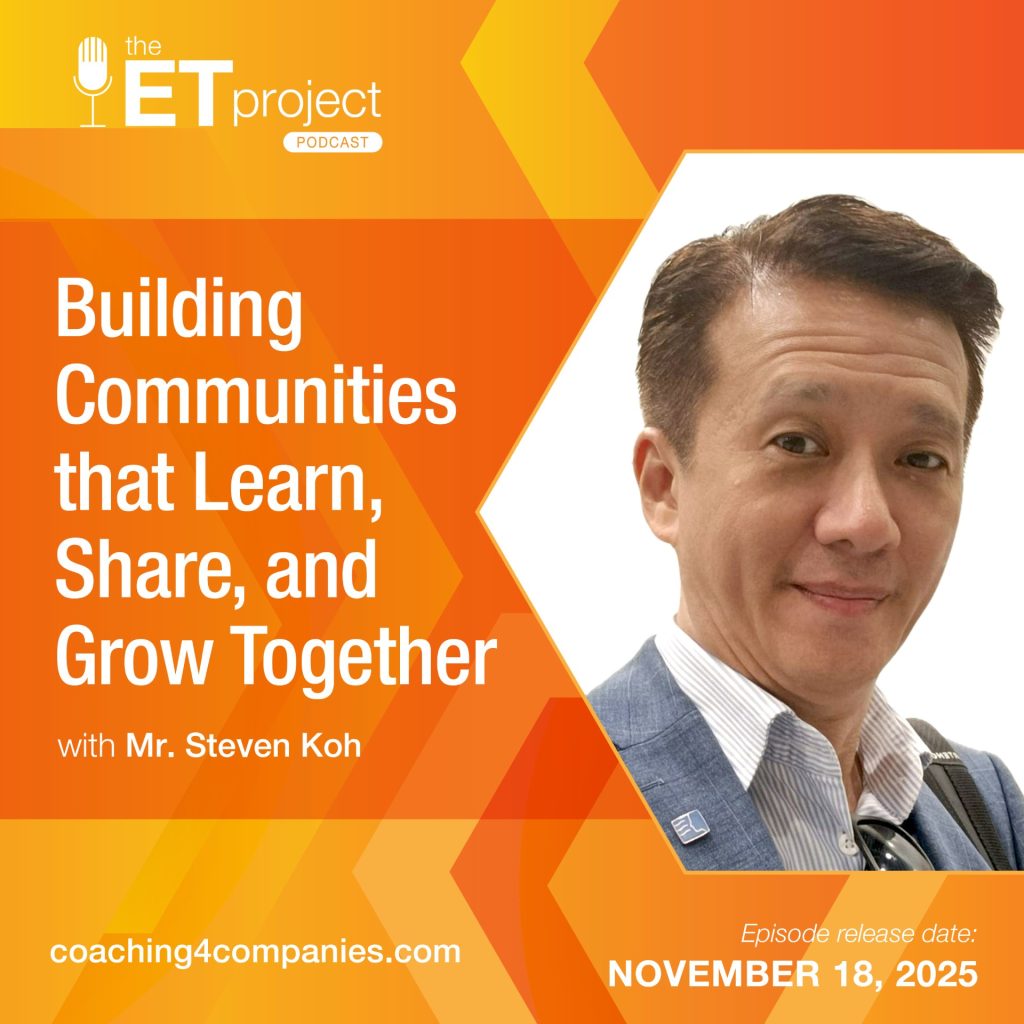
WAYNE BROWN: Hello, I’m your host, Wayne Brown, and welcome to the ET project. We’re delighted to be delivering this podcast for executive talent all over the world, whom we’re affectionately referring to as ‘Team ET.’ Today, we’re chatting with the CEO of Glearn Training & Consultancy and founder of the Community of Learning Singapore, Mr. Steven Koh. Steven is an experienced speaker, learning facilitator, curriculum designer, business consultant, workplace learning specialist, and community leader with over 32 years of industrial and management experience. He has developed and delivered impactful training programs for established organizations and top brands across diverse industries. As the founder of the Community of Learning (Singapore), a thriving community that promotes lifelong learning and the kampong spirit, with over 5,300 leaders and professionals from more than 99 cities worldwide, Steven has played a key role in fostering collaboration and growth through communities. In 2018-2019, he served as the lead for the Facebook Community Leadership Circle Singapore. With a decade of community building experience, he currently teaches community learning and leadership programs at SMU Academy as an adjunct faculty member and has guided many leaders in developing their own communities. He is frequently invited to speak at seminars and events on community building, leadership, and social learning. And from 2022 to 2024, he also served as ambassador for the Institute of Adult Learning special interest group Singapore, where he contributed to their growth and development. Team, Steven brings with him unique insights and a vision that is focused on fostering a caring, centric, and curious world where all people live in harmony inside and out of their organization, and one where learning is done with intention and purpose.
INTRO: Welcome to the ET project, a podcast for those executive talents determined to release their true potential and create an impact. Join our veteran coach and mentor, Wayne Brown, as we unpack an exciting future together.
WAYNE BROWN: Hello team, welcome to this week’s episode. Would you agree that our environment often feels increasingly busy, we’re feeling more anxious, there’s so much noise, and we’re even acting more individualistic? All that leads me to ask, is there still a place for the warmth of the kampong spirit, a sense of community, if you like. Can the simple power of connecting with friends be the key to meaningful growth in today’s professional landscape? Well, we’re very blessed and incredibly privileged to explore these questions with a true pioneer in this space. So please join me in welcoming our special guest, Mr. Steven Koh, founder of the Community of Learning Singapore, as he’s going to help walk us through what has been a three-decade-long journey for him, where he has been fostering real learning and building a supportive community grounded in the very heart of Singaporean values. Steven, first of all, a huge welcome to the ET project.
STEVEN KOH: Yes. Thank you very much, Wayne, for having me as part of your podcast.
WAYNE BROWN: You’ve built this community from ground zero, basically, into what it is today, which is seen, as I see it at least, a thriving ecosystem. As I mentioned, 30 years in business, working in adult education in that industry, I’m sure there has been a lot of experiences, was there anything along that journey that convinced you to look deeper at community? Was there something missing that you identified, or was there a need for stronger community? What was the impetus for the whole focus on community?
STEVEN KOH: I’ve been in the training industry since 1994, when I first started my training business. And I always feel working alone, just doing my best in my training program, helping my learners, and I thought it will be wonderful if we can come together and really learn, share our learning and doing well in life. So, I feel that the loneliness is something that I feel every day, and I hope that we can build a community.
[00:05:00]
WAYNE BROWN: I can associate with what you’re talking about. It can be a very lonely experience when you’re working by yourself, particularly as a solo entrepreneur, and the whole concept of coming together and being able to share the journey, I’m sure is appealing to many people.
STEVEN KOH: Especially when things are getting more and more challenging with the new world, I think it’s important to come together to share our collective wisdom, and also give each other the support that we all need to do well in life.
WAYNE BROWN: So, we’re talking 2015, when you first started, is there one big way that the community has defied your original expectation when you first started this whole journey? Has anything popped out and surprised you?
STEVEN KOH: When I first started, my original intent was a very simple one: to get all my friends to come together to learn, attend seminars, or training programs together. Because as a training professional, I attended a lot of seminars, a lot of training programs. And very often, I went alone, I came back alone, and I thought it would be wonderful if I could get a group of people to go with me, and after we are back, we can share our learning, and we can apply our learning in doing well. What surprised me after 10 years is that this little, small toss has grown into a big movement that I am now physically handling. By a simple act of organizing and getting people together, it has turned out to be a big blessing in my life. I still can recall my first meeting. I called a group of 10 friends, I booked a place in a cafe in the afternoon, I paid for the food, I gathered everybody, and said, “Okay, let’s start to learn together.” That was how we first started. And after that, we organized many, many such gatherings and such sharing, and I am very surprised that many people bring me a lot of opportunities. I’ve now become a speaker; they bring me opportunities to interview on the radio, they bring me opportunities to be interviewed by the press, they bring me project opportunities, and they bring me a lot of leads on new opportunities in my business. So, I’m very, very thankful for how a small act can turn into such a movement at this moment.
WAYNE BROWN: And still growing. So just the start of the journey in many ways, I’m sure. One of the things, Steven, that jumped out to me when we first met is that you’re a big believer in the need for lifelong learning. And when I look at your bio and everything that you have achieved, you have a lot of qualifications, you definitely practice what you preach around this need for the continuous learning approach. Did the formal training and all the qualifications that you acquired, like in adult learning and the principles, have they influence your approach to creating this informal kampong spirit in your community?
STEVEN KOH: Certainly, because I attended a lot of training. So, a lot of them are classroom training. So, after the two days, I feel that we have learned the knowledge, we have the practice in class, but the real learning starts after class. So, I thought it would be wonderful if we could gather all my classmates to continue applying what we have learned after the course, and we can share our application, we can support everybody.
WAYNE BROWN: So, this is the informal approach, right?
STEVEN KOH: Yes.
WAYNE BROWN: And for the audience, you may have wondered what I was saying, kampong spirit.
STEVEN KOH: Yes. Learn together and apply together. We can attend the class together and then after that we apply together, we share our experience, and I think that will make learning even more effective and more meaningful, yeah.
[00:10:00]
WAYNE BROWN: And there’s another Singaporean Malay expression or word, kakis.
STEVEN KOH: Kakis. Kampung, kakis, yes.
WAYNE BROWN: Right, what does that mean?
STEVEN KOH: I think it means friends, we are all friends in life.
WAYNE BROWN: Friends, right.
STEVEN KOH: We share our life journey together, I thought it would be wonderful if we can share with each other, we can share what we have with each other, I think that that will be a very rewarding experience to have.
WAYNE BROWN: There’s normally a connection, I know with many of our guests that I speak with, the whole impetus or journey started with the prompting from other friends or mentors or coaches, whatever brand we like to give them, was there anyone in your life, your journey, who sort of opened your eyes to the value of community and friendship?
STEVEN KOH: In fact, I always look for a mentor in life. I always love to learn from others, but I’m afraid I look around, I really can’t find a mentor. I still remember when I first started in 1994, I was a junior, I’m completely new in business, I attended a program, I hoped somebody can mentor me, but I didn’t have the opportunity. So, 30 years down the road, I would like to offer this opportunity to whoever needs a mentor, because a mentor cuts short the learning curve, because the mentor knows the way and it will be a big blessing to have a mentor in our life to guide us, to cut short our learning path, to help us to overcome some of the obstacles and to give us the confidence to go for our passion in life.
WAYNE BROWN: One of the other elements that I’ve heard you mention multiple times is you talk about you feel blessed, and I think you mentioned it earlier today as well. You feel blessed, and it’s sort of central to your story from what I can see. Why? Why do you feel blessed? What is it that gives you this sense?
STEVEN KOH: I feel blessed because we have many people who show love to me; they bring me opportunity, they support me, and we have become great friends in life. In the community, we have a lot of people, you get access to a lot of people.
WAYNE BROWN: Yes, there’s over 5,000, I believe.
STEVEN KOH: Yes. So, we can actually meet everyone to come together for a social learning session to learn something from them, and imagine that everyone is a teacher to us, we can learn from them. And secondly, we can also share our knowledge with them, we can bless them with our knowledge. So, it’s both ways. The blessing is tremendous, and if you go out to social media, you can connect with a lot of people. This is abundant, and we have abundance, we no longer have to live with scarcity and people have to fight for things. We can build a world where everybody can share, and the more we share, the more blessing will come back to us, and that’s my experience.
WAYNE BROWN: I can imagine where you were 10 years ago, you had a vision of how it would all evolve, and I’m guessing the vision, as well as the journey has evolved. So, things like kindness, patience, joy, what do you think, maybe feel, about the success that you’ve experienced so far with the community? Beyond the numbers, we mentioned 5,000 people-plus in your community, is there something that you feel deeply about the community beyond just those numbers?
STEVEN KOH: I’m very happy to see many of them after joining the community, they become good friends, they organize our team together, they widen the circles, they are updated with the latest development in the industry.
[00:15:00]
WAYNE BROWN: Yeah.
STEVEN KOH: They feel supported, and I think we have many, many people become great friends to the Community of Learning, and I myself have a big circle of very, very CoL friends that I made over the last 10 years, and these relationships are available, I’m thankful for them.
WAYNE BROWN: Back to the blessing, the whole…
STEVEN KOH: Friendship is something that is a big blessing, and we really, really connect with each other, and we become very, very great friends in life.
WAYNE BROWN: This journey is probably similar to many journeys that we’ve been on. If we were to go back to the beginning, is there a piece of advice that you would give yourself today at that moment of commencing the community? Is there any advice, based on your 10 years’ experience, is there any advice that you would offer yourself?
STEVEN KOH: I would have started a community way, way before 2015. I should have started it the first thing in my career, in my life, then I would open up to a big community of contacts of friends who can support me. So that is what I’m thinking that I should have started long, long ago, but it’s also not too late, I started in 2015, I have no regrets. It was just a simple thought, I took the first step, and now it has grown into a certain size, and I’m happy about it, yes.
WAYNE BROWN: There’s an old expression, the best time to plant a tree was 20 years ago, the second-best time is now.
STEVEN KOH: Yes. Well, that’s life.
WAYNE BROWN: Yeah. You started 10 years ago, and you can see now the fruits of your labor. Is there a story that comes to mind about one of the members of the community about their transformation during this 10-year period?
STEVEN KOH: Yes, certainly, I can share a story, a very good story. I met my best friend, Sean, through Community of Learning. Sean is my fellow admin in Community of Learning, I first knew him about eight years ago when he started his career as a trainer after he finished his corporate tour. He is a wonderful friend after eight years, we met regularly, we supported each other, we shared our perspective of running the community. We’ve been through a lot in life, and he’s one of my best friends and I’ve learned a lot from him, and I’m always thankful. When he first started, I actually worked together with him because his first… he was new then, as I started connecting with him, I introduced him to different training organizations, and we had many wonderful conversations together. So, you ask me, this is one of my most touching stories. He is my elder in my life, I would say. I learn a lot from him, and I think this is one of the wonderful things I cherish a lot, yes.
WAYNE BROWN: Yeah, I can understand that. And we mentioned mentors earlier, I guess Sean is probably an informal mentor, maybe.
STEVEN KOH: Yes, I think he has shared a lot of his perspective because he is a very experienced professional in corporate. He has been through a lot in life, so he shares a lot of things. But we don’t agree all the time, like we debate, we share and we really embrace a different perspective, and I really learn a lot from him. And I’m very, very thankful to him for being with me in this eight-year journey in community building. It is a tough journey, in fact. We sat down and looked at some of the challenges, and he is always a very loyal friend, someone who always stays by me, and I’m thankful for that.
[00:20:00]
WAYNE BROWN: We can never have enough people like that in our lives. I don’t know if you’re in Singapore or if you’ve heard the expression, but we often talk about our personal board of directors in our own lives, just similar to what a corporation might have.
STEVEN KOH: Yes.
WAYNE BROWN: And my own experience is the more we surround ourselves with people who can share their perspective, as you said, we may not always agree, but the more we can see alternate perspectives, the deeper our insight is. So, very nicely said. The community, the CoL that you founded, has also created opportunities for you, I remember reading about Facebook, and they have an International Community Leadership Circle, I think it’s called.
STEVEN KOH: Yeah.
WAYNE BROWN: Back in 2018, somebody nominated you and they selected you to represent Singapore in this leadership circle, what was the most valuable lesson that came out of that for you? I mean, a great honor, congratulations, but what was the lesson that came from that opportunity?
STEVEN KOH: In 2018, I applied to the Community Leadership Circles of Facebook for Singapore and I’m very thankful I was selected and we attended the Community Leadership Circle’s training by Facebook and I flew to Berlin, I met all the leads from different cities in the world. The first thing I felt then was, wow, there are so many people who are so kind-hearted to volunteer their time to serve others, it’s amazing. And I see the world is so big and there are so many of them, and many of them are great communities of quite a big size, some of them are as big as one million and they are contributing greatly to their cities, they’re doing a great job to support everybody and I felt that there is still a lot for me to learn because I first started in 2015, 2018, I was just about two to three years in the community building. There is a lot of things I need to learn; how can I get my community organized? How can I give everybody a purposeful, a rewarding learning experience and even a diversified world? How can I demonstrate what love, kindness is being? And how can I win… I would say, how can I get a buy-in for the majority of people? For that, I feel that there’s a lot to learn. So, when I came back to Singapore, I started the circles and I really put a lot of effort in reflecting what I’ve done in the community. Of course, some of the plan works. How can I be better? Be mindful that there isn’t any solid community building training, though I went through Facebook training, which is very good, but there’s still a lot more in building a community when we start building, so, I think consciously learning is important.
WAYNE BROWN: Again, the lifelong learning, being and thinking about the learning, there are so many sound principles that you brought into the community of learning. There’s one thing that a couple of expressions or a couple of terms that the learning community knows quite well, one of them is the term VUCA, V-U-C-A.
STEVEN KOH: Yes.
WAYNE BROWN: The other is a more modern or a more recent term called BANI, B-A-N-I, both of them really defining the challenges that we’re facing in business in the world. You’ve put your own twist on the term BANI, and I used some of the words when we were doing the opening, busy, anxious or anxiety, noisy, individualistic, can you share a story, how you saw this BANI reality playing out in your community?
[00:25:00]
STEVEN KOH: As you can see, nowadays, everyone is busy, that’s the first B, they are busy because they have a lot of responsibility. First, some of us are doing caregiving, this is a huge responsibility. Some of us have to take care of young children, some of us, in fact, most of us must work to ensure our financial sustainability. So, everybody is very, very, very busy. And that’s a challenge, how can I get them to do something when they are so packed? Secondly, angry, I don’t know if angry or anxious, I think there are a lot of frustrations in life given the current world situation. So, sometimes you become very angry, including myself, what we see the world and what it should be. So, anger quietly creeping in our heart and we are pulling it out, we are not storing it. The next one that is noisy because there are so many WhatsApp groups, there are so many community or family groups, and there are so many messages, there are so many friends on our hands, yes, it is quite a noisy world. And I, as an individualist, we begin to start thinking about ourselves now, a lot of us are more individual-focused to handle our busy life. So, if you were to ask me, how can we handle this situation, I think as a community, we need to help everybody to handle this environment that we are in. So how can we handle ourselves? So, after 10 years, I’ve changed the way we run the community and we use the 4S model. First, if you are busy, it’s important to slow down, yes, slow down our life, take care of our self-care, if you are angry, we have to manage ourselves because it’s just really natural to be upset with what happens around us, it’s just human. So, we have to remind ourselves to be steady, keep our cool, that’s important. And the next thing is noisy, there’s a lot of noise, there are a lot of messages out there on social media, therefore it’s important to keep things very simple so that people can understand, people can digest it easily, so keep things simple, very simple so that you don’t overload everybody given such an information-overflowing world. And finally, the last S, individualistic, yes, take care of yourself, start small and dream big, micro is beautiful, start with micro intentions, these are small intentions that we can manage. Every morning as we wake up, we start with a small attention or a micro intention, it’s a term that we are sharing, we are starting with a small intention, something that we can manage and something that can be achievable. And I think with this 4S model, I think we will be able to have a peace, the inner peace that we have in life, and let’s practice the 4S, let’s slow down, be steady, keep things simple, keep things small that can be manageable, step by step, I believe we can do well.
WAYNE BROWN: It’s a nice approach to the chaos that we live in, and the busyness that we’re surrounded by. You also have another framework called the 5R, which is more applicable for our learning methodology and our approach to lifelong learning, would you mind stepping us through the 5R?
STEVEN KOH: Yes. The 5R framework is because, saying about 4S is easy, learning it and applying requires some real application learning, and also with the fast-changing world, we have AI, we have social media, we have lots of things in this world, the next thing is we need to really upskill ourselves.
[00:30:00]
STEVEN KOH: So, the 5R model is a model of upskilling. So, first we must really learn, we must learn skills that transform to outcomes, I think that is very, very important, the focus is really learn the skills and apply in our life that produce outcomes, so the first thing is real learning. The second one is real facilitating, the facilitator must facilitate real learning, that’s what we mean by that. First, number one, you see there are a lot of things you can find, ask from ChatGPT, you can google, it’s not by coming to the classroom, the facilitator repeats those things, so the real facilitating will go beyond AI, when the participants come together or the learners come in the class, it’s important that we share real experience, so we will have to use real learning. So, it means that when you come to class, we must sign a learning contract, so you are clear what skills you are learning, how you are going to apply, how you are going to achieve outcome, that contract will make every learner committed, the facilitator has to set that. Then throughout the whole learning program you must have activities that share experience that cannot be found on social media or through ChatGPT, because you can find those answers, you have the activity for them to share, and then finally you must have an action plan where they commit to apply in their life, and the action plans must be real, so it has to be real facilitation using a real methodology. So, you have real learning, you have real facilitation, the next thing is we need the real learner. The real learning can only produce results if the person is really learning, is willing to learn, so you need a real learner. Then finally, you need to apply, there must be real application, the skill must be applied, the real learner will apply, and then once you apply, you will achieve your real outcome, but the beautiful part of this model is you let the learner to decide whether they are ready to learn or not, they decide. So, after going through the course or their experience or a learning journey that you have created, they will have to decide whether they want to apply or not. Sometimes, it can be applied immediately, sometimes it may take a while for them to apply, but it’s okay. But we give our learner the autonomy to decide how they’re going to apply, when they’re going to apply. So, the community will offer an environment to support their application, so after their classroom training or mentoring, if they’re still, when they apply, they have questions, they can go to the community, ask the question, the facilitator can answer that, or the rest of the classroom can answer that. So, with an ecosystem like this, a framework like this, people can really learn, they are not pressurized to learn, they know what they need to learn, they are supported, and you respect them to learn naturally, comfortably. And I think this is something that we want to advocate for in the current new world that you really learn, yes.
WAYNE BROWN: I think you’re touching on something highly important here, we’ve all been in a scenario I’m sure where we attend a training, at the moment of the training, it’s all clear, we feel great, we walk outside the door, we’re back in the real world of our busyness, and within a day, a week, two weeks, the learning has been forgotten at best part and we’re back into the normal mode, and there is no real outcome or application of that learning. And for me, the community that you’re running really is the missing piece of that jigsaw, that puzzle that says, where’s the support after the initial learning? I can be the motivated learner, but regardless, I’m still going to be consumed by my life outside of this classroom or this training.
[00:35:00]
STEVEN KOH: Yes.
WAYNE BROWN: What’s missing is I need that ongoing support, and from what I can see, that’s what your community of learning and upskilling is really bringing to the table.
STEVEN KOH: Yeah. One of the things I want to add on the latest in the industry is something called skill-first. Skill-first is a movement, so the training that we conduct, it has to be focused on skill. The moment you master the skill, you have it for your life, and after the course, you got all your fundamental, all skills that you need. After that, the community will offer you the environment to practice your skills. So, it has to be on skills, otherwise you’re learning something very vague. So, I just want to focus… of course, skills couple attitudes, couple mindset, and these are things that will be covered in the course, but it is skill-focused.
WAYNE BROWN: Right. So, we have to attend with the intent of learning and acquiring those skills and look for opportunity to apply after the learning, and should that be in place, then the community really is a great supporting avenue for everybody. One of the things I know to be the case for me and my own journey is that things that are worthwhile take time to evolve, and I’m sure in your case, it’s a 10-year journey, you’ve been building this community of learning, you’ve been building a tribe, and it’s a marathon, we’re not in a sprint, we’re in a marathon. Has there been a significant challenge that you’ve had to overcome during that marathon, whether that’s conflict, whether it’s in improving the support, is there anything that comes to mind during this 10-year period that is a learning that other people can take away who might be contemplating setting up a community like yours?
STEVEN KOH: The challenge is to handle the working world, it’s really volatile, it’s really uncertain, the conflicts are ambiguous, we have a tough debate among our team, what is right and what is wrong? It’s very, very ambiguous. And now we have BANI which is brittle, things break so easily, relationships, one or the major parts breaks so easily, people are so anxious, how do you handle a community with a lot of anxious people? They’re so eager to find out what’s next, and the best part is nonlinear. Your past experience, you can’t believe forward, you thought that in the past you attend the business school, management school and you thought this work, no, it doesn’t work, and a lot of these are incomprehensible. You just imagine we now have ChatGPT, it has never happened in the last 10 years, you have something that you can talk to and give you advice, so it’s incomprehensible what we are facing. So, the big challenge is, how can you get everybody on the same page, given these two have different definitions, there is a lot of emotion involved in the community. So, we have to handle the emotion, we have to be purposeful, very clear on which direction we are heading. We are going to have to cover a program that everybody feels happy about, that’s a huge challenge because they look at the program on all angles, and building trust is one of the most difficult things to do, to win over the trust of the members of the community. So, if you ask me what challenge, this is a huge challenge that we are facing, yes.
WAYNE BROWN: Yeah, you might call yourself a glutton for punishment, because you don’t just have one community, you have several communities.
STEVEN KOH: Yes.
WAYNE BROWN: You’ve created this ecosystem of communities, you have the LSE group, I believe LSE is an acronym as well, it stands for Learn…
[00:40:00]
STEVEN KOH: Share, and Excel Together Community, yes.
WAYNE BROWN: Learn, Share, and Excel Together. And then you have another one, the Community of Community Leaders.
STEVEN KOH: Yeah.
WAYNE BROWN: What’s the role of those small communities? Is there some strategy that brings all three together?
STEVEN KOH: Because I’ve been through a rough patch to build the community, I thought maybe I should start a course to help all of my kakis to be as blessed as me, I started a course called Community Learning for Personal Development. The intent of the course is to share with all my kakis how to really learn, share, excel together. So, it’s a two-days program, I really liked the experience, I’ve done eight classes. And my intent, I started with a very kind intent, because I’m blessed. So, I asked myself, can I do more to help my people? That is my pure intention, so they can come together, they can learn, and they be blessed. And I noticed that a lot of people joining a lot of communities, they are very quiet and they are not maximizing the time they spend there, so I feel that a lot of them are lonely, as I said before, lonely. But they join a community, they are still very lonely, because they do not know how to join a community, and really learn in a community, and develop themselves. So, the title of the course is Community Learning, Learning in the Community for Personal Development, master the art of learning, how are you going to be sharing and excelling together in a community. So, this is something I started, and then after the course, they will join the LSE community, these are all the graduates of the two programs. I’m so happy to have them in the community, and they can be supported in their Learn, share, excel journey, that’s why it’s called ‘Learn, Share, Excel Journey.’ We organize a lot of events for them to come together, to connect with us, so that they really can do social learning, they learn how to do social learning, they know how to share on social media, they can collaborate together and do well. So, we have that LSE community for all our graduates, for the program. And then I feel that since I built that community, I would like to give, as you know, it’s not easy, so I started a community building a leadership course, I want to help others to build communities, because if they can build a community, they have their own network. And in these two courses, I share with them the template. They will develop a community learning plan, they know how to join a community and how to go about doing social learning with a plan, and have their supporters. Same for community building leadership, they will have a plan, which I put it, I give all of them a template, they can plan it out, and they start building the community. And then after they finish the course, they join the community of community leaders to support one another to build community, and I support them to build their community. So, I’m quite happy we have about 15 communities now. They are growing, some of them already have a community, but they want to join us so that they can be supported as well. We have done about five, I think I’m going for my sixth class of community of building leadership course. We are going to go through the next phase of growing these smaller communities that we have, each of them have specialized in one topic, for example, Community of Inner Peace, we have Community for Retirement, we have Authentic Women of Asia, we have Supporting Parenting Singapore, these are the new communities that we build, we hope to grow, and each of them serve a function in the society. We want to grow that, but I told all the community that let’s be patient, you have just finished the course, you are still in year one, I’m year 10, let me guide you step by step, there’s no rush. So, we want the rest of the community to develop of course, we have the community of community leaders community for people who attend the course, and so that they are supported after the course, and these communities, they can join.
[00:45:00]
STEVEN KOH: I do not charge a fee, and I do it happily and I’m happily connecting with them, and they bless me in return, and that’s something I love.
WAYNE BROWN: So that’s with the Singapore Management University, right? If I remember correctly.
STEVEN KOH: Yes, the class I have at Singapore Management University Academy, SMU Academy.
WAYNE BROWN: SMU Academy. Now in addition to that, you’re also involved actively with the Institute of Adult Learning, I believe, the Singapore Institute of Adult Learning, there are so many things, there’s something of interest that I was reading about, it’s this tripartite project that you’re working on with the education union, as well as the corporations within Singapore, what’s that all about? I mean, what’s the purpose behind that arrangement?
STEVEN KOH: I actually love how the union in Singapore works, that term tripartite, I learned it from the union. It’s an interesting model, tri means three, the employer, the employee, which they term as workers, and the last one is the government, they believe in a tripartite relationship, everybody will benefit from having this relationship. I love the model, I adopted the model, it’s what I’m doing now. We have a program to help the employer to upskill their business, where we are able to upskill the employer or the corporates or the company to do well in the business, we then can tell them to treat their employee fairly well or fairly or treat them well. So firstly, you get the employer to do well, secondly, we have a training upskilling program to help the employee or the workers to upskill themselves, real upskilling, so that they can help the company or the employer to do well. So, we need two programs, one program to upskill the organization or the corporate, one upskill program to help the workers, you have to have two programs, and the beautiful part is, in Singapore, we have very beautiful initiatives, with lots of support from the government. So, what I did was I looked at all the wonderful government schemes, and I helped to bring all this to the employer, to the workers. I explained to them how can they pick up those schemes, and really upskill, and really upskill for the workers. So, I’m doing an informal job advertisement in our community, because in our community there are a lot of employees, I’m bringing in corporate members of my community now. So, ordinary members that you see here in our community, we are beginning to take corporate members as a new vision for 2030, we are now working very closely with corporations, we collaborate with them, we understand their businesses, and we tell them, “look, how can CoL bless you?” “How can all my companies bless you?” “How can the government scheme help you?” And we have real conversations, and I bring them to take up those government schemes, they benefit from that. These government schemes including programs by the union, the union do have a lot of meaningful programs, I bring all these existing programs to them, and also bring it to their employees. So, this is the tripartite that I talk about, I learned it from… not from me, I learned from the union, and I thought this is good, and I applied in my community and applied to what I want to do for the next 10 years. So, I joined the union, by the way, I’m an active union member, I’m very active with the Education Service Union, I like to say, all the union leaders there are lovely, they are very kind, they are very helpful, they are very eager to help, I have a very enjoyable relationship with them, and we are working together.
[00:50:00]
STEVEN KOH: I met many employers, they are very eager to have skills, and of course I came across many friends from the government sectors as well, they are working hard to get the scheme up, helping everybody. I thought it would be wonderful if all these kind, intentional efforts can really come together, I think we will be able to build a wonderful ecosystem for Singapore.
WAYNE BROWN: Yeah, very nice, and a great segue, by the way, I mean we’re getting close to running out of time. But you’ve recently released for the CoL, the Community of Learning and Upskilling, an updated five-year mission and vision set of statements, one of those is you talk about going global together, what does going global mean from a practical sense?
STEVEN KOH: After we build a successful ecosystem in Singapore, we also hope to share our ecosystem with our friends in the world, so that they will have a very good system as well, so that’s what we mean by going global, that’s one way, one angle. The second angle is to bring our other educators to Singapore, they have a lovely program, and I hope we can actually bring their program, or their teaching, or their experience to benefit the rest of the world, and yes, that’s what we mean by going global.
WAYNE BROWN: Very nice, and in full disclosure, and to that point Steven, I’m excited to announce that you and I, or our companies are in discussion at the moment about… exactly that about a collaboration to expand the community reach, if you like, to the MNC world, and look at how we can cooperate in that regard. Is there a good place to be able to connect with you, like if people want to continue the conversation that they’ve listened to today, where’s the best place for people to be able to connect and find out more about what you’re doing with your communities?
STEVEN KOH: I think for us we are active on social media, including you, we are all very visible, you definitely can find me on LinkedIn, you can search ‘Steven Koh, Community of Learning.’ You can also search me on Facebook, ‘Community of Learning Singapore,’ you will definitely be able to connect with me, because we already put ourselves out there. So, I welcome anyone who shares the same passion and belief to connect with me, I’ll be happy to have that conversation with you, yes.
WAYNE BROWN: Well, Steven, a great conversation, thank you so much for being a guest on the ET project. I look forward to our collaboration. I look forward to staying in contact of course and working closely, but for today, all the best and enjoy the remainder of your day.
STEVEN KOH: Yes, thank you so much Wayne, and welcome to Singapore.
OUTRO: Thank you for joining us on the ET project, a show for executive talent development, until next time, check out our site for free videos, eBooks, webinars, and blogs at ‘coaching4companies.com.’
[END OF TRANSCRIPT]