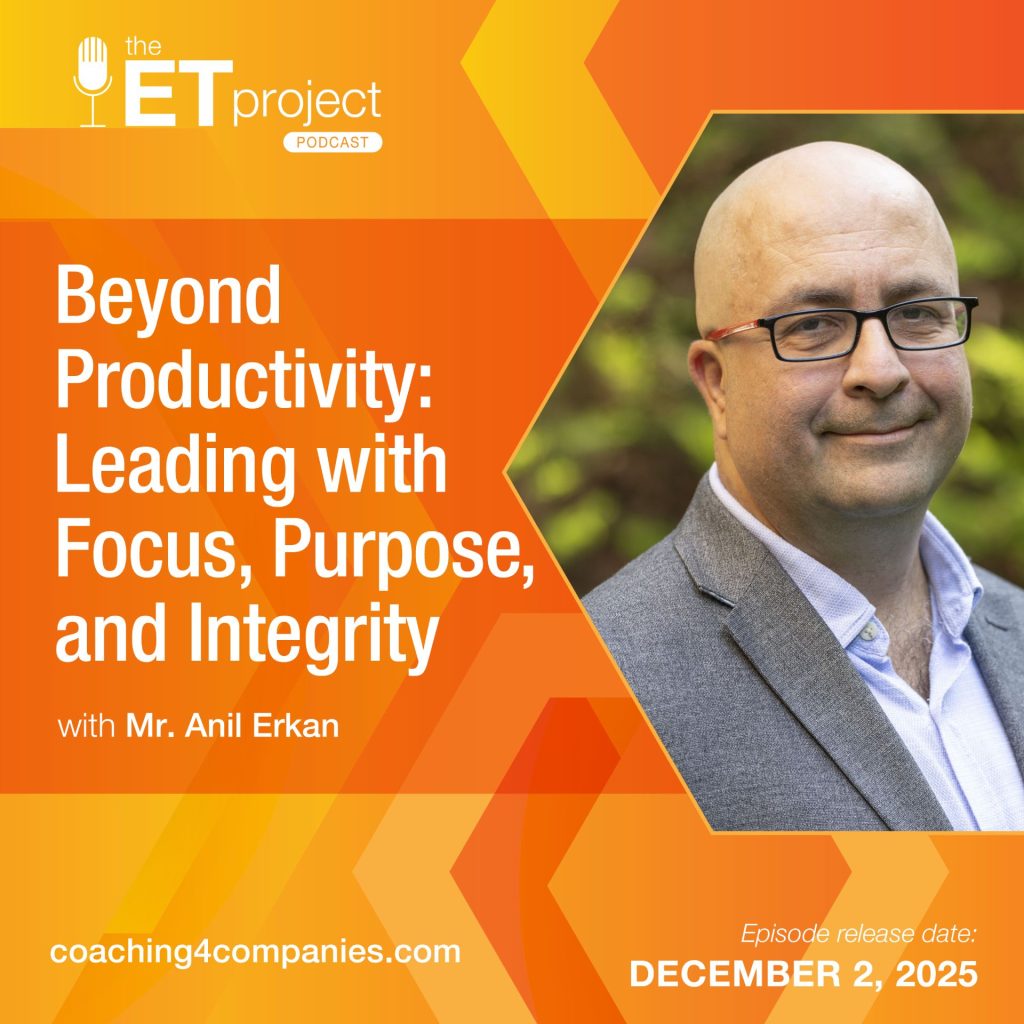
WAYNE BROWN: Hello, I’m your host, Wayne Brown, and welcome to the ET project. We’re delighted to be delivering this podcast for executive talent all over the world, whom we’re affectionately referring to as ‘Team ET.’ Today, we’re back in Lisbon, Portugal, and chatting with Gestalt coach, Anil Erkan. Anil has over 25 years of corporate experience, and this includes international coaching roles since mid-2021. His clients include executives from Google, American Express, BP, Mars, AT&T, and other Fortune 500 companies. He has contributed extensively to leadership programs, as well as culture change projects, and voluntarily coaches young talent leaders. With almost 2,000 hours of coaching experience, Anil has a background in internal audit and risk management from his tenure at Arthur Andersen, PricewaterhouseCoopers, and Citibank. His C-level experience includes serving as a chief risk officer at STFA, which is a large Turkish conglomerate. He is an EMBA graduate and has completed programs in Gestalt Coaching, plus executive and leadership coaching. Anil is interested in Eastern philosophy and has been studying Dharma since 2014. And during our conversation, you’ll hear us chatting about how the application of Eastern philosophies, as well as Gestalt theory, influences Anil’s coaching practices. Team, this conversation gives us an opportunity to explore the paths least traveled in our modern society and everyday leadership practices, so it’s definitely worth listening in, I trust you’ll enjoy.
INTRO: Welcome to the ET project, a podcast for those executive talents determined to release their true potential and create an impact. Join our veteran coach and mentor, Wayne Brown, as we unpack an exciting future together.
WAYNE BROWN: Hello team, welcome to this week’s conversation. You know, I speak with so many leaders who feel this constant pressure to have all the answers. They’re focused entirely on the external game, whether it’s the strategy, the P&L, the next quarter, the next great AI tool that’s coming out. But what I’ve found and what the best leaders discover is that the real work begins inside us, understanding the whole you; your triggers, your patterns, your inner voice, these aren’t soft skills, they’re foundational for resilience and the authentic leadership that we need. And I’m incredibly excited, therefore, to explore this with our guest today, Anil Erkan, an expert who bridges the world’s top level corporate leadership and the transformative practice of Gestalt Coaching. Anil, great pleasure to have you with us on the ET project today.
ANIL ERKAN: Thank you for having me, Wayne.
WAYNE BROWN: Let’s jump straight in the deep end. I mean, you have a unique blend of, I think, around 25 years in the corporate world in your career, plus now working as a Gestalt coach, from your perspective, why is the classic command and control leadership model inefficient for today’s complexity and business environment?
ANIL ERKAN: Thank you, Wayne. It’s a very good question to start. So why isn’t it working? When leaders start to go up the ranks, their main focus generally is to go up the ranks, but that doesn’t enable them to really enjoy the journey as much as they think they will. Research now shows that CEOs that become CEOs in the first six months are generally depressed or very unhappy, although they have become CEOs, although they have reached the main goal for the corporate career. So being your authentic self and being happy in your way up should be the way to go, actually. And when it’s not like that, that’s why now it’s not really working for many executives.
WAYNE BROWN: Right, right. And I guess there’s a lot of people listening, our audience is essentially leaders, so I’m sure there’s a lot of people listening that can associate or align with exactly what you’re saying there. Our theme today is really talking about understanding ourselves, self-awareness, understanding the whole you as such. And in a business culture where we’re often encouraged to compartmentalize, what’s the risk for a leader who shows up as only their professional self and leaves the other parts of themselves at the door? What’s the risk there?
[00:05:00]
ANIL ERKAN: Well, so it’s very hard to form trust when that’s the case, because people can see through this very easily. And when we are working with leaders, especially in relation to their teams and how they are managing, not just themselves, but the people that they are managing, trust is one of the main factors. And if you’re only just professional, you will probably lead from a place of authority rather than with an energy of an authentic leader. You might still get results, but it might not be as expected, or it’s just, you might have a good team that has come together, but it’s just from a place of authority rather than your own leadership energy.
WAYNE BROWN: Right. So, it’s definitely not the whole, it’s a portion of you that is showing up, and therefore you don’t have that authenticity. I was reading somewhere about a personal interest that you have around Eastern philosophies and whether it’s Taoism, Buddhism, the Hindu and the whole concept of Dharma, how do those concepts and understanding that interconnectedness or the balance, how does that inform the way that you look at the whole person in your coaching? Or does it? Maybe is a better question.
ANIL ERKAN: Oh yeah, definitely. So, this is, I will need a few minutes to go deeper on this. So, on the personal level, I practice secular Buddha philosophy, that’s how I call it. So, I’m not in a sense maybe religious, but more trying to tame the mind through Buddha’s teachings. This is my personal journey, but if we take it to the corporate side for a leader, the main way that we can bridge Dharma and leadership or the corporate world is that in order to progress taming your mind, you have to see who you are and understand who you are first, which is not an easy journey to do because we have certain values, beliefs and assumptions about ourselves, what we can do, what we cannot do, about life, what success means for us, what ethics means for us. So, there’s all these different layers that come to make us who we are. And when you put all of that together, this constitutes our ego or our identity. And what actually Buddha is trying to tell us is the more you let go of these identities, the more you will be set free or get close to enlightenment. Now this actually was also brought up by Marshall Goldsmith, he’s also, as far as I know, a Dharma practitioner, and as you can see in his work, actually he wrote a book on this, not like Dharma-based, but more corporate-based, which is called ‘What Got You Here, Won’t Get You There,’ and actually, the title says a lot to us. So, basically what Marshall is saying, and which also I like to work on with people is what set of beliefs you had in your junior years or in your first years in the corporate, may have taken you to certain places, but unless you decide to let go of certain habits, let go of certain beliefs about yourself and about the corporate world, you cannot transition into the higher levels. Why? Because it’s now different, before you were more a doer, now growing up, you’re becoming a leader. And when you become a leader, you’re not just doing your career for yourself, you’re managing other people, you have bigger responsibilities. And so, letting go of certain things is necessary in order to succeed actually, but first to succeed inner worldly, if that’s a good way to put it.
[00:10:00]
ANIL ERKAN: I’ll give an example, if a person has become a CEO by their strong communication, like they know how to talk, they know how to have a good speech maybe, and maybe they really command the room when they’re in a meeting, in the boardroom or somewhere similar. Now, let’s consider this, let’s say some executives are doing a presentation to the CEO and the CEO says, “have you considered this other option?” What we will see in many corporations is the executives will take that as an order or as an agreement for that option. So, what I’m trying to say is what that CEO… like, maybe for the CEO, it’s just a normal question, maybe they are just really asking a question, but a good CEO, a good executive or whoever, needs to understand that their position as CEO has a different, you’re not just an executive asking the question now, your questions have different weights.
WAYNE BROWN: Yes.
ANIL ERKAN: So, if you are a person that likes to communicate and likes to talk, when you’re CEO you really have to be self-aware in when to talk, when to not talk, and when you talk, what to say and how… is it coming from my identity, from my ego, is it really necessary? This is why Buddha says, if you’re going to give feedback to a friend from your Sangha, you know, Sangha is the people that are on the same path in Dharma. Ask yourself, is it really necessary? Will it really help them? Will it really take them forward? If not, don’t say anything. So basically, what Buddha is preaching here is, be wise, don’t just talk for the sake of talking. And this is also valid for executives. As an example, I mean, I came from the example of the communication, but the higher we go, the more we know ourselves, the wiser we can become. And that makes the difference because if I know myself, then I can intervene to my decisions or intervene to what I could be doing versus what I really should be doing. And I can go deeper on that, but yeah.
WAYNE BROWN: There’s many aspects to what you’ve just shared there, we’ll probably touch on some of those, I guess, as we go into the conversation. But one of the things I know about Gestalt psychology and I guess Gestalt Coaching is the present and the being, and I guess to a large extent, that’s what you’re suggesting is we need to be more present in our mind, in our thinking, in our communication and not sort of just doing what we’ve always done, so to speak. We have to make the transition, which is quite an easy thing to say, but maybe not so easy to actually execute when it comes.
ANIL ERKAN: Yeah, very hard to execute, actually, yes.
WAYNE BROWN: Yeah. Let’s dive into Gestalt, maybe the psychology, first of all, before we come to the coaching, I don’t want to go too deep into it. But people may have a limited understanding of Gestalt practices, how would you best introduce, what is Gestalt psychology or theory and how does that come into your coaching practice?
ANIL ERKAN: Yeah, so in terms of Gestalt, actually what we’re trying to do is we’re trying to look at the person as a whole and this might include all of their feelings and whatever they are experiencing in that moment, so that is the main basis for us. So, if we can understand holistically where this person is, what this person is experiencing, then we can go deeper on that.
[00:15:00]
ANIL ERKAN: So, for us, the feelings, how the body is reacting and all of these start to become very important. Because when, let’s say, I’m upset at something, there is definitely some kind of connection to the body, like I’m going to tense up somewhere. If I am very used to that, I might not really recognize that I’m tensing up, but if I work on my self-awareness and my presence, I will be able to say, “oh, I am tensing up, something is bothering me, something is getting to me.” And in our coaching sessions, we try to uncover these so that we can go to the root of it and see what’s going on and how this can be taken forward. But one word of caution, of course, Gestalt coaches, we are not psychologists or therapists, I should underline that. As a coach, in any kind of coaching, our main aim is to look into the future. As far as I know, therapists, they are also more interested in the past and dissecting the traumas. But for us, it’s more about what’s happening now, what’s the person feeling now in this moment and how we can take it forward. And that’s how it connects to Dharma, actually, because also in Dharma, what’s happening now is the main thing, because other than that, the past and the future in some fashion are non-existent, actually, there is only the now.
WAYNE BROWN: Yes. And is there a core ideal or a principle within Gestalt that the whole is different from the parts or the sum of the parts? Is that also at play here?
ANIL ERKAN: Yes, actually, the sum of the parts can be different, but… yeah, definitely, it can be different. But in order to look at the holistic picture, this is why we try to understand the feelings and how the feelings are having an impact on the person. Now, when I explain these, people are like, “well, how do those feelings relate to my professional development or my…” But those feelings are making us do or not do certain things, they are impacting us in different ways.
WAYNE BROWN: Yes.
ANIL ERKAN: And so how I communicate or how I don’t communicate, maybe I close down, maybe I talk more. So, everybody has their own way of looking at it. So, what we try to do is, in terms of Dharma or Gestalt, et cetera is we try to segregate with the person to not to become enslaved by their emotions, by their feelings, actually. Now, this doesn’t mean we’re trying to negate their feelings or push them away, feelings they will always be feelings, but how it impacts us defines everything. So, you could have the potential to get upset when somebody says something in a meeting, but if you can get that feeling and park it for 10 seconds, then you can reply to that person in a calm fashion, but if you are getting swept away by those feelings, I call it ‘The Autopilot,’ you will probably say something from what your identity will make you say in that moment. So, some people, they will reply very harshly, some people will shut down. So, I’m not saying replying from the automated place is bad, but it’s not under your control, it might not turn out to be a bad thing, but it’s your automated structure that is giving the reply, basically. So, you’re not in control at all. So, if we can get awareness to that in our sessions, the person in those moments can have the ability to catch themselves and say, “oh, this is coming and I have to park this.” But it takes time, of course, it’s not easy.
[00:20:00]
WAYNE BROWN: Yeah.
ANIL ERKAN: To explain is also not easy, but it’s easier, but also to practice these takes a long time with the mindfulness techniques, meditation, you know, coaching is just a part of that.
WAYNE BROWN: Yes. If I understand correctly now, you’re essentially saying that we need to become more intentional with our action, our behavior and being able to manage our feelings and our thoughts so that we can behave in the way we want to. With our students in one of our programs, we talk about the fact that we all have a choice. So, every situation we have a choice on how we’re going to respond, that is, whether we have that within our control to be able to make that choice, or as you said, we just act on autopilot and our response is automated. And then we’re at the whim of the automated response, that habitual response that we have.
ANIL ERKAN: Exactly.
WAYNE BROWN: In many cases, we have to unlearn before we can learn the new way forward. And another thing you mentioned earlier when we were talking about presence, if I visualize a leader in today’s world, they’re surrounded by this complex environment, it’s busy, there’s a lot of uncertainty, there’s a need for people to be looking to the future, constantly planning, whether that’s strategizing, whatever it might be, how can you help them pull back to stay present and rather than constantly just be looking ahead or looking behind, how can you guide them to maintain that presence when they need to?
ANIL ERKAN: Yeah, I generally tend to pull them to the present depending on the person and depending on a little bit their situation, et cetera, but there are different approaches that are to be used. So first of all, we have to work on and discuss with the person so that they understand that just looking at the future is actually very painful, because when you’re just looking at the future, you’re missing what’s happening today and, in these days, in these moments. Now, of course, this is very paradoxical because people are like, “well, I have these goals, I have these objectives from my board or from my CEO, how can I forget about them?” We don’t forget about them, but we don’t get enslaved by them. So of course, we will have goals, but in order to reach those goals, we have to first understand what are the things that I can do with myself or with my team that can have an impact on those goals, but we all have to understand, nothing is 100% in our control. There are so many examples, everybody… it’s very obvious, but our egos, our identities always make us forget this. Something will happen in the big markets, in China, in US, like tariffs, when I think six months ago, eight months ago, just tariffs came into the picture and everything suddenly changed.
WAYNE BROWN: Yes.
ANIL ERKAN: I was called by a CFO in China, actually, and her life changed because of tariffs. How do you manage that? How do you take, you know, because they’re a big international company, also present in China as well. It was a very big, huge… so, you can do all these things, but then something like that can happen. So, the only thing we can do is we can do what we can to the best of our abilities and we can still work hard, but not get enslaved. If the world happens, it happens. Now, of course, corporate world leaders sometimes don’t like to hear this because they want to control the end result, and that’s what we’re doing.
[00:25:00]
ANIL ERKAN: Okay, we’re concentrating on today, but if we get enslaved by it, this is going to stress you, this is going to make you do things, you’re going start to force things, and that is going to take away your clarity of how you see things. So just to reach that goal, you might do all these different things and damage many, many different stakeholders, processes, or everything. So first of all, we have that discussion. We have to first, especially for the Western mind, the Western mind is a mind that first wants to understand. So, once we can get the understanding and then if we can get the person to apply these concepts in their normal lives as well, not just the workplace, then it starts to settle in easy, in a much more easier way. So, if they are willing, I teach them meditation, where we will practice with journaling certain concepts, depending on what we’re really working on. And it’s very much an iterative process after that, so they go, they… the first maybe six sessions or something are more in preparation and getting into an understanding and the structure. And then after that, in the real world, they face certain things, maybe they made mistakes or they do it right, whatever, and then we dissect them together, you know, keep them on course, keep them going in the right direction.
WAYNE BROWN: In Gestalt Coaching…
ANIL ERKAN: I hope that was clear.
WAYNE BROWN: Yeah, sure. I was just trying to visualize or recall in Gestalt Coaching, you use a cycle of experience, is that one of the methodologies that you use in Gestalt Coaching? And part of that is to find closure, is that correct?
ANIL ERKAN: Yes, yes. It starts with the sensation or the feeling in the body. And then there’s an awareness and then there is an action, we take the action. So, if let’s say I’m in a meeting and somebody says something nasty. So, I feel a warmth, maybe I’m getting angry or frustrated, and so, oh, I am… I get the awareness that I’m angry or frustrated and then I have to do something, so I will take action. And if I say something and I make contact, it might be to my satisfaction. So, if my need is met and then I disengage from that, how do we use that is we try to see where they are stuck, basically. So, let’s say somebody said something in the meeting nasty and I got frustrated, but I didn’t take action, I closed down. So, then we understand that maybe we need to talk about what happened to close the person down. And so, I might ask them, so we will dissect it together, but I might ask them to journal on it or, you know, so we go deeper on that, try to really understand why the action was not taken, or maybe… so it could be in any of those stages really, but generally the sensation can be there, the awareness is not always, it’s really interesting, people are surprised by this, but you might just feel something, like many feelings have different layers, so you might feel frustrated or angry, but it could be fear or you could be jealous, but you don’t really understand that it’s jealousy at that point in time, so that is also very, very crucial. So, what we think we feel might not be really what we think it is and that takes time to master for ourselves. So, like when somebody says something nasty, am I getting frustrated and angry because they said something bad? Or am I getting angry, frustrated because I have fear that the meeting will not go as planned or it could be both, of course, very combined and mixed up.
[00:30:00]
WAYNE BROWN: Right.
ANIL ERKAN: But if you just say it’s one and disregard the other, then again, that’s also another issue as well.
WAYNE BROWN: In many ways, I guess it’s like identifying blind spots that we have about ourselves, so you’re helping people to see that bigger picture and understand themselves more deeply through the practice.
ANIL ERKAN: Yes, exactly.
WAYNE BROWN: Right. Is there a typical awakening or awareness that you see with many of the leaders that you work with? Like, is there one or two more common areas that people tend to find or is it very, very broad? Those blind spots.
ANIL ERKAN: No, it’s not really broad, actually, there’s a couple of things. Yeah, there’s a couple of things. So one is, as I was mentioning, they start to become aware that they cannot control everything, which is another stressor, but also a relief because when they understand that they cannot control it, it doesn’t feel good because that’s the main driver, but it’s also a relief because like, okay, if I can’t control everything, then maybe a little bit of the responsibility is lifted off their shoulders, so that’s definitely one. Many executives, they understand the importance of feelings because for many it’s just, oh, there’s no feelings, we just work, we get things done, we, you know, we boom, boom, boom, we go for it. But actually, the feelings are the human element as well, so when your team has a certain feeling to see that, to understand that, to read into that and to talk and communicate, not just to reach the goal, but also just to be a proper team, to have trust, to have that connection, those are what makes it valuable and important. So, people start to understand this, especially in the Western world. Now, why I say this? Because Eastern world, you’re in China, so you might maybe relate to that, Turkey is a bit of a mix, but like, as far as I know in China, in the Chinese culture or in the Eastern culture, especially in terms of hierarchy, if you tell someone to do something, generally they would do it, even if they’re not really sure how to do it, they will try to do it, but in the West people will be like, “how? You didn’t tell me how to do it, you have to tell me what should I be doing.” So, it’s a very important distinction, actually, the cultural differences as well. So, although the majority is the same, we are all human at the end of the day, there are certain things like that, but those are the main awarenesses, feelings and they’re getting caught up by the end result, the control factor, yeah.
WAYNE BROWN: Right. I’m a very pragmatic person, so I like to try and apply the things that we talk about. So, I’m thinking while you’re talking, is there a simple technique that a leader can use or a question that they can use to check in with their own awareness, when they’ve catch themselves in a moment, let’s say they’re in a meeting and you’ve spoken about different scenarios in meetings, is there a technique that they can apply to really check in on their own awareness about how they’re feeling at that moment?
ANIL ERKAN: Yeah. So, there’s a couple of things that I would recommend anybody to do, leaders or not, but it works for everyone. So, in order to increase our self-awareness, we need to practice. It’s a muscle, we can think of it like a muscle. So, at the end of each day, initially I would start off with basic, very simple journaling questions. Now, when I say journaling, people who are watching or listening, you don’t have to understand it as pages and pages of writing and writing and writing, so at the end of each day, I would write down what felt good today, what didn’t feel good today; it can be just two or three sentences. And then at the end of each week, I would write, how did this week go?
[00:35:00]
ANIL ERKAN: Was I able to do my leadership as I wanted to do it? Not in terms of the tasks. Was I the leader I wanted to be this week? So, every week you write about this, you reflect on this. Now, why is this important? Because there’s two aspects to it. So first you are strengthening your self-awareness, okay, that’s great. But the other one is, especially the second one I mentioned, it gives you the intentionality, the intentionality is very, very important. So, intentionality and self-awareness go hand in hand, you have to be the leader you want to be. Like if you want to, I’ll use a very simple example, if you want to have a disciplined gym routine, every week, every day, you have to have the intention to say, “okay, what can I do today to go to the gym?” If you’re not doing that, then… like putting it in your calendar is not enough because your mind will find ways to evade that or something. So, this is what you can do individually. But getting an accountability partner, well, maybe the word accountability might be too strong for certain cases, but what Marshall Goldsmith has, which I love to use as a tool as well, is the power of questions. So, you find someone, preferably a close friend, because they will also be doing a lot of work, you give them a set of questions that you’re going to be working on and depending on the frequency of whatever you’re doing, they call you at a frequency, let’s say every day.
WAYNE BROWN: Yes.
ANIL ERKAN: So, they call you every day at the same time and ask you that question and the questions have to be structured as, “did you do your best?” So, let’s say I am going to try to set a routine to go to the gym three times a week; Monday, Wednesday, Friday. So, Monday, Wednesday, Fridays, my friend calls me and asks, “Anil, did you do your best to go to the gym?” Now, why is it, “did you do your best?” Because the mind is, if we say, “did you go?” and the person didn’t go, it just creates guilt and it just creates a deviation from that. So, we don’t want guilt, we want the person just to say, “yeah, I did my best and I did go, or I did my best, but…” I don’t know, “I had a flat tire and I just couldn’t make it on time,” whatever. But we want the person to try to go rather than to go initially. Now let’s take this and apply it into the corporate world. Now, it is not going to be easy to do in the corporate world, but you can still, for certain aspects, do it. You can also get someone to… or you can, if you have that self-discipline, you can also do that with yourself and like every day, as I was saying, every week, answer those questions for yourself and hold yourself accountable, which is not very easy. Or you work with a coach, et cetera, et cetera. I mean, you need external help maybe. But those are the… I hope are practical enough, I don’t know if that was what you were looking for, but.
WAYNE BROWN: Yeah, very good, very good, thank you. Some of what you were talking about, I know you have a term, ‘Awareness Intelligence,’ is somewhat what you mentioned related under that term?
ANIL ERKAN: Yes.
WAYNE BROWN: I guess most people are familiar with the term emotional intelligence, awareness intelligence is a different aspect or it comes from a different angle and that’s why I was asking you, is what you were talking about related to awareness intelligence?
ANIL ERKAN: Yeah. So, awareness intelligence, I like to talk about that in terms of understanding at the end of the day, or was I aware today? It’s really hard to be a hundred percent aware all the time, it’s not really possible for even the best of us. Like it’s very hard, because the way we are structured doesn’t really allow that to be, but if I can make this my priority to be aware.
[00:40:00]:
ANIL ERKAN: So, this is why when we were first, me and my wife, we were first starting off in Dharma, we would have certain stickers everywhere around the house so that everyone would see it; oh, okay, to be aware, like I go back to my awareness. So how do I do that? Actually, a good way to do it is to go to the body, to connect to the body as much as possible, because the more you have a body awareness, the more you are aware actually, because why? The body is always in the present moment, the mind goes back and forth between the past and the present. But basically, the more self-aware you are, the more awareness intelligent you become, actually. So that’s why I like to use it. Emotional intelligence word I think was used initially by Daniel Goleman, I don’t know exactly why he put it like that, but I think it was much more easier for people to really capture, this was I think twenty-seven years ago when the book first came out. But actually, if you go deeper on Daniel Goleman, you’ll see that all of that theory is also based on Dharma actually. So, he was one of the people that brought meditation and Dharma actually to the US from India or China, I’m not really sure. But yeah, so awareness intelligence is related to the strength in self-awareness actually.
WAYNE BROWN: Thanks for clarifying that, I wasn’t aware that there was a connection, so that’s great.
ANIL ERKAN: Yes.
WAYNE BROWN: One of the things that I’m thinking and many of our listeners are probably thinking to themselves, this all sounds a little bit too soft for my bottom-line-focused everyday job, how do you make that hard business case for leaders to invest in this type of experiential development if you like for themselves?
ANIL ERKAN: Yeah, that’s a very good question actually. So, let’s take an example from an investment decision to be made. So, let’s say the person I’m working with is a CEO and two people will be making a presentation and they will both be presenting two different investments, potential investments that the company can do and the CEO and the C-level, his/her direct reports are there to listen. Person A during the first investment presentation has been in the company for a long time, 10 years let’s say, is very well known, is known as a successful person in their field and has already managed different investments that were successful. So, this person has a very good positive image. The second person has been in the company maybe for a year or a year and a half. I mean, they’re not new, new, but they’re relatively new, relevant to the other person. There’s nothing, no negative image about this person in the company; they’re hardworking, they’re quite good-performing, but they’re not as positively known as the other person. So, research shows us that even if the second person’s investment, which is numerical, right? Numbers talk. Even if their investment project is better in many factors numerically, the CEO and the C-level people will be swayed by this person’s past into going with that decision. The only way you can really capture yourself to not fall trap to this bias is when you’re deciding on this and making this decision, if your self-awareness is strong, you will catch yourself leaning towards that person. If you can catch yourself, then you can say, okay, guys, I think, you know, yes, we’re leaning towards person A and… because there will be all kinds of company politics, when you choose person A and even if it doesn’t go well, you have a way out, you can say, well, this person did so many projects, it was like the first time, it’s easier to defend, the second person it’s harder to defend.
[00:45:00]
ANIL ERKAN: So, that’s why when you are self-aware… now, does it mean that the second person’s project will be as successful as the first one’s? We don’t know. But decision-making, it’s of course a whole different area, but one thing I do know about decision-making is that a good decision is made only with whatever information we have at that point in time. Generally, good decisions are weighed in afterwards according to the end result, they’re like, oh, we made the wrong decision. Well, maybe not, at that point in time, the information that you had was this decision. But in this example, the information that you had in this moment, it should have been person B, but you got your emotions, maybe your own career plans and your values got in the way and you’re leaning towards person A. So, this is how it is very much connected to actually concrete results, because you cannot really separate yourself from these situations. Like, in sports as well, if Michael Jordan is playing bad and you need to take him out of the game, you need to take him out of the game, if you don’t take out Michael Jordan, nobody can say, “Oh, why didn’t you take out Michael Jordan?” But if you’re a good leader, you’re a good coach, then you do take out Michael Jordan because he’s not performing.
WAYNE BROWN: If a leader was to take away just one thing from our conversation about understanding the whole you, the whole self-awareness concept and topic, what would you want that to be? If they could take away just one thing from our conversation.
ANIL ERKAN: Self-awareness, I call it the main pillar, not just for the corporate, but let’s stay with the corporate, because this is… if you are not self-aware, the probability of being a good leader is very low. Now, it doesn’t mean you won’t be successful, but you won’t be a good leader, a good leader is where someone is followed by their people because of the things they do and they don’t do, whereas you might be getting results, but it doesn’t mean you’re a good leader. So, the main takeaway would be is to always invest in your self-awareness, always invest in that. Because knowledge can take you to a certain level, but knowledge… if it was the case, we would all just watch all the YouTube videos and do all the courses online and everything would be done. So, the main difference is the emotional regulation and the emotions and how it defines us. And the answer to that is if you’re not aware of what’s going on, that knowledge, it’s not really going to be… you’re not going to have the ability to use it, that’s why it’s so fundamental.
WAYNE BROWN: Very good. Where can people connect with you, Anil? If they want to learn more about what you’re doing and the good work that you’re doing, where can people go to follow and connect with you?
ANIL ERKAN: Yeah. So, in terms of the corporate world, my company with my two other partners, Paramita, it is paramita.com.tr. On an individual basis, they can also go to my name, last name, anilerkan.com.
WAYNE BROWN: Perfect. Anil, a great conversation and thank you for being on the ET project, I really enjoyed it.
ANIL ERKAN: Thank you for having me.
OUTRO: Thank you for joining us on the ET project, a show for executive talent development, until next time, check out our site for free videos, eBooks, webinars, and blogs at ‘coaching4companies.com.’
[END OF TRANSCRIPT]