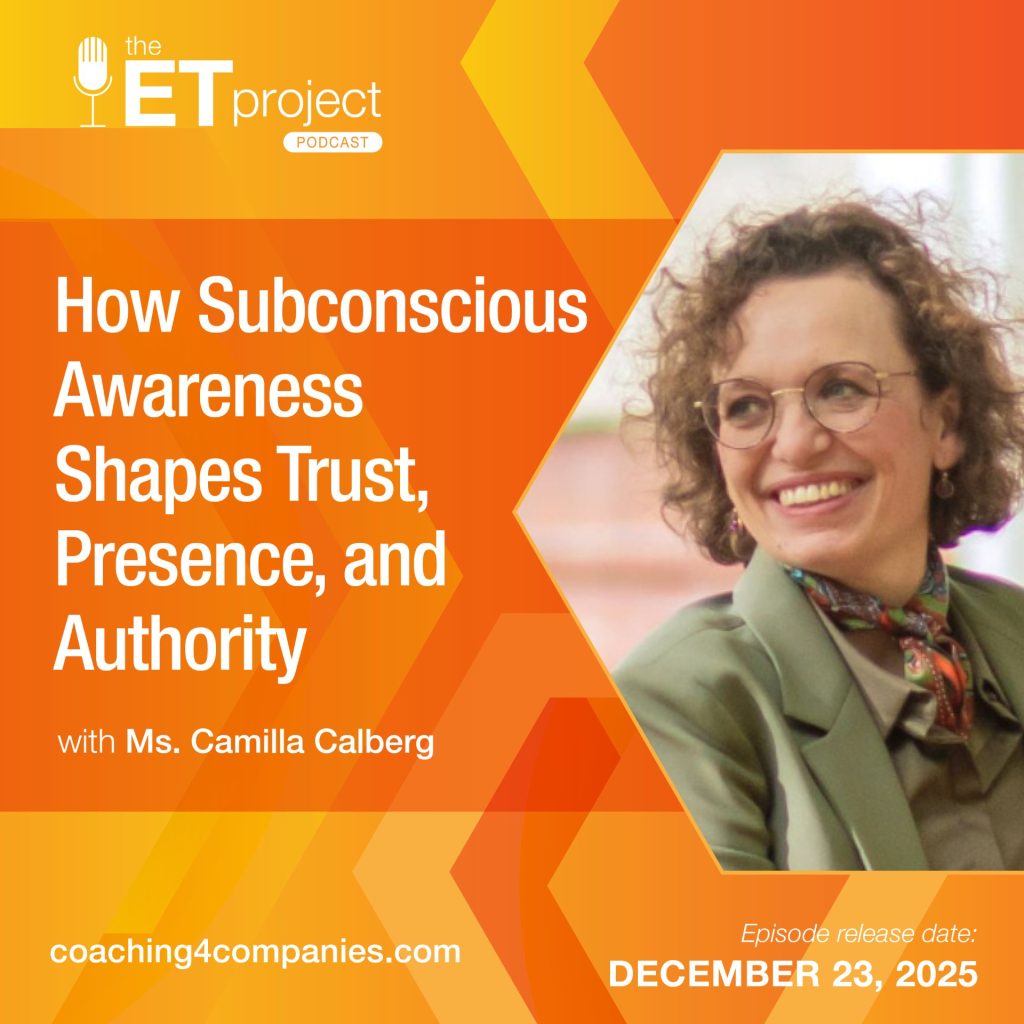
WAYNE BROWN: Hello, I’m your host Wayne Brown and welcome to the ET project. We’re delighted to be delivering this podcast for executive talent all over the world, whom we’re affectionately referring to as ‘Team ET.’ Today we’re flying into Copenhagen and chatting with Camilla Calberg, an experienced transformational coach. Camilla has worked as an experienced corporate advisor for BP, Shell and IBM, leading large scale transformation projects, helping these companies to build market platforms and their employees to embrace new working processes. Since 2016, Camilla has been an independent advisor to the pharmaceutical industry through Calberg Consulting, taking on communication and interim leadership positions and advising on leadership best practice. In all these roles, she has delivered and achieved major change. Having discovered that divorce is the second highest stressor a human being can experience, Camilla has devoted her life to being a full-time coach. From 2020, she has been helping business leaders navigate their turmoil that’s associated with divorce and can threaten and disrupt their professional existence, teaching her clients what she herself has enforced successfully and has been coaching leaders for years, telling them the same thing over and over again; stop hiding and start showing up as the real you. Team, this conversation gives us an opportunity to understand topics such as subconscious awareness, mindset shifting, as well as giving yourself permission and space to pause and think. It’s a great reminder on the importance of shifting to being intentional and making conscious decisions. I trust you’re going to enjoy.
INTRO: Welcome to the ET project, a podcast for those executive talents determined to release their true potential and create an impact. Join our veteran coach and mentor, Wayne Brown, as we unpack an exciting future together.
WAYNE BROWN: Hello, team, and welcome to another week’s conversation. Today we’re going to be diving into what I believe is a really interesting topic, and it’s the hidden force that is shaping almost every one of our decisions, our reactions, and it even is having an impact on our career trajectory, it’s our automatic thought pattern. It’s often invisible, it’s ingrained in our mental scripts, if you like, and it fuels self-doubt, it can silence some of our best ideas, and it keeps us playing small in many cases. So, the question is, what if we could disrupt that thought pattern? Our conversation with our guest today is going to explore how we can break these cognitive loops and try and unlock greater performance, even our authentic leadership, as well as our professional freedom. So here to guide us through this transformative process, I want to say I’m joined by Camilla Calberg, a former corporate advisor for giants such as BP and Shell, I believe, Camilla. You’re now a transformational coach, and you’re specializing in helping leaders, especially those going through a profound personal crisis, to stop hiding and to start showing up as the real powerful leader that they are meant to be. So, Camilla, welcome to the ET project, I’m looking forward to our conversation.
CAMILLA CALBERG: Thanks very much, Wayne, for having me. I’m super-excited what it’s going to unfold when we’re together.
WAYNE BROWN: You have a fascinating background, you led large-scale transformations, as I mentioned, for giants like BP and Shell. Was there something that really stood out as a consistent human challenge when trying to get employees to embrace that new way of working?
CAMILLA CALBERG: I love that question; it’s always adapting to change. My whole career took off when I joined BP and then I went to IBM and then to Shell, Shell and IBM, I can’t remember, but it started off with BP. Before anyone was talking about change management, and I was responsible for the whole of Europe, merging, buying up companies, so many brands. But getting everyone to follow one brand, that was one identity, then we had to take on a new identity, that was one challenge, but a bigger challenge that really got me to knock on the door at the headquarter, and I happened to end up in a very important right-sizing, which was that nobody really… I don’t think understood, but maybe acknowledged.
[00:05:00]
CAMILLA CALBERG: One thing is that transformation looks easy to implement on paper, but we have with human beings, we have emotions, we’re emotional. And I started saying, we need to do something, not change management, right? But I just saw the challenge. And I think that’s what we often forget, is that even though we have big change projects, the one who is leading that… oh, my body is responding now because I had so many cases, they may still be very emotionally impacted. We expect so much from that leader, but if that leader has to downsize a team with 50% or more, he is emotional as well. And that’s what I started to pick up and started to create a one-to-one relationship to how to coach you through this. And I ended up breaking some of the most uncomfortable messages because they couldn’t do it themselves.
WAYNE BROWN: Was there a pivotal moment for you that you realized, I’m preferring working with individuals than doing it at a corporate level? Or was that not the case?
CAMILLA CALBERG: Actually, I haven’t even thought about it, but I just knew… I could see that… first of all, as we’ve all said, just do it, but they didn’t do it. So, I had to understand, why don’t you do it? And that’s why I understood… it got to really under the skin and that’s why I’m so passionate about showing up to serve and being offensive. Because when you do that, they tell you, “I’m too vulnerable, I’m too hurt, I’m too emotional delivering this. Can you help facilitate?” But you only get to that level when you are really in the one-on-one. So, I think that’s why I started to balance both the group and the [Inaudible 00:06:55] and then building trusted relationships one-on-one.
WAYNE BROWN: And the audience by now have picked up on your accent, where are you sitting? Which country are you in and where are you from?
CAMILLA CALBERG: I’m not in Australia or US, I’m based in Denmark, but I worked out from UK for most of my career, yeah.
WAYNE BROWN: Okay, very nice. Now, you’ve openly shared, and you don’t have to talk about it, but I’ll put the question there, discovering divorce as one of life’s greatest stressors was also a key catalyst for you. So, could you explain that a little bit more if you don’t mind?
CAMILLA CALBERG: Yeah, no, absolutely. So, this is really interesting because one of the biggest stressors is actually divorce; death, and then divorce. And it happened also, my dad was passing and waiting wound, I now learn, is a bigger stressor than the death itself. So, I experienced all three, but that of… I had a conversation recently, when you go through a divorce and this divorce was not a divorce I couldn’t have imagined. I mean, I normally say, “I’m in bed with the enemy,” because a couple of years ago, I chose to decouple, a few months later, he opened a court case. I didn’t know that and he opened another one. So, we are starting the whole thing again. But in that moment, and it was really interesting, I’m doing this really four and a half years short, but I ended up in court discussing energy. Energy is contagious and energy travels. And in that conversation, I secretly and silently was thinking, how on earth do I have to spend so much money and end up in court on something very different, discussing energy with lawyers? And all this to say, it was so deep, the conversation, so impactful at the same time. If I did not learn to regulate myself, I would never learn to reset my daughter. My body is responding now, this is so deep. I had no choice but to learn to recalibrate my thoughts, to get my thoughts in the right order, even though… I’m here, “victimhood, ugh.” But that doesn’t work, if you want to have more joy in life, if you have responsibility for kids, you got to really want to create a bigger life. And in this way, she was… psychological abuse and what we have. She had, from a very young age, wounds, emotional wounds. I was the one to reset her.
[00:10:00]
CAMILLA CALBERG: So, that’s what kickstarted my personal development journey, and now women are coming in who have been emotionally abused when they were kids or abandoned by their mothers, their moms. And I just know that if we don’t heal from a young age or don’t heal our wounds, we will always carry those wounds within us. So that divorce has become a double blessing. Finding my true calling, I’m here as a channel to help other people regulate their emotions in the moment, read the emotions in the body. What is a fear? Destroy that fear and tap into a greater version and a better reality.
WAYNE BROWN: Yeah. There are so many rabbit holes we can go down with that particular discussion, but I couldn’t help think while you were talking there that going to a court is a very strange place to go for a change management lesson, right?
CAMILLA CALBERG: Oh, yeah.
WAYNE BROWN: If you like, let’s jump into our core theme, which is about disrupting our thought patterns and the court probably was a nice segue in that regard. But if there’s a high-achieving leader listening to our conversation right now, they may be thinking, well, my thoughts are what got me here, they kind of stick me in good stead and take me forward. How do you work with people like that to help them see that it may be those very thoughts that are actually holding them back right now?
CAMILLA CALBERG: I would say that most of my coaching and mentoring and sessions together with my clients is about what we believe to be true oftentimes lies. And I say to new clients, new people who come into my world and my clients, I say trust me and I trust you and trust me back. But if you believe more in your own thoughts than me, you will never move your needle. But here’s what I learned from court and the personal development is a high-achieving individual leader, person, we have all this love language, woman, man, “I see you, because I’ve been there,” but we believe because I think there’s still a lot of education to be done in the neuroscience world, that we believe more in our thoughts and we want it to be the reality. But those thoughts are often the memories based on the past. Why it’s sabotaging your own success or my success is that… also, at times when we procrastinate, if we believe a thought to be true and it keep us stuck or go backwards, then it’s time to feel why you believe that thought to be true, destroy, pick a better thought and move forward because that fear is a lie.
WAYNE BROWN: It’s one thing to identify it even if we can get to that point, but then I find it’s an entirely different situation to be able to break it and to move forward from it. How do you deal with that situation?
CAMILLA CALBERG: That’s a good question. So, I can’t remember if it’s Deepak Chopra who says… or definitely Dr. Joe Dispenza, but the thoughts are the language of the brain, the feeling is the language of the body. The first step to break a thought is to feel, feel what’s going on in your body. Because oftentimes a thought that is disruptive or disrupting where you want to go… And I tested this so much in my circles, we tend to, Wayne, the shoulders get tight, we get pain in our cheeks, I kind of get too vague when that fear is showing up, the heart contracts, that is the body telling you that something… you get to slow down. That’s the very first thing… Be aware, that’s intuitive leadership, intuitive listening. Listen to your body and be curious about, what is that pain about? Some of my clients before delivering a keynote, not keynote on stage, but on stage too, to the CXO team, they could suddenly be out of breath, almost like… what do we call it in English? But fainting. So, we have to work with that chakra. What is that? That’s power to truth. Speak power to truth. Like, “I can speak.” So, we get to be curious about that. And then is that a situation, a story, that we get to heal, to de-story, get out of the body, and then move forward?
[00:15:00]
CAMILLA CALBERG: But the body is so wise, it sends us a lot of signals, but we haven’t learned yet to listen to them. But this is a good conversation now to have that new tool, just listen to your body. Be curious, what is really going on?
WAYNE BROWN: And I love these discussions. I hope you don’t mind, I like to play devil’s advocate a little bit.
CAMILLA CALBERG: Yeah, absolutely.
WAYNE BROWN: But in the sense of, you mentioned people walking up on stage, in that moment, how can we educate or help ourselves realize that it doesn’t have to be? So, we can get ahold of that subconscious thought in that stressful moment and change it to something more conscious.
CAMILLA CALBERG: I love that, and that is so important. Before any stressful moment… I don’t know where we’re going right now, but this is so important. Because one thing is who we are right now, but who do we really want to be when I go on stage? Who do I want to be when I’m on that stage? Like, before we connected to have this amazing conversation, I would set myself up, “I’m going in with Wayne, I’ll have the most amazing conversation.” So, I would prep myself up to be in that next frequency. So before doing anything that matters, always connect with that next version of you. If you’re new to this, then do it the day before, connect with some fears so we can work through those fears, so destroy some of those fears. But like five minutes before, just really manifest, “I’m going on that stage and I’m here to serve. I’m not here to be lied, but I’m here to serve with integrity and I know that this is going to be the most amazing conversation (or keynote) I ever delivered,” that is how I prep my clients.
WAYNE BROWN: Yeah. You used a phrase that I like a lot because emotional intelligence talks about self-awareness. You talk about subconscious awareness, which I love that distinction because it really forces us to think self-awareness is really understanding our thoughts, our beliefs, our feelings, all of that whole gambit, it’s not just self-awareness as a generalization.
CAMILLA CALBERG: Oh, yeah. I’m so glad you picked up on this because exactly, self-awareness and self-consciousness is really how do I show up in this moment? How do I feel? And what do I… I really love how you just… again, the intro is like, these invisible faults, the stories that I tell myself and that’s why… if I believe more in myself than in you, so I have to surrender if I want to have a better life, but that’s where we want to be, the only way to a greater life in all aspects, not only money, but freedom. I mean, going from divorce and the toxic divorce, I can tell you when negative energy was feeding my body to letting go and have so much more space in my body. And the first thing is to be aware where we’re leaking energy or where our focus goes. And so, remove those faults because… just create more space in the body.
WAYNE BROWN: Right. Another thing that I read that you say is, “stop hiding, start showing up as the real you,” what do you mean exactly by that?
CAMILLA CALBERG: That has to do with masks, we wear so many masks. We oftentimes wear masks to please and end up being a doer, and especially people who play with the power. I hear so often from women, “but I thought he was in control, I thought he knew what he was doing, because he showed up, but he didn’t know.” So that was a boomerang. So, if we want to create more success, also in our own lives, also in our own body, to have more space, the way forward is to bring all of you to the table and you, and I teach them, and sometimes I’m very thought-provoking, you are not in that room to be paid for doing something, you’re in that room to serve. You’re not in that room to be liked, you’re in that room to serve the other person.
[00:20:00]
CAMILLA CALBERG: And I say, remove your ego, we all have ego, because the ego disrupts our success. I can’t think because… I had another client say, “but I think about the result, he does not want the result.” But how do you know the result is right? Because then you’re not present in the conversation.
WAYNE BROWN: Yeah.
CAMILLA CALBERG: You cannot have the result because then you… actually, results come from the past, it’s not created. So, be so honest and bring all of you in the conversation, show up with integrity and not… when we go into that level of details of integrity, that’s all… so, not everyone is on integrity, and be authentic. So right now, you’re… and it sounds so easy, but they’re super scared when we train. I say, “just call them out.” I say, call them out with love. So, right now, I can see you’re frustrated, why is that? But you get to really come from that place of, I see you, why did you say that? That’s being authentic, that’s being all of you in that room. If we don’t serve or you don’t call out, what I’ve been trained to believe and believe to be true, that I do a disservice if I ignore what I actually think will stop you from achieving your goals.
WAYNE BROWN: Why do people have masks in the first place? Is it purely ego-driven or is it a fear? I guess there’s many purposes behind it.
CAMILLA CALBERG: That’s a big, broad question, but I can say what I know to be true, it comes from childhood and I think it also comes from our parents, that’s a generational construct that we have been taught to respect authorities, that can be one of them, respect. And also, just smile, pretend that you’re not emotional, because, at least when I was brought up, emotional is like crying, but we’re not taught to read our emotions and honor our emotions in a healthy way and we want to have that. It was that job security, we want to have that job, so, just smile and just do it. I just think that time is very different now to actually… it’s time to not show up and cry, but honor your emotions, how you feel. And then that’s why you are being triggered, but honor that emotions. But I think it’s from childhood, from conditioning, and from… when everyone else is happy, I’m happy too. There is this social construct and people at work don’t really see you.
WAYNE BROWN: Yeah. Do you ever encourage your clients to try and find an ally in the room or somebody that they can feel has their back or is in their corner? Just to give them that inner courage that they know they’re not the only one in the room that’s going to be adversarial or taking this stance, does that approach ever work?
CAMILLA CALBERG: I’ve used it myself, but then for so long I’ve been self-employed and under my own brand, so I haven’t really applied that tool so often. But what I oftentimes encourage my clients to do is to schedule an important call or call me five minutes before they go in or 15 minutes before they go in so I’m in their pocket to help them out, that’s how I do it.
WAYNE BROWN: Yeah. How long it takes to make this cognitive reframing or rewiring, if you like, of the neurons lasting, so, we can do it once, but we know that doing something once is just a step, it’s not necessarily the permanent end. So, how long would we have to practice something like this to be able to rewrite that subconscious habit to a new approach?
[00:25:00]
CAMILLA CALBERG: Oh, that’s good. And I’m on this every single day, rewriting or upgrading, let’s call it upgrading because we are upgrading our identity. So, just tapping into Dr. Joe Dispenza’s work, we think between 60,000 to 70,000 for today, so we have a good volume to work with, right?
WAYNE BROWN: Yes.
CAMILLA CALBERG: But I would say if you’re coachable, just the awareness in the coaching session can say, “damn, that’s why I’ve been playing small, I no longer want that. What do I do next time? How do I practice that?” It can be that fast, because they do it, they want to upgrade who they are, those who are not willing to be coached or less coachable and putting in the reps and do that work, it can take longer time. But the awareness and the commitment to, “that’s why I played small,” and then being vulnerable in the coaching, “I’m done playing small, I’m done. I can feel that fire within me. I’m no longer that woman.” It can go that fast. But then it’s the reps, we have to remind ourselves, like, “who am I today? Who am I when I’m seeing that?” It’s not just when you are in the room with me and then you go up, you have to put in the reps yourself.
WAYNE BROWN: Yeah.
CAMILLA CALBERG: But I’m seeing clients doing the reps and they get promoted every three to six months and being considered as one of the very few leaders with high EQ. So, it can go very fast when building your personal brand, when you just show up and dare to lead, really.
WAYNE BROWN: There’s another area which often brings people unstuck and that’s the dreaded feedback. So here we are, we’re making great progress, we’re changing, we’re learning how to break our thought patterns and then we come along and it could be a performance review, it could just be a water cooler comment, all of a sudden, somebody is giving us some negative form of feedback and it’s, “oh, here we go, I knew it was all just fake and all of my hard work, it’s all unraveling.” What do you say to people with the feedback coming?
CAMILLA CALBERG: Oh, I love it. And I just did a video on that, actually, on what field we plug into. I think feedback can be… we don’t give it any meaning, it’s just information. And use that information to set you up for more success. But in the moment, that’s subconsciously the negative feedback, you already have an attitude that that is negative feedback, it is negative and then you can… it only destroys you. Whereas say, why do you give meaning to that? How does that serve giving meaning to feedback? And what if you flipped the perspective and it’s complete silence, because they don’t know what… they’re in their emotion, flip the perspective, I don’t know, what do you want? But that’s so fast, we can break feedback as set up for success and thank you and use what is useful and discard what is not, and that’s it.
WAYNE BROWN: Is there a simple daily practice that we can put in place that can fight in our own awareness, our subconscious thinking awareness and help us to break those patterns?
CAMILLA CALBERG: I want to share what I do, every morning I connect with who I want to be in the moment or today. And I have here, on my wall, there’s five levels of motivation. And the highest level inspired by Dr. Joe Dispenza is having a purpose, when we don’t have a purpose, we often end up in this loop and it can be really negative. So, the morning practice, tap into why you are here. Why are you here? That’s what I do, tap into your ‘why?’
[00:30:00]
CAMILLA CALBERG: Because then suddenly it becomes so important, it’s not just you going to work or clock hours, you have something, an important mission, that’s at least how I do it. Every time I know what to do, the three most important things, that’s a 10X mindset. When I don’t do something, when I procrastinate something, be curious about, why do I not follow through? What is that fear? What is it still that I… am I not invested in this? Do I not believe enough in this? That’s how I learned to connect with those deep, deep subconscious structures or patterns that still run me and we all have those subconscious patterns. But when we connect, we’ll be curious about why did I not follow through on my most important goals? What was it? And then be proud of you. Connecting with those thoughts, not judging, but connecting. And then at night reflect on how far you’ve come, what you achieved, your wins and say, “I’ve got another day tomorrow, how do I want to show up tomorrow?”
WAYNE BROWN: There is a three-question set that works in so many environments, I can imagine it would work in that environment; What went well? What should I stop? What should I do different tomorrow? Type of thing. Do you practice journaling by the way? Just out of curiosity, are you a journalist?
CAMILLA CALBERG: Yeah. I’m a journalist, I journal, I meditate. Due to Dr. Joe Dispenza, he has an abundance that is so powerful, his abundance. I spend about two hours in… but more on the meditating. But I journal in the morning and sometimes in the evening, I don’t always get to journal in the evening because I’m too tired. But I learned by Regan Hillyer, do you know her? Regan, about emotional hygiene. So, if you brush your teeth, you also reset your emotions. And when she told me that, I cannot not reset my emotions because I want to have emotional hygiene. So, if I don’t journal at night, at least I connect with my vision and my purpose before I fall to sleep.
WAYNE BROWN: Yeah, it’s an interesting, Joe Dispenza, of course, very famous and well-read around the world. But the whole concept of purpose, I feel, recently is starting to get, the word itself is starting to be taken for granted and we’re starting to lose the value it brings. And I have a guest coming up in a couple of weeks, actually, she uses a different word, but with the same reasoning and meaning behind it. So, all of these buzzwords that are really prominent at one stage run the risk of becoming overlooked because it’s too cliche or all this type of stuff. But I’m happy to hear that you still refer back to your purpose as a reset tool or preparation for you in the morning as you go into your day, I think that’s a very powerful approach.
CAMILLA CALBERG: Otherwise, I would slip. If I don’t tap into my big purpose, my big ‘why?’ then I can be really busy, but it’s not really fulfilling my soul. So, when I learn to always connect with my purpose and under that purpose, training with Dr. Joe Dispenza and 10X mindset, there are three steps, there are three things you have to do and then suddenly that’s why you find motivation. But it’s interesting with your reflection on purpose, I think many people don’t really… there’s many different meanings, I don’t want to give it any meaning, but there are many different meanings of purpose, but to me, the purpose is my life’s calling, yeah.
WAYNE BROWN: Yeah, very good. Camilla, where can people connect with you if they want to find out more about what you’re doing and get closer to the conversation?
CAMILLA CALBERG: Thank you for asking. So, people can find me on LinkedIn, Camilla Calberg, I think we are one or two, we are very easy to find. And my website, camillacalberg.com, there’s a few free courses, you can book a consultation if you want.
[00:35:00]
CAMILLA CALBERG: And people can also go… I think there’s a few things on Instagram, but I drop videos and super-short trainings on YouTube, it’s Camilla Calberg. So, there’s different ways to get closer into emotional intelligence and authentic leadership. Yeah, it’d be amazing to welcome them.
WAYNE BROWN: Yeah, fantastic. It has been a great conversation, we could have talked for hours around this because we’ve really just jumped onto a couple of points, but thank you for being on the ET project, it has been a wonderful time.
CAMILLA CALBERG: Thanks for having me, Wayne.
OUTRO: Thank you for joining us on the ET project, a show for executive talent development, until next time, check out our site for free videos, eBooks, webinars, and blogs at ‘coaching4companies.com.’
[END OF TRANSCRIPT]