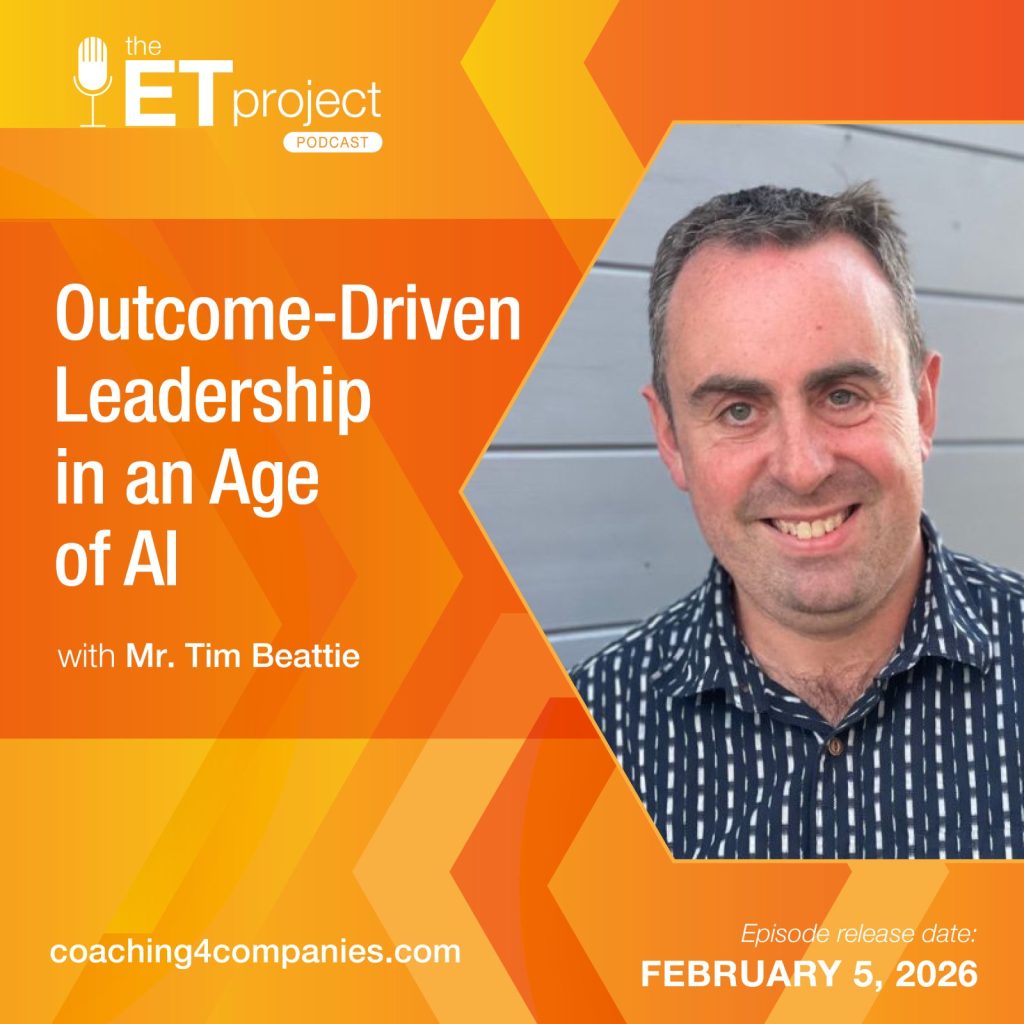
WAYNE BROWN: Hello, I’m your host, Wayne Brown, and welcome to the ET project. We’re delighted to be delivering this podcast for executive talent all over the world, whom we’re affectionately referring to as ‘Team ET.’ Today we’re flying in to Dubai and catching up with our guest, Mr. Tim Beattie. Tim is the co-founder of Stellafai, an outcome coaching platform and operating system to connect product sales and customer success teams. Tim advocates for changing traditional consulting models, which he believes are broken. Instead, he envisions a shift towards enabling services where asynchronous coaching empowers teams to become self-sufficient and continually improve. He has over 20 years’ experience driving transformation at global organizations, having consulted at PwC, IBM, Deloitte and BAE Systems before serving as the global head of product at Red Hat Open Innovation Labs. Under his leadership, Stellafai has disrupted the consulting model and enabled boutique consultancies to scale and help technical teams in the cloud infrastructure space articulate and accelerate their impact through measurable outcomes. Tim is the co-author of the bestselling book, ‘DevOps Culture and Practice,’ and a sought-after speaker who regularly shares his insights on why transformation initiatives stall and how being outcome-focused can unlock lasting change through keynotes, podcasts and thought leadership platforms. When he’s not driving outcomes at Stellafai, Tim is either with his family and his black Labrador or chasing miles in marathon training, proving that he never stops running towards progress on the track or in business. Team, this conversation gives us an opportunity to glimpse the future, not only from a consulting or coaching perspective, but for all businesses. And for leaders, it’s a great opportunity to bring clarity to your thinking on subjects such as AI, I really hope that you enjoy.
INTRO: Welcome to the ET project, a podcast for those executive talents determined to release their true potential and create an impact. Join our veteran coach and mentor, Wayne Brown, as we unpack an exciting future together.
WAYNE BROWN: Hello, team. What does it mean for you when we talk about giving advice, whether it’s through coaching, consulting, guiding, particularly in an age where artificial intelligence now has the ability to draft a strategy before we start breakfast, right? I’m sure we’ve all been there, where business complexity is really beyond a simple diagnosis anymore. And one of my favorite topic is longevity and the concept of a career that’s now stretching 60-plus years. The old playbooks are just not being updated, they’re being totally rewritten in my view and I’m sure Tim, as our guest, will have a discussion around that. But I want to say welcome to all the listeners and our conversation today is really about the near future. You could say it’s the present, you could say it’s one year ahead, we’re going to project maybe even five years ahead. So, over the next 40 or 45 minutes, we’ll explore how two twin professions, consulting and coaching, are being radically reshaped. And where we’re moving from delivering expert answers, we’ve probably moved for a while now, but we’re looking at the Human-AI symbiosis, or if you like, we’re looking at quarterly reports differently, where they’re now live strategy dashboards. And we’re talking about coaching in a different frame, where we used to talk about coaching executives for peak performance, we’re now starting to look at stewarding leaders through their 60-plus year multi careers. Thankfully, I’m not going to be having this conversation with you by myself, I’m very happy to have Tim Beattie here with me as we try and work our way through what’s often a very disorientating terrain. But I’m extremely interested in the topic and I’m looking forward to this conversation. Tim, welcome to the ET project.
TIM BEATTIE: Thank you, Wayne. Thanks for having me. I’m really excited about this conversation. I know we spoke before and I think we’ve got a lot of shared interest and passion. So yeah, I’m really looking forward to getting into it.
WAYNE BROWN: Why don’t you start by just giving us a brief background? What have you been doing? What are you doing now?
[00:05:00]
TIM BEATTIE: Yeah, sure. So, my background has been in consulting for just under 25 years. I’ve worked for Big Four consulting like PwC, Deloitte, I’ve worked for IBM a few times, I’ve also worked for more niche boutique small consulting companies. And I think I’ve been on a journey about learning better ways of delivering professional services. In my first 10 years I learned a lot about, I guess, suboptimal ways of delivering big systems, integration and transformation programs that took years and years to deliver any value. I stumbled upon more modern agile ways of working around 2005, 2006, which was [Inaudible 00:05:49] years, I loved it, and that to me was definitely an improvement. And then in the sort of 10 years that followed after embracing business agility and lean and DevOps and other approaches like that, I still felt my consulting services was all about doing and not so much about enabling and that to me didn’t quite wash true with me. In 2017, I got hired by Red Hat to help build a new function, all about innovation labs and the focus was about enabling high performing teams inside clients and not making ourselves so sticky and ingrained in clients that we can never leave. So that was another step and I loved the services I delivered there, I absolutely loved it. It just felt so rewarding to not just leave behind a deliverable or some technology, but to leave behind high-performing people just felt really rewarding. And that has really been my focus in the last few years, I started my own company three and a half years ago, Stellafai. The focus here is really around enablement around outcomes and create everything we do in services around outcomes and finding new ways to deliver. And like you said in your intro, everything is changing with digital content, AI, so finding new ways to deliver coaching and consulting services, but with much more of an enablement focus and absolutely anchored around customer outcomes, which has got to be the center point of everything that we do.
WAYNE BROWN: Yeah, exactly. If we look back at consulting, coaching, in the past, I feel like our value proposition that we would use or put forward to our clients was pretty clear. I mean, we’re there to support, to help, and to guide and sort of bring value, right? But as we’ve spoken about already, things have shifted, is there an element of that old style proposition that has now become obsolete? Is there something readily that springs to mind that’s no longer relevant that we used to hang on to?
TIM BEATTIE: I mean, the thing that springs to mind first is the way consulting or coaching is sold or engaged and the most traditional model is you pay for the expert’s time, you pay for time and material. I see how that works, I see how it has worked for a long time, but there’s a little bit of an anti-pattern I think, in a world where time to value is of the essence, delivering outcomes really quickly is often the differentiator between whether an organization succeeds or not, being able to adapt, being able to pivot, being able to learn really fast is so key. Paying experts for their time is sometimes a little bit of a, I don’t know, it’s almost like an alternative because if you think about it, it’s actually in the interest of a consultant to go slower. Ethically, maybe they don’t want to do that, but from a financial reward perspective, it’s actually in their best interest to sort of stretch this out or make themselves more indispensable or sticky and create new problems and I think a lot of that prevailing approach to the way the engagement is set up is not necessarily set up for success, which should all be about delivering outcomes. So, I think that maybe some of that’s become obsolete and we need to find or finding new ways to engage those experts that is in a much more adaptive and outcome-oriented way so that the value becomes a little bit more visible much earlier on.
[00:10:00]
WAYNE BROWN: Yeah. Where we used to bring value through expertise, through exposure to different methodology systems, AI can now do that in seconds. And the question therefore is, what is left for us mere humans, whether we’re consultants or leaders? I mean, do we reach a point, is there a risk where we’ll reach the point where we just can’t bring anything unique to the table anymore?
TIM BEATTIE: Yeah, it’s fascinating, a fascinating time to be alive, isn’t it?
WAYNE BROWN: It is.
TIM BEATTIE: Scary for some as well. I think really good consultants or really good coaches have got a very unique personal skill around communication and storytelling and telling stories about experiences and what happens in a certain situation, I’m not sure AI can get to that level of emotion. I absolutely agree, if you’re interested in knowledge and how to execute a framework or how to use a tool or how to adopt the technology, I see less and less need for a human to come in and spend all that… I still think there is a human aspect to it, but the need is substantially reduced. I think when it comes to learning new behaviors and adapting mindsets and ways of working, there is definitely a level of context that a human coach can bring and a storytelling capability that I think will be hard to disrupt. Of course, the sweet spot I think is going to be the coach that uses AI to amplify their impact. Some of the coaches I work with don’t rely on AI, but they are using it to unlock things that are in the back of their head. They know it already, it’s there, but now it’s almost like reminding them of things or just giving them a different perspective and it’s helping them prepare to be a better coach or is unlocking it, reminding them of a story or an example or a situation or an experience that maybe they wouldn’t have thought of if they hadn’t had a bit of a chat with AI beforehand. So, a huge potential, I think, actually make coaches even more valuable or even more powerful in the content that they deliver and I think for some kind of coaches, it’ll be a real gift. For others, where it’s pure, I just come and show you how to do something, they probably need to be thinking about what’s next or can they adapt their skill set to remain relevant.
WAYNE BROWN: Yeah. Another angle that I often talk about, and I’d be interested in your perspective on this, is that there’s the theory or the method, the T-shaped leader. So, we used to have the vertical being the specialty, so we have our specialty and that’s the vertical, but now there’s more of a requirement for this broadening of skills around that specialty. Not to say we lose the specialty, but we need to be able to have a broader set of skills that surround that so that we can become more valuable and we can solve more complex situations and offer different perspectives, what are your thoughts around that?
TIM BEATTIE: I’m a big fan of that I-shaped versus T-shaped and sometimes they can go one level, the M-shaped, if you imagine the M, having…
WAYNE BROWN: Yes.
TIM BEATTIE: And yeah, I think the leaders of the future need to be very adaptable, kind of very responsive to change. Even if you look in the last five years, nothing to do with AI, but when COVID hit, for example, the organizations that succeeded the most were the ones which didn’t fear the fact that there was suddenly a massive change globally happening. Some of them were able to adapt and say, well, okay, we can’t sell this product the way it was, we’re now going to have to go into this whole new digital technology or we’re going to have to go into this whole new way of communication. And the ones that rolled their sleeves up and said, okay, bring it on, there’s a big change, they were the ones that succeeded. So, I do think those leaders who haven’t become leaders because they were so skilled in one area and that is their thing and only their thing.
[00:15:00]
TIM BEATTIE: I think the leaders of the future are the ones that have had a few balls in the air and consent and responds to whatever the changes or society or the markets are asking for and are able to react quickly and are able to communicate and measure really well and not expect things to fall into their lap the way that maybe their predecessors would have had. But I’ve got a more rounded set of leadership skills that can then just grab whatever the data starts to say they should be doing next because that’s an unknown.
WAYNE BROWN: If we were to bring out the crystal ball a little bit now and just start to probe, maybe rather than speculate, but probe, what does a typical afternoon on a client’s site, maybe in 20… what are we in now? 2025, end of that. Let’s say in 2027, let’s say a year and a half from now, how is it going to be different? What are we really talking about here? What’s the nuts and bolts of this whole conversation when it comes to as we live through this, we’re seeing these incremental changes, they’re fast, they’re happening, but they’re still incremental in terms of implementation. But if we look to the future a little way ahead, it becomes easier for us to see the biggest steps, I think. So, if we were to do that exercise in say 18 months, two years from now, we’re working with a client, we have today’s approach, what does it look like in the future?
TIM BEATTIE: Well, I think the first thing is that it may not be a client on a client site, which a lot of consultants are used to. They think, right, I get deployed onto a client for six months, nine months, a year, sometimes many years. I think that might not be happening because I think more and more organizations are learning to enable internally and to build capability internally. I think the consultant in two years’ time, the successful consultant in two years’ time, will be using real-time data. You said something about live dashboards which I wrote down, in your intro I think, that has got to become such a… because data is just a foundation to so many things at the moment. So, data-driven consulting I think has got to become the thing that wins. So, I think you’ll have a consultant who is looking at the data of their client, is looking at the problems that they’re trying to solve and the measures that they have defined that will indicate that problems are being solved or outcomes are being generated, and they will be using data to guide what their next steps are. I think that the consultant can deliver services on-site as we’re used to, but they can also deliver in other ways. We see how engagement with people has been changing over the last few years, even the fact we’re having this conversation, I’m in Dubai, you’re in Asia, we’re having conversations in a very real-time way, and we’re consuming content through lots of channels like YouTube and Instagram and TikTok and all of that. So, I actually think there’s an opportunity that services will be provided using some of those things and not having to be on-site all the time. And then the third thing, of course, AI, I think where there’s an opportunity to use AI to solve a problem, which is what consultants are doing, they should be solving problems, and we think, well, I can use some AI to help with that problem really quickly and I’ll be able to measure the benefit of it, or I can build a little application. Even now, I don’t even need to go forward 18 months, 24 months, but even now, every day, I’m building a little app that helps with the problem using new platforms. It’s hard because even if I were to go back two years from now, AI has exploded so much. I think that was when I first experimented with AI in my services, it was about two years ago, and now I’m using it to reflect on the services I’ve provided to unlock things in my head, to build apps that I can then use with my clients to deliver solutions to problems faster. So, I just think it’s going to be all of that 10x, maybe 100x in two years’ time.
[00:20:00]
WAYNE BROWN: I’m on board with you 100%. At the moment, I’m building a platform as well, building an app. What I’m finding, though, is there’s still today some shortcomings with technology, and as fast as it has evolved, maybe our expectation of that evolution is faster than what it actually has in application. I often hear from leaders, perhaps they’re caught up a little bit in their legacy world, they talk about, oh yeah, it’s all the next shiny object, but the reality is putting it into practice is going to take years, and there’s some truth to that, I feel. And I’m curious how, with the rapid exponential growth that AI is having, is there a tipping point where that changes as well? And we do get to this fluid state, rather than being traditionally asset-heavy, we’re in this very fluid state of things are all in the cloud, we have very few assets, we have a much greater ability to pivot, demonstrate agility, et cetera. Do you see that as a direction?
TIM BEATTIE: Yeah, definitely. I think that notion that AI is going to replace everything, and it’s this next shiny thing, and there’ll be need for a lot of the things that we do today, I think the core skill, the foundation skill set that’s still going to be required with AI is communication and collaboration and articulation of problems. For me, that has always been the bare bone of a really good coach and a really good consultant, being able to have really good conversation, and we have lots of practices and methods and techniques and workshops that help us drive a great conversation. We now have this new player coming to those workshops, AI, and I think maybe the tipping point is where you’ve got a consultant or coach, a client, and an AI agent almost like a little three-person team, because you’ve got the consultant coach who has got that experience and knowledge and context of whatever the thing is that they’re an expert in, you’ve got the client who has got that business domain expertise of the organization they work for, and then you’ve got this AI who can do things really, really quickly for you. And this tipping point is going to be when the three of you feel comfortable talking to each other in real time and ideating and brainstorming and throwing out ideas and experimenting. That has got to be that sweet spot where we get into that build, measure, learn cycle hundreds of times a day, potentially, and it almost becomes cognitive. It becomes this is the way that we interact with each other, and we’ve got this thing between us that’s our friend and it’s helping us get stuff out of our head and into something that we can see and touch. Obviously, they’ll start with software, and we’re seeing it now with software, I can literally iterate on an app hundreds of times a day to solve a complex problem, but I imagine it will eventually start to end up in robotics and hardware and real products and stuff like that. But the speed of the iterations are just going to get faster and faster, we won’t be working in two-week sprints anymore, we’ll be doing it in kind of two arguments and things like that probably, and we won’t be working in two pizza teams of seven or eight people, I think it’ll be half a pizza between two people on an AI bot to deliver products really, really fast.
WAYNE BROWN: Yeah, for sure. So, we’re in a dynamic, a really fascinating dynamic at the moment where birth rates around the world have dropped significantly, which is meaning we have less people coming into the workforce, and it’s getting substituted or the potential to substitute through technology. But then we have this other end of the spectrum where people are living longer, staying healthier longer, and prepared to stay in the workforce longer, maybe need to eventually. What are some of the areas that they need to be focused on and we as consultants, coaches can help them?
[00:25:00]
TIM BEATTIE: That’s a really good question. I think the relentless focus on value, the relentless focus on inspecting are, am I delivering value? Am I providing value? In the last decade or two, I guess, a lot of organizations have moved to a subscription economy. Think about your general life, you have a Netflix subscription or you have a gym subscription or you have a shopping subscription. And what underpins that? You keep subscribing, you keep paying your subscription if you keep getting value from it. And if you stop getting value from it, after a little while, you’re going to stop that subscription. So, if you think about what have all those organizations done? What is Netflix doing to retain its customers? What it’s constantly having to think about, are we delivering value? And it has to keep continuing improve its technology, its content, its operating model and that’s how it keeps subscriptions and how to keep subscribers and it keeps revenue growing. And I think for anyone in the workforce, it’s almost that mindset needs to continue. So, consultants have got to think about almost like, what if our clients were subscribing to us on a month-by-month basis? Can I demonstrate that I’m delivering value? And that may well change month by month or year by year, what used to be valuable is no longer really valuable coming from a consultant because they can get it from an AI bot, but there will be things that they can adapt into. So, I think that kind of focus on what is valuable for a consultant to deliver in their services? How is that value measured? And can that become almost like the contract with the client? Well, if I keep delivering you value, you keep subscribing to me. If I stop delivering value, I expect you to cancel a subscription with me, just like I cancel my Netflix subscription or my gym subscription if I stop using it or stop getting value. So, I think it’s a mindset thing for consultants to sort of head towards that subscription or at least learn from the subscription economy and think about what is it that works so well for those organizations and can we apply it in this legacy industry?
WAYNE BROWN: That’s a great idea, actually. And I was just thinking while you were talking there, what would be the measures that we would look at for that value? Because it’s so transient, as you said, it keeps evolving. How do we then find a measure that’s going to be useful beyond the next quarter type of thing? Do we say, okay, we have to be so flexible and our value needs to be adapting so regular that there is no long-term KPI or measure anymore?
TIM BEATTIE: Yeah, I think the measure is very context-specific to the organization, but they absolutely should be something that matters to the client. So, if you’re anchoring your services around a measure that matters to your client and you’re saying, right, it’s the equivalent of how many minutes or hours of Netflix content I’ve streamed. But in your context, it’s got to be number of staff that I’ve enabled or the employee happiness score of your organization, which I’m going to try and move the needle. I’m going to try and move that up through the training and coaching that I provided, or maybe it’s a connected outcome that they have with their customer. And I think visualizing that connection or starting to see, join the dots, we’re not saying we contract or we sign up to absolutely hitting those because a lot of those are out of our control. But what we are saying is we’re going to relentlessly focus on those outcomes and those measures. And when we meet every month or every quarter or something like that, let’s review those measures that matter to you because I’m going to try and move those needles, I already know they’re really important to you, that they’re the measures that matter to you. So, if I’m not moving them, it’s either I’m not doing my job, in which case you should cancel your subscription or something has got in the way, something’s blocked, in which case I need your help to unblock that so I can move those needles. So, it reframes the conversation around value to the customer and focuses on the measures that are not valid metrics and I think it’s going to vary from customer to customer. And it’ll be hard to get those, sometimes people don’t know what the measures are that really matter to them, so that probably needs a little bit of work, but, yeah.
[00:30:00]
WAYNE BROWN: Yeah. It almost sounds like there’ll be an advantage in being a small player versus some of the big players that you’ve worked for because it’ll be an easier agility point. That’s not the right term, I’m trying to think of the right way of saying it, but the big firms tend to have the problem of steering the shift and turning the large shift as quickly as what’s going to be needed. And I’m wondering, are we seeing anything from the big players at the moment, the McKinsey’s, the Boston Consulting, all the large groups, are they already starting to show signs of transitioning in preparation for this?
TIM BEATTIE: Yeah, that’s a good question. My experience with those firms is that they are very much on the left-hand side of a traditional plan. They write strategy papers, they’ll set out target operating models, they’ll write big designs or organizational designs, and then they’re not always involved in the execution side of things. That might be a generalism, but it seems to be that it’s sort of definition and design rather than execution. Now, the value of the work that they do is quite a lagging value because there then needs to be a lot of implementation, embedding in, and usually I think that’s when sometimes it either goes to one of the big SIs or the Big Four, and they will command fairly large fees, probably because they’re buying some of the risks. There are so many unknowns and then therefore that risk of unknown is being factored into the price so it can go down to the Big Four, or like you say, it goes to the smaller nimble boutique consulting companies and I think that’s where there’s a lot more adaptive behavior, adaptive culture, the ability to respond to change, less reliant on big frameworks that have served. So, I guess it comes down to the client as to where those relationships are, I can understand why the client likes to buy in a big name because it probably feels safer. Well, I’m not going to get fired for hiring a Deloitte or a KPMG or something, whereas if I get these small guys, my neck is on the line. But equally, there’s lots of stories of huge programs failing and they hemorrhage tens of millions of dollars, sometimes of taxpayers’ money in the public sector. And you think, well, if you had maybe more adaptable and data-centric smaller players that you trusted, then maybe those things would have been at least recognized a lot earlier, if not fixed a lot earlier.
WAYNE BROWN: Yeah, one of the reasons that I do this podcast is because I get the opportunity to get different perspectives from people like yourself and the whole gambit of leadership around the globe that helps me keep my level of broadness about what’s happening. But if I’m an individual consultant or an individual coach and I’ve got my partner AI, that’s great, but when it comes to acquiring the tools, building the apps, all of these things, often they disconnect. So how will we stay relevant and stay current and up to date as the speed of change continues to accelerate?
TIM BEATTIE: And I think the power of community is so important here, where we’re forming community. And I learned a lot about open source communities when I worked at Red Hat. I thought I understood open source but then when I went to work for Red Hat, I learned, gosh, it’s not just about putting your code on GitHub, it’s a whole new way of collaborating and learning and being in a pool of other people’s ideas. I think the coaches and consultants that are going to win are the ones that don’t just think about themselves and know this is, like you said at the beginning, I do, this is my tool and my specialism, but embrace taking time to go and watch other coaches in action, to learn from them, to network with them, to explore the technology they’re using, the tools that they’re using, and almost treat consultants like an open source community that you can fork their code, their way of working and trying their own, you know, and then adapt to get to model your own things.
[00:35:00]
TIM BEATTIE: So, I love watching other coaches facilitate. I pick up little tips, little tricks, even the way they say things or the way they present things, I love setting up the rooms sometimes, so I’ll ask to do that. And then I guess in this digital content world there’s so much content out there, if you can find the right YouTube channels or podcasts, you could learn so much. You know, this is your podcast, for example, this helps other coaches and consultants because you just hear different perspectives and that sets the cogs off in your head and you don’t steal other people’s ideas, you just build on them. And, you know, having that community of people that just, you know, are like-minded, got common values and principles, want to build on each other’s work makes us all just a better community of change agents.
WAYNE BROWN: If I take that to the next step and I think about how we upskill ourselves as coaches, consultants, and if you were engaged by a consultant or a coach yourself at the moment and they said, Tim, I need just one new skill or one new thing that I need to develop to keep me current to keep me engaged for the next one, two years, is there something that you see in the market or you’re seeing evolving that you would recommend that people get involved in or understand?
TIM BEATTIE: That’s one of those, it depends, I’m sure. I guess it’s like everything, what is your baseline? Where are you now? And that would probably then highlight what you want to change. I suppose, back to AI, right? If you’re not using AI at all and you’re against the idea and you think AI is not for me ever, I imagine that’s going to become a challenge. So, I would definitely encourage, and I do encourage people to start playing with it, just chat to it, just download these apps, try these things out. Not for any specific output, but just to sort of stay involved in that and just have that in the back of your head. So, I think that’s definitely something that you cannot ignore and if you haven’t stepped into that world, I definitely encourage just to give it a go. So, you think measures are just going to become more and more important. So, if you’re not measuring the impact of what you’re doing, then that is going to become more and more of a challenge because I think organizations are just going to come under more pressure to show the return on investment on expenditure. When you’re spending on consulting and coaching and change, you need to be able to articulate that in terms of measures that are moving in the positive direction. So, I think having some kind of skill to find the measures that you’re going to help move is going to become really, really important. So, measure and AI, together, I think are really important skillsets to learn.
WAYNE BROWN: If I sit here, Tim, I want to learn how to develop a higher tolerance for ambiguity, is there something I can do to really ground myself in the uncertainty that we’re in and not let it become overwhelming? Like, I see so many clients confronted with at the moment.
TIM BEATTIE: Yeah, I think visualization is such an important tool really, getting out of people’s heads and onto a wall, whether that’s in a room together or on a digital wall, I think ambiguity exists because people’s cognitive loads are huge, they’re carrying so much information in their heads. Whether you’re a business expert or a technical architect or a leader or a graduate developer, whatever it is, every day you’ve got so many things that you’re juggling and it gets worse if you’re context switching all of the time. So, I do think getting stuff out of heads, getting it onto the wall with other people around you that you can have good conversations around, using powerful mapping practices and there’s loads of them, whether it’s value stream mapping or impact mapping or domain driven design.
[00:40:00]
TIM BEATTIE: There’s lots of practices that really help get rid of that overwhelmed feeling of gosh, there’s just so much stuff to think about and organizing it structurally in the form of a map. And also, then accepting that some ambiguity still has to remain, we cannot solve everything, so we’ll put a pin in that and we’re just going to focus on this. So, this idea of being able to, what are the two, three things that we’re focusing on? We’ll let the rest of the ambiguity sit there, that’s another day thing, these are the two, three things to focus on and iron out that ambiguity and get better alignment in place for all those things. But yeah, visualization is the key behind all of that.
WAYNE BROWN: I have to wrap up with the classic coaching question, if you could leave our listeners with one single provocative question to ask themselves about their own practice going forward for the future, what would it be?
TIM BEATTIE: I had one of my coach’s mentors once said to me many, many years ago, I was quite junior at the time and I was getting very stressed about the thing I was doing and this guy said to me, “Tim, is anyone going to die here? Come on.” I was taking it so seriously, I was getting so worried about it, and he just reminded me, I guess, of the, come on, let’s just put things into perspective. I said that, I pass it on to so many people because I do see a lot of people get stressed and I say, “come on, we’re at work, we are trying to do a good job, we’re trying to achieve an outcome, but no one is going to die here.” So yeah, I think that’s it, I think it would be just to remain calm and remind yourself of your principles, your values, and do the best you can.
WAYNE BROWN: Tim, an excellent conversation, thank you so much for being on the ET project.
TIM BEATTIE: Thanks for having me.
OUTRO: Thank you for joining us on the ET project, a show for executive talent development, until next time, check out our site for free videos, eBooks, webinars, and blogs at ‘coaching4companies.com.’
[END OF TRANSCRIPT]