[music]
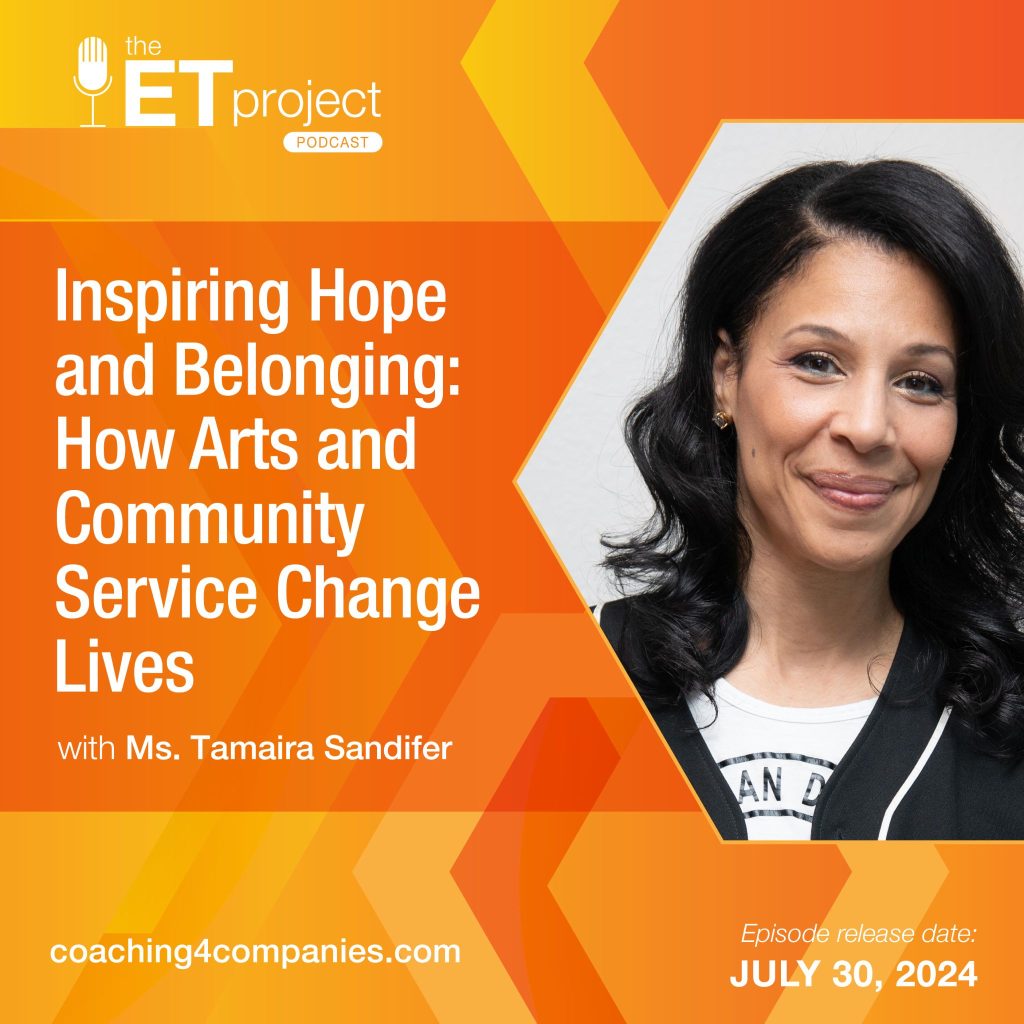
0:00:03.7 Wayne Brown: Hello, I’m your host Wayne Brown and welcome to the ET Project. We’re delighted to be delivering this podcast for executive talent all over the world, whom we’re affectionately referring to as Team ET. Today we’re visiting the capital city of California, which just happens to be Sacramento for the uninformed, to chat with the award-winning entrepreneur, impact leader and youth arts program creator, Tamaira Sandifer. And here’s an impressive stat to get us underway. Tamaira, or Miss Tee as she’s affectionately known, has mentored over 880,000 youths in school districts in underserved communities across America. She does this largely through her Studio T Arts & Entertainment company, where they instill real-life skills, hope and a sense of belonging through groundbreaking programming and diverse educators who specialize in creating avenues for the development of trauma-informed youth and cutting-edge technologies.
0:01:00.8 WB: Tamaira has developed some of Hollywood’s most sought-after young dancers, including the 2016 winner of So You Think You Can Dance, the 2018 World of Dance Stars and members of the Jabbawockeez. Her graduates currently travel the world, performing with stars such as Justin Beiber, Jennifer Lopez, Selena Gomez, Rihanna, Chris Brown, Usher, Beyoncé and Ellen. Her students have gone on to work for the White House and be seen on stages of MTV Music Awards, Nick Choice Awards, BET Awards & more, as well as to defy the statistical odds. As a pioneering champion for pathways through the arts and business, Miss Tee has garnered recognition such as Forbes Cultural 50 Champion, Woman of the Year by California Legislative Women’s Caucus, NAWBO Outstanding Woman Leader and Hub Magazine’s Exceptional Women of Color.
0:01:55.9 WB: Tamaira is also the founder of California’s Day of Dance, a board member of Californians for the Arts, a member of the City of Sacramento’s Race and Cultural Equity Task Force and Chair of Americans for the Arts Art Education Council. Wow, that’s a list and a half, and as you’ll hear during our conversation, Tamaira lives to serve. As a community and a business leader, she’s adamant that this approach ensures you are constantly performing and delivering to your best ability, even when you’re experiencing those tough moments yourself. So team ET, please join Miss Tee and I as we look at what it takes and how it’s possible to become the leader of impact and influence through the support and service of others.
0:02:39.3 Speaker 2: Welcome to the ET Project, a podcast for those executive talents determined to release their true potential and create an impact. Join our veteran coach and mentor, Wayne Brown, as we unpack an exciting future together.
0:02:55.7 WB: Hello, Team ET, it’s a pleasure to be back with you again this week. Have you ever met someone that you’re immediately drawn to, and then you find out more about that person and what they do and you become in awe of them? I’ve had the incredible privilege to connect with some fairly amazing people through my career, as you can see, I’m very gray, so it’s a long career, heads of countries, heads of mega corporations, leading global influencers, and more recently through this business and the projects that we run, and I continue to be inspired and amazed by those people that I meet. And today is another of those moments as we have the opportunity to chat with Ms. Tamaira Sandifer, or perhaps better known to her followers and their supporters as Miss Tee, the founder of Studio T Arts & Entertainment in Sacramento in the US. So, Tamaira, welcome to the ET Project.
0:03:50.5 Tamaira Sandifer: Thank you. Thank you very much. I’m happy to be here.
0:03:54.5 WB: Yes, it’s a real pleasure to have you on. I’ve been blown away in my research just looking at everything that you’re doing. And first of all, I have to say, as a global community member, I just wanna say thank you for the work that you’re doing with young people. Even though you’re primarily States-based at this stage, you’ve recently started supporting youth around the world through one of your platforms, and we’ll talk more about that. But your organization is playing what appears to be such an important role, so thank you for that.
0:04:26.7 TS: Oh, thank you for saying that. We certainly are trying.
[laughter]
0:04:31.5 WB: You probably don’t remember, but during our first conversation, I asked you how you managed to fit everything in that you’re doing and get it all in your schedule. And your response has really resonated and stuck with me. You said, when you’re passionate and believe in what you do, then you make the time to make it happen.
0:04:51.0 TS: You’re right about that.
0:04:52.8 WB: Yeah, and I felt through that simple response that I’ve probably met somebody quite unique. So I was very keen to dig deeper and find out a little bit more about you. But as it turns out, it seems that just by the sheer volume of awards and recognition that you receive, that I’m not the only one that feels that way. There’s many people and organizations that share my view and you’ve been acknowledged at such high levels during your career.
0:05:24.7 TS: Yeah, it’s truly an honor. It’s nice when your peers or when your industry celebrates your life work. It’s not something that we necessarily look for, but it’s definitely something that we’re grateful for when you can get some level of endorsement that says your hard work is paying off. So yeah, it’s pretty cool.
0:05:46.9 WB: Perhaps we could start for the listeners’ sake, if you don’t mind, and you could introduce what Studio T is all about and what you do there.
0:05:54.7 TS: Oh, certainly. So Studio T started as just a hip hop and urban dance academy. And we found very quickly once we started Studio T dance that our kids, especially the kids that we were servicing in more trauma informed and under resourced and tech-starved communities, they needed more than just dance. And so we started adding things. So Studio T Dance became Studio T Arts & Entertainment, and that encompasses anything from definitely the performing arts, we still do a great deal of that, but also media, culinary arts, music, that’s anywhere from beat making to bucket drumming and entrepreneurship. And then we added a social services component because a lot of our kids have to make the very difficult decision, do I eat today or do I by toothpaste? And I just felt like people shouldn’t have to make those sorts of choices. So we added social services to what we do. So it gives a holistic approach to our young people.
0:06:58.0 TS: Not just teaching them talent, but teaching them how to be leaders, teaching them how to take care of themselves, and then teaching them how to show up in their communities and take care of their communities. And once we started to couple all of those things together, we started to see some outcomes that shifted not only the trajectory of our kids’ lives, but also the financial standings of families which impacted their communities, which impacted our city. And so a lot of leadership started to take notice and support what we were doing. But the ultimate goal is truly to invest in the whole child and their parents, so that our families have a legitimate shot at a better life.
0:07:37.8 WB: Wow, truly amazing. I know like many people, including myself, the starting point wasn’t where you are now.
0:07:47.0 TS: No.
0:07:47.3 WB: And perhaps if you don’t mind, you could introduce a little bit about your earlier life as much as you’re comfortable with and how you found your inspiration.
0:07:57.7 TS: Yeah, certainly. Well, a lot of these kids are like the kids that I grew up with when I was a kid. So I’m from a part of California called the Bay Area and that’s like Oakland, Richmond is where I grew up. And those communities I grew up in the height of the crack cocaine epidemic, so we were losing a lot of young people to the drug wars and gangs. And we were losing a lot of our parents and adults in the community who fell prey to the substance of crack cocaine. So they were dying because they were overdosing or over consuming. And so growing up that way, it really created a kind of community that we knew… We didn’t know who was going to show up to school the next day. And so we were very intentional about being protective of one another. And community aunties started to present themselves, community grandmas, not necessarily blood related, but we became our brother’s keeper just to survive the circumstances that we were all forced to grow up in.
0:09:00.7 TS: Just growing up in a community where it had systemic lack of opportunity. So my generation wasn’t the first generation to have the experience of lack by way of opportunity. And so growing up that way, it built something in me that said, I am my brother’s keeper. And I started teaching, and my mom is a single mom, she had six kids. And one of the ways that we were able to stay occupied at something positive was I would teach dance. And so we see what Michael Jackson was doing on the music videos, we would see what Janet Jackson did on the award show and then I would take the moves that they did and I would teach them to my siblings and other kids in the community. And I just became known, even though I was violently shy, I became known as the one who does the dance, and that just kind of stuck with me my whole life. So fast forward a bit in 1999, I was married with two little girls and we were living in a part of the city that you just couldn’t afford to find something nice and safe.
0:10:12.5 TS: We were living in what we could afford, which put us in a really bad part of town. And so we were looking to have a better lifestyle and so we relocated to the capital of California, Sacramento. And I was able to afford to have a home and my kids had a safe place where they could play outside and not be concerned with things like stray bullets. And once I got here to Sacramento, it’s a very conservative city, and so I was looking for some of the culturally rich programs that we were accustomed to in the Bay and I couldn’t find them. So I just started volunteering. I would go to churches, urban housing authorities, community centers, anywhere where people would let me do it for free and work with the kids. And I found very quickly that I had found my niche and I started out at a park. There was four kids and there were my daughter’s friends at the time and it grew very quickly to 30, and then before you know it, there were 70.
0:11:12.0 TS: And we started doing things like competitions and performances, and they started winning awards at international competitions, national competitions, was like, oh, my goodness, we’re onto something. And then they started to break into Hollywood, we used media to leverage the playing field a bit, because our families didn’t have the money to pay for a flight to go to Hollywood to audition, but I could capture a video and send it to a casting director. And so my breakout started working with Britney Spears in the height of her career, Jennifer Lopez, Selena Gomez, Usher and Chris Brown and the list is very long. And then we had a So You Think You Can Dance winner during the peak of So You Think You Can Dance. And so, again, I knew very quickly I was onto something when that started happening back to back. And so when you talk about grassroots, grassroots is, you know there’s a problem. And I teach this to my young people all the time.
0:12:09.9 TS: If you just focus on problem solving, entrepreneurship will evolve on its own. People follow vision, money follows vision. And so I never did it because I wanted to earn a check, that just came. I did it because there was a problem with the kids, and it was the same problem with me and my siblings and my peers as kids. There was a systemic lack of opportunity, but once opportunity was gifted to them, they really took it and started flying with it. And so that told me, okay, you’ve got the recipe now we need to duplicate the recipe so that we can have more little birdies flying from the nest. And that’s what we’ve done.
0:12:50.5 WB: Well, that’s an incredible story. There’s so many tangents that come to mind that we can talk about. I just wanted to mention I wore my Stanford shirt just for you today.
0:13:00.8 TS: I see you. So cool.
0:13:04.8 WB: And a geography lesson for many of the people outside of America, I guess, Sacramento, the capital of California. Now, most people, I’m guessing, would say, if I asked that question to my listeners, they’d probably say LA. Sacramento, right?
0:13:21.5 TS: That’s why I said it, we’re the capital people, baby.
[laughter]
0:13:26.0 WB: So the formation of Studio T came about as a result of everything you introduced. It sounds like it took off very rapidly and now you’re moving into or you already moved into a new building called the Innovation Factory.
0:13:42.7 TS: Yes.
0:13:43.4 WB: Congratulations on that, by the way.
0:13:46.0 TS: Thank you.
0:13:47.7 WB: The journey itself, like all businesses, I’m sure you’ve had challenges.
0:13:52.7 TS: Oh, my goodness, valleys for sure. Peaks and valleys.
0:13:56.5 WB: How do you stay, and probably back to my original comment, but how do you stay motivated throughout all of this?
0:14:03.5 TS: Because none of this is an option. Like none of this, what I’m doing is not designed to motivate Tee. I know why I’m here and I know why I’m doing what I’m doing. And what I’m doing has nothing to do with how I feel, but everything to do with who I am and who I was created to be and how I was positioned to serve people. So there’s nothing that in this that is my motivating factor. I’m the motivating factor for every young person I touch, every parent that I come into contact with. So I keep that in mind. They’re not here to please me;I am here to serve them. And it’s only when you forget that that you expect that there’s something that’s supposed to be inspiring you to do what’s right. And I never ever make that mistake. I do what’s right because I do what’s right, not because someone is doing something or saying something or even acknowledging the something that I’m doing. I’m motivated because I know why I’m here.
0:15:00.0 TS: And as long as I keep showing up every day to be myself in somebody else’s life, it shifts the trajectory of somebody’s life. And that all by itself is worth waking up every day.
0:15:12.0 WB: You introduced very briefly some of the programs that you offer through Studio T. I wonder if you’d go a little bit deeper on some of the things that you’re doing, if you don’t mind.
0:15:22.8 TS: Yeah, certainly. So our performing arts program is all things dance. So it’s not just dance in a traditional dance studio space, it’s also virtual dance classes, which exploded us across the country during COVID. It’s also platform-based, subscription-based performing arts where our kids can learn at home. And we do a great deal with our dance by way of mental health and well-being. That’s one of the things that we do with our families that kind of keeps them mentally and emotionally stress-free and it brings community for us. So, we do a lot of dance. I also founded a dance day for the state of California. So California’s Day of Dance is the second Saturday in April every single year, and that’s another community activator. So we build a lot of community through dance and movement. We also have our media arts program, we have entire media department. So they do anything from videography, photography, graphic design, social media content creation and management.
0:16:24.4 TS: And all of those things really super-helped our young people by a way of being expressive, especially when they were going through really difficult times. So the storytelling piece that comes through media has been just critical for getting our kids on the other side of the pandemic, for getting them on the other side of some of the traumas that they experience is just by living the life that they’re forced to live. And so media has been huge and now we’ve scaled it where we have corporate partners. So now they’re learning entrepreneurship through their media arts. And then I founded a film festival to honor one of our young people that we lost to suicide, the [0:17:03.1] ____ Malola Fest. And so it also gives our young people not just the opportunity to create content, but also have their content evaluated by professionals in their craft that work those shows like the Golden Globes and the Critics Choice Awards and the Emmys and the Grammys and the Oscars.
0:17:18.4 TS: And then we share it with community, people vote on it, they evaluate it. And then we even in our Innovation Factory, we have a movie theater. So we give them the full experience, from creation to preview, to putting it out in the world for evaluation. And then our music arts program, that’s anywhere from beat making to DJing. We have little five-year-olds doing turntables and making their own beats, which is a critical thing if you think about everything that corporate America need when they’re doing content creation, they always need music, royalty-free music or licensed music that they could buy to make their content dynamic. And our kids create that in addition to doing community building events, like parties and pop-ups in parks, I can show up and bring the music and the fun. But we don’t just use technology to make music, they even do bucket drumming.
0:18:08.4 TS: And that’s just like a paint bucket turned upside down with some drumsticks. That’s how I learned and so that’s how they learned and it worked for me. And so that’s music. And then we added our culinary arts program and we did that… Well, technically, it’s called our Meal Prep Academy. It’s because we had a lot of young adults, especially during the shutdown, that didn’t have the ability or capacity to sustain if they weren’t Uber-eating and welcome to McDonald’s, may I help you? And so we had things like meal prep and how to grocery shop on a budget. And so that created a whole program, not just for our young adults, but our littles. So now we’re starting them at a younger age, where they’re so used to swiping and consuming visually. But the hands-on piece is most time parents, especially if you’re in a single-parent household, you don’t have time to teach those things anymore, the times have changed. And so, we come in as a supplemental provider. And then our kids, especially if they’re in a single-parent household, they’re able to help mom prep a meal. So by the time mom gets home, she can… They can all eat together and she doesn’t have the stress, the pressure to just be the only sole person in the household doing the meal prep and providing and it’s easy stuff and the kids absolutely love it.
0:19:18.7 TS: And then we also have a full commercial kitchen on our campus. It’s a very large, a two-story full commercial kitchen. So should our kids show some aptitude in their culinary abilities, they have a pathway to turn that into a career. And that goes the same with our music program. We have music producers that work with anybody from Snoop Dogg and Missy Elliott. And so our kids have a pathway. The same with our dance. The kids have a pathway. So everything that we’re doing by way of programming on site, it’s coupled with entrepreneurship. And then there’s a feeding lane for them to be able to go into a career if they choose. And we have podcast studios. So again, they’re able to produce their own content. We have multiple podcasts. We even have a broadcast kitchen where they can stream their cooking. We have dance studios, multiple. Again, we have a movie theater, banquet halls, rec rooms, you name it. And it’s multiples of everything so that we can really truly service thousands of young people in the course of an academic school year and train the trainers that work with these kids.
0:20:22.9 WB: I’m almost ready to buy my ticket and hop on a plane [0:20:26.2] ____.
0:20:26.8 TS: Let’s go! Well, that’s just Sacramento. We’re in San Diego also, we’re in Fresno, and we’re scaling to Tulsa, Oklahoma. Philadelphia, Harlem, New York, and Atlanta, Georgia. So this thing is pushing its way physically, before it was virtually, now it’s physically popping up across the country and we couldn’t be more excited about just being able to really super serve.
0:20:50.9 WB: Yeah, it’s fantastic. You also have a business or a side, a thing called the Side Hustle Academy.
0:20:58.0 TS: Yeah, that’s our entrepreneurship. That’s Side Hustle. Absolutely. Absolutely. So everything we do, it’s coupled with entrepreneurship, everything. So never teach them a creative discipline without teaching them how to monetize their skill set. So everything has entrepreneurship attached, side hustles attached to everything.
0:21:15.4 WB: And you said monetize, so you have a financial education built into this.
0:21:20.4 TS: A 100%. In fact, today we do summer camps too with kids. And today we did a whole budgeting, the kids earned their money, the paper money. And then we activated, you’ve taught them budgeting. This is how much you have to spend, this is how much you wanna save, this is how you can earn. And so they were able to activate those things. And then again, we have a movie theater. So they went to the movies and they had to buy their own snacks. And you had the ones that, I wanna to spend all my money ’cause I need more popcorn. And then you had the ones that were like, no, no, we’re coming back next week. I’m saving $14. So they’re starting to learn those things. And then for our younger, teenage and then young adults, for them it’s actual stipends. They get stipends when they come with us and they learn things and they’re on the job and they’re assisting us in the day-to-day business of things just so that they can learn, okay, here’s this amount of money, but you’re getting a remuneration for your efforts that you’re putting in. And then we teach them, okay, so now you have choices.
0:22:19.3 TS: You can either rent some space and start building out your own entrepreneurial endeavors or you put this in the bank, don’t touch it. Most often they wanna go get some shoes and eat out and things like that. But we’re constantly grooming them and educating them to think business, to think budget, to think multiplication, to think, how can I take this $600 stipend and double it just by making business cards, putting flyers out and booking clients and using the Innovation Factory to execute some of the learning that I did and make money on it. And we have a hair shop. That’s another thing. So we teach them, they could come in and do hair. We’re dealing with tons and tons of kids and they always need their hair done. We shoot tons of videos, lots of dance shows. They always get their hair and makeup done. So again, entrepreneurship is everywhere, especially as a single entrepreneur, but also in respect to building a team. So let’s say for instance, you’re a makeup artist. You have this, you have a media person, you have a music person, you have a video person, and you have a dancer. So you’re doing this, but all of a sudden you can make this concept video for TikTok promoting the fact that you do makeup. And so all the parts are there. And now they’re working with other like-minded, like-spirited and like-learned other talents. And it’s all under this, the auspice of Studio T Arts & Entertainment. And it’s really designed to create entrepreneurs who win.
0:23:42.1 WB: How much, I know you mentioned technology with or without, but how much is technology integrated into everything you’re doing at the moment, like virtual reality, AI?
0:23:52.1 TS: Oh, certainly.
0:23:54.6 WB: Yeah.
0:23:54.9 TS: Critical. It’s critical. So we use AI quite a bit and we use that by way of the script writing. If you know you’re gonna simplify it, that’s helpful. Document tracking and then thought processing. Sometimes we don’t have the time to do the research required to build the model required in order to execute a new program. AI helps us with that. But we also have other kinds of technology like three-dimensional projections. So we have instructors that can come in from other parts of the country and drop in dimensional form into a classroom and teach kids something from their country. And that’s, again, another leveraging agent for us for cultural experiences. Some of our kids are not gonna go to Ghana, but they can work with someone who’s in Ghana in their space. And they’re not only learning like dance and creative movement, but they’re also learning the technology needed in order to get this person in the [0:24:50.7] ____ auspices with them. And then they’re also learning the cultural norms. They say mate, we say friend. And so they’re learning that it’s still English, but it’s their English and our English. And so technology plays a massive role.
0:25:04.2 TS: Just Innovation Factory like this, we’ve created multiple jobs for young people in IT. Like just getting things wired, making sure there’s a Wi-Fi, troubleshooting, surveillance cameras, broadcast cameras. Tech is so huge. And then doing something like having huge fiber optic pipes that terminate right here in this building just because of the amount of data that we transfer with just our video. And then you think about the cameras and the systems that we need. We have partnerships with Blackmagic and Sony just because technology changes every single day. And then we give our kids, we’re delving a bit into robotics just because of the level of maintenance and upkeep that we have to do around the building. We have to hire people to come in and paint. How come we can’t have robots that can come in and do our painting for us and our kids are the foremen and oversights and the programmers of these painting robots?
0:26:00.6 TS: So we’re delving more into ideas like that so that they get accustomed to their workforce not just necessarily being only human but now being robots, ’cause we’re literally already there. So that’s a teaching that we do. And then, of course, there’s the coding. And they build their… They build… We build our computers, some from scratch, our PCs. So those sorts of things. Number one, it keeps us agile, but it also helps them to develop portfolios that make them competitive when they go to look for real paying jobs. They can say, I’ve had hands-on experience building this. And that’s not normal. Typically, you get internships after college that give you the experience that you get from the factory.
0:26:44.1 WB: You mentioned earlier about a lot of people that have become success stories. In one of my shows, I think we spoke about when we first connected, one of the shows I like is So You Think You Can Dance. And you had some early success with that. I wonder if you could share some of those stories.
0:27:00.1 TS: Oh, sure. So, our So You Think You Can Dance winner is a young man named Kida the Great. And I started working with his older brother and older sister. He was only four years old when I met him. And technically, my sister met him first. And they were outside in front of a grocery store. And his oldest brother is deaf, but he wanted to dance. And so in order for me to teach him, I had to go back to school to learn his language, which was sign language. And so my sister saw him and he had earplugs in his ears, like he was listening to the music and dancing with the music ’cause he didn’t want people to know that he was deaf. And so my sister saw him dancing and she said, you need to meet my sister. And so, shortly after that encounter, they came to my studio and then I started studying his language and started working with him, working with him. And then one day we’re in the classroom and I’m training him, I’m a tough coach ’cause they have to survive in a tough world. And I’m watching in the back of the classroom, everything the big kids are doing, this little guy, this little four-year-old little guy in the back of the classroom is doing, he’s just, he’s not doing anything big.
0:28:03.8 TS: He’s just… But he was well-synced, he knew the movement, he knew what to do with all the different parts of his body. And I said to his mom, okay, you know, everybody’s leaving, class is over. And I said, you need to leave him here starting next week. I need to see him every day. And she says, Miss Tee, he’s gonna cry. I said, he’ll get over it. I’m telling you, you need to leave him with me every day. Every time you drop them off, you drop him off. And then, it was within months. I trained him like I train the 16, 17, 18 year olds and he could take it. And so I said to her, I said, I just want you to know this kid’s special, and I know it when I see it and he has it. And so I would give his brother and his sister assignments, make sure that Kida knows this when you guys come back. Work with him at home. I wanna make sure that… So I gave the family the responsibility of developing him with me. And so he started, we started putting him on the circuit and I was mildly nervous because he was so young. I didn’t want it to corrupt him. He had a genuine gift. And so we started putting him on the circuit and I’m telling friends and colleagues in the business, I say, I got one.
0:29:12.3 TS: Like, yeah, I got one for you. And I remember going through a very difficult time. I was going through a divorce. I was, in 2012, ’13, I had lost my second building. And I was really in a process at a time of restructuring, personally. But I remember not having very much money, but putting everything, every nickel I had into flight tickets for him and his mom to go do this one competition where I had invited a talent scout out because he needed an agent. And so we had to get him to them. And so I put every nickel I had into this kid and his mom to get him out to Arizona. And what happened is what I thought would happen. He blew them away and he got his agent. And then he made a video just sitting in the lobby of the dance studio. It’s him and two other little guys and they’re just passing the wave, you know, they’re waving and passing the wave and somebody just took out a phone and said, oh my gosh, look at these kids. And then he went viral with that one video. And so then at the age of seven, eight, nine he’s just all over the place dancing and performing, him and his two buddies that he met in the lobby of a dance studio. And then shortly before he went on So You Think You Can Dance, his dad passed away. We had a whole epidemic that hit the States called the swine flu.
0:30:39.6 TS: And his dad actually got it and we lost him. And for some people, that could open the door to depression and destruction, but for whatever reason, it made him even more determined to win. And so he auditioned for the show. He had the story to match the time with losing his dad and then being perseverant in his efforts. And then when he got on the show, he did everything, all the different disciplines. Some of them he’d not been trained in, but he earned it. And he showed everybody that he was brave, that he was courageous and he had heart. And no matter what life threw at him, he was gonna fight and win. And he did. And what it did was it didn’t just shift his life, but his mom, single mom, seven kids, it shifted all of their lives. They have a better home, they have a better lifestyle, they have different incomes. They all have jobs as a result of this in the industry, but it started with one little kid. And I won’t take credit for somebody else’s talent, but I will say that meeting him and then having the experience of him and his family, it taught me a lot. That was one of the things that cemented my why, is this family has had blow after blow after blow. They just need some hope. And we got to be that for a season. And it made the difference.
0:32:01.6 WB: Wow, that’s an incredible story. What type of advice would you give to, let’s say, the young entrepreneur who’s looking at trying to do something themselves, start their own ventures? What type of person do you look for? Or what do you have to be? Who do you have to be?
0:32:19.9 TS: Oh, I don’t look for anybody in particular, other than someone says that I want to try a new business, or I want to learn something new, or I want to be a part. I don’t have criteria that we look for. I believe that everybody deserves a shot at whatever their dream is. And so we can help you with your dream. That’s why we’re here. And for some people, their dream is to own their own company and be their own boss. For some of our young people, their dream is to be influencers and YouTubers. And then there’s some that are dreaming just to graduate from high school and make it, they’re happy to be alive and graduate from high school. And so whatever that dream is, our goal, our job, our purpose, our intent is to just get them those tools and the resources, the connections they need to achieve their dream. So again, I don’t look for any specific criteria other than your heart’s beating, you’re breathing and you want to try.
0:33:14.7 WB: I have to ask, do you have any mentors or role models that have guided you or helped you through your career?
0:33:23.7 TS: Yes, I do. There’s one in particular that I like to celebrate and express gratitude for as often as I can. His name is Bill Krause, and he happened to be a local pastor in a city that I moved to when I’d lost everything and was homeless and I met him. And he had some very strong business savvy, and I would tell him what I’m doing. And for the first time in my entrepreneurial life, he made me not feel crazy for the bigness of what I was saying based on who I was at the time. You know, most often people say, you can’t do that, Tee, you’re broke, you don’t have this, you grew up like this. But he never saw me that way. He says, wow, you’re a champion. We should go for it. And he would help me along the way. He passed away two years ago, two years ago tomorrow, he passed away. But before he transitioned to heaven, he really, really poured deeply into me.
0:34:24.9 TS: And it’s anything from business to people serving. He was very, very good at loving people. And so I learned a lot from him by way of, how to forgive when it’s really difficult, how to love when they’re not lovely. And sometimes I work with kids that have been through so much trauma that they’re just so hard and so angry that it takes a special kind of love in order for them to feel loved. And he helped me learn that. So when I think of mentorship, he left lots of videos, books and things like that. So I still study what he’s taught me. And my heart desire is to honor him by living what he taught me. And so I try really hard to do that every day. He was an honorable man and I try to be an honorable woman. He was a man of his word and I try to be a man… A woman of my word. He was a lover of people and a true, genuine servant and I try to emulate that every day. So when I talk about mentorship, he really, truly [0:35:29.9] ____ creased my life. And I hope to show up in the lives of others that way.
0:35:33.0 WB: If people, and I know you have many people around you that would look to you as a mentor, as a role model, if they’re listening, what’s the message you would give them?
0:35:47.5 TS: Never quit is number one. We live in a time of challenge and extreme change, and it’s moment to moment change. And I think that sometimes because of the tumultuousness of the days that we’re living in, it’s easy for people to tap out. So I would say never quit. Number one is recognize that what you live, endure, do with your life, it affects other people. And if we remember that our actions impact, if we can remember that our words change, transform, give hope or help or make people, it can open the door for hurt or depression, if we can remember how important we are to the lives of others, that’s always my advice when someone asks, how can I be a better business person? How can I build a company that makes a lot of, brings in a lot of resources? Serve people, serve people and never mind you. I find that when I’m focused on serving others, that I’m always taken care of in the process. And I think a lot of people that take up positions of leadership forget that. And I’m taught that let he who is greatest among you be servant to all. So if you have some level of influence, if you have some level of higher aptitude in any sphere or capacity, that qualifies you to be a public servant. That means you should be serving others because you have an added gift, added strength and added ability.
0:37:23.5 WB: Thank you for that. Where can people go and connect with you or follow what you’re doing or even get engaged with what you’re doing?
0:37:31.1 TS: Yeah, sure, sure. That’s easy stuff. Okay. So we have websites, studiotarts.org. And then I have my personal one, sweetteetime.com. And that’s where you’ll get a lot of this kind of advice and how to and they motivated, things like that. And then we’re on all the social media platforms. So Instagram, Studio T Arts, Sweet Tee Time, Facebook, YouTube, the handles are pretty much all the same. And then, once you’re on the website, we do ask people if you wanted to stay connected, like we do some, we’d send out weekly and monthly newsletters just to kinda keep people abreast because things grow and change so fast around here. We try to keep people in the loop. So I do ask that once you jump on those websites, sign up for the newsletter so you stay in the know. ‘Cause sometimes we get opportunities that our community and our partners can take advantage of. For example, Chris Brown is coming and doing a concert. So we have a group of young people that get to go and experience the concert. And so… But they only know about that because they’re on the newsletter.
0:38:32.9 WB: Not only young people. I like Chris Brown. Come on!
0:38:36.0 TS: Yeah, okay. Our parents say the same thing. But we always get fun opportunities like that just because of the relationships that we have in the industry. And we can only broadcast it so many ways. And so we figured if you just sign up for the newsletter, we can stay connected and we can give you guys all the opportunities. Like for when the hair shop opened up, we had so many young people, especially kids of color that needed their hair braided for the summer. And they got that free of charge. Normally that’s an expense that costs families a lot of money. And some families can’t afford to do that, but they got it for free because they were informed because they signed up for our newsletter. Oh, can I share something else really cool?
0:39:13.7 WB: Please, please.
0:39:14.8 TS: I just launched my podcast today.
0:39:19.0 WB: Really? What’s it called?
0:39:20.9 TS: It’s called Sweet Tee Time. And it’s on…
0:39:23.2 WB: Okay.
0:39:23.3 TS: Spotify, iTunes, and YouTube. So Sweet T-E-E Time. Yeah.
0:39:31.7 WB: We’ll put it in the link, and I’m sure I will definitely be listening, so.
0:39:36.2 TS: Oh, thank you.
0:39:37.2 WB: Look, fantastic connecting, wonderful understanding more about what you’re doing. And so incredibly inspiring just for me listening to everything that’s going on.
0:39:48.6 TS: Thank you very, very much. We’re always grateful when we get to connect with like-minded, lighthearted people. And that is who you are. Thank you for making this so easy and fun.
0:40:00.8 S2: Thank you for joining us on the ET Project, a show for executive talent development. Until next time, check out our site for free videos, eBooks, webinars, and blogs at coaching4companies.com.