[music]
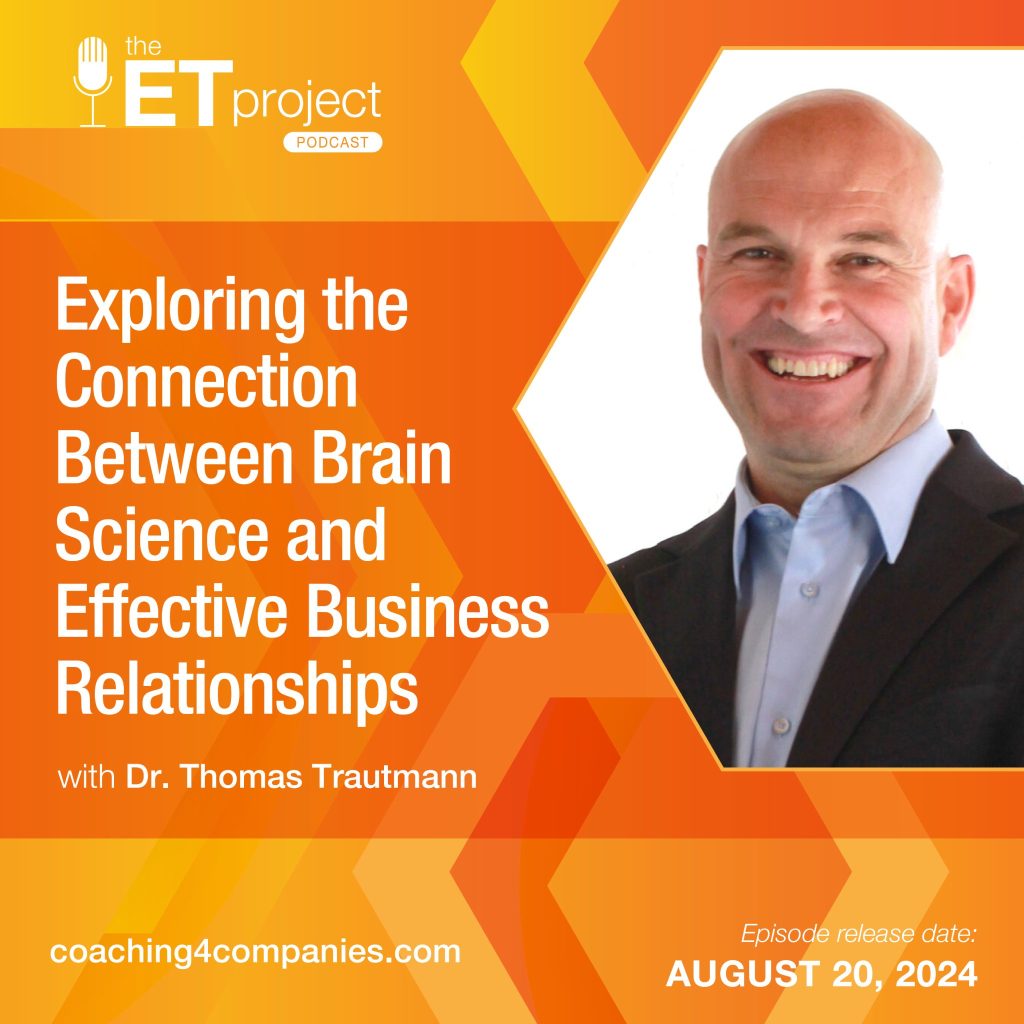
0:00:03.4 Wayne Brown: Hello, I’m your host Wayne Brown and welcome to the ET Project. We’re delighted to be delivering this podcast for executive talent all over the world, whom we’re affectionately referring to as Team ET. Today we’re visiting the beautiful seaside township of St Raphael, nestled in the French Riviera, to catch up with our guest, the Happy Brains founder, Neuro Couple’s creator and author, Dr. Thomas Troutman. Thomas has a real passion for people and their brains, a bit like a zombie. Driven by people’s smiles, he enjoys life with his family, pets, horses and friends. He speaks fluently in English, French and German and started his career as a computer engineer and wrote his PhD thesis working in improving an artificial neural networks model. So team, you may rightly guess where this conversation is heading, but there is a twist. After a while he moved towards the dark side, towards marketing and sales, wanting to be closer to the decision maker, the client.
0:01:04.4 WB: Thomas has worked with major companies like HP, Bosch, AOL, Steelcase, as well as smaller ones before founding his first company. His scientific as well as marketing, sales and strategy knowledge allowed him to get certified as a neuromarketing instructor with SalesBrain. The more he read and studied about the decision processes in the human brain, the more he noticed the differences between male and female brains. After two years of data collection and compilation, Thomas launched the Neuro Couple concept and published his first book, Is There a Brain in Your Couple? With the driving force behind efficient marketing, sales, strategy and relationships being persuasion, Thomas is now leading ethical persuasion strategies and techniques. Team, Thomas speaks a lot in his work about understanding the differences between the male and female brains and how we can leverage the latest neuroscience to strengthen our marriage and business leadership. You’re about to listen to one very interesting conversation, so get yourself ready as Thomas and I explore the impact the brain has on relationships, both private and professional relationships.
0:02:20.3 Intro: Welcome to the ET Project, a podcast for those executive talents determined to release their true potential and create an impact. Join our veteran coach and mentor, Wayne Brown, as we unpack an exciting future together.
0:02:36.6 WB: Welcome, Team ET. Another week, another episode. This week, we’re going to be delving into the center of the nervous system. Yes, we’re donning our neurological caps and exploring some of the functions and the structures of the brain. Now, I know you may well be asking why, and that would be a good question. An unequally good response is that we’re gonna be exploring the impact that the brain has on relationships, both private and professional relationships. We’ll possibly also speak through the eyes of us as leaders, as well as look at some specific roles such as sales and how this all ties together. We’re very fortunate to have with us today as our guest to guide us on this journey, Dr. Thomas Trautmann. Thomas, firstly, welcome to the ET Project. It’s great to connect, and I’m looking forward to what promises to be, from my side at least, a very insightful conversation.
0:03:39.7 Thomas Trautmann: Hi, Wayne. Thanks for having me on the podcast. Really appreciate it. I will do my best to make this as interesting as possible, and as scary as possible, because you’ll see some information, are going to make you wonder why you’re still alive.
0:03:55.6 WB: We were just talking before we get recorded about your city in France, and at the moment, you have some interesting events going on in the background. Hopefully, what’s happening in France is somewhat of an indication about our conversation, I guess. It could be…
0:04:14.4 TT: Maybe.
0:04:15.7 WB: It could be fraught with danger, but we’ll dip our toes into the water and see what happens. So, you have a really fascinating career background, if I put it that way. You started with computer engineering. You then moved into artificial neural networks. I’m gonna find out what that means more in a moment. You looked at neuromarketing, and now you’re happy brains and neuro couples. So, you have a very interesting background. I wonder if you could share with the listeners a little bit about that journey. What led you along that journey to this point?
0:05:03.0 TT: The funny thing is that I always wanted to be an entrepreneur, I think. My dad was a CEO, so I think that somehow that influenced me. And I told someone recently, it was very funny. A few years back, I went to visit my parents, and I found a little figure or something like that that you play with when you’re a child. And that little guy was holding a sign, and that sign was written TIC. When I was a teenager, I already created the Trautmann International Company. That was funny. I always had it in the back of my mind, but I got hooked by computers. I’m 58 now, so I belong to the second wave of computer geeks. I started playing with TRS-80, Apple II, stuff like that. Things that couldn’t even draw a circle without losing all the memory. Very interesting times. I started with that, but my plan was always to build a strong foundation to one day be able to build my own company. The PhD was also a little sidetracked somehow, because I had the opportunity to do it. I think that’s also something based on the decision process in the brain. I think it was part of, decisions are driven by something called a subconscious frustration, or more than one.
0:06:39.5 TT: One of the subconscious frustrations that I had, or still have, I think, is I want to prove that I am better than the rest of the family or something like that, or that I can do at least as good as that, you know? So, I am the first one in my Trautmann family to ever have a PhD so that sticks, that’s checked.
0:06:54.4 WB: There we go.
0:06:54.5 TT: And then I moved back to my corporate life at HP. And HP has the advantage that at that time at least, it had the advantage that you could move from one function to the other if you had a manager that was interested enough in your profile. So I moved from computer science, project management, stuff like that to marketing. So I had to change all my stupid jokes engineer have about marketing people. So that was the most complex things I had and changed my thinking processes. So I started that way, moved around in the marketing world, through some companies, HP, America Online, and then moved to the biggest office furniture by a company in the world, which is called Steelcase. And it was very interesting because as much as you can tell a lot of things about high tech products, services, when you talk about office furniture, it gets more complex. And they hate when I said that there, because I said, it is just a plank with some iron tube screwed on it. So yeah, that’s a desk, right?
0:07:57.5 TT: So they said, “No, Thomas, it’s a concept.” I said, no, it’s still a plank with… ” But I learned to tell stories and to discover that in fact, it’s not about the features, it’s about something else. Anyway, time went on. I met my second wife. We decided to create our first company. So here I was, I was finally an entrepreneur, and we did something that has nothing to do with all what I did. We had a company doing high-end motorcycle tours. And it was very interesting because, it was all about emotions. We wrote our articles based on emotions, and that’s how we attracted clients.
0:08:38.3 TT: That’s the time I heard for the first time about neuromarketing. So it’s stick in the back of my brain. And a few years later, I became the CMO of a Swiss/German company where we only had 400 competitors in the German speaking, geography. So only 400, we’re all doing the same thing. So to differentiate ourselves, I managed to get the budget to do a neuromarketing project, and that’s at the end of the project. We did a workshop and I thought to myself, yet, that’s what I wanna do. I’m done with electronics shit and so on so sorry for my French. [laughter] So I asked the guys, can I become one of you guys? Can I be one of your business partners? They said, yes, you have to get certified, and so on. And everything went together because I had brain science as a background. I was a scientist.
0:09:29.6 TT: I had marketing, I had sales, I had project management. I already had founded a company. So that made me the potential. So between codes authority, because there is a guy called Robert Cialdini who put down the six rules of inference. And one is when you want to drive decisions, you have to be the authority. So people have to admit subconsciously that you know more than they know. So when you give a neuromarketing workshop and when you start by saying, so, I’ve done marketing, I’ve done sales, I have a PhD in artificial neural networks, they listen to you. If you start by saying, I’m a mechanic, I know perfectly how to paint a car body, I’m going to teach you neuromarketing. Even if you know a lot about it, you don’t have that authority. It’s like when you go to…
0:10:17.8 WB: Yes.
0:10:17.9 TT: Your medical doctor, if he has a white coat on him, it’s the doctor. It’s stupid like that but that’s the way it works.
0:10:26.8 WB: Understood.
0:10:28.5 TT: So after a little while, neuromarketing, I was super happy to do neuromarketing because it’s all about the human brain. It makes things human again. But there are still something missing and having a conversation one evening with my wife, it’s the word of, humanity that came out. Neuromarketing is missing humanity. Meaning that when people learn about neuromarketing, they learn how to improve the marketing, the sales of their company, but they don’t learn something for themselves. So that’s why I decide to say, okay, I’m going to create my own model, which is called the ethical persuader, which is based on neuro persuasion. And while neuro persuasion is a science, the ethical persuasion is the art.
0:11:10.2 TT: So where people learn first about for themselves, how to get from someone a decision while helping that person to make the decision that person needs, because we know how the brain makes a decision, and it’s about that famous subconscious frustration that you need to remove from that brain. So in parallel, that’s what you said. I created also the Neuro Couple concept with I saying, okay, if there are still divorce lawyers and couple therapies, we still haven’t sorted the problem, right? So what’s wrong there? And in fact, everyone admits and can see and differentiate a male body from a female body, but still everyone is convinced that our brains run the same.
0:11:49.0 TT: That we’re equals, we are not equals, we are complimentary. That’s how human evolution evolved. So that was the second thing. And I got certified end of last year, as a 10X business coach by a guy called Grand Cardon. And so I had those three elements. I said I had, it’s confusing, it’s even confusing for myself. So I have to do something. And I created the impact system, which puts everything together in a six-step system. The first one is ethical persuasion, because you cannot do the rest without understanding how the brain makes decision and how ethical persuasion works. Second step is about inter gender communication. So how do you get your female brain to talk with a male brain or your male brain to talk with a female brain, in your private life, but also in your business life? Then we talk about money mindset, how you can drive your own decisions because you also have to be ethical with yourself.
0:12:41.6 WB: Sure.
0:12:43.2 TT: And then we talk about marketing, we talk about sales. And the sixth step is about creating recurring business using the fundamental structural element of the human species, which is a tribe. We cannot live alone. We live in tribes. We are either a leader or a follower or a leader of a tribe. We are in many tribes. Well, your company is a tribe. The division inside of the company is another tribe. Your sports club is a tribe. Your church is a tribe, your family is a tribe. So you have very different roles in all the tribes. And by using that, you can generate recurring business. So that summarizes the whole story.
[laughter]
0:13:19.3 WB: You’ve covered the whole gamut. We’ll unpack some of those points along the way, I think. But if we go back to neuro-marketing just for a moment, how did that experience when you’re doing and learning about the methodologies behind neuromarketing, how did that shape your understanding of the brain’s role in decision-making?
0:13:44.8 TT: Oh, in fact, neuromarketing didn’t reinvent the wheel, but it provides the scientific background behind everything that’s decision-related. And it helps you to understand why. If you have a super excellent sales guy and you don’t understand why he’s so good, it gives you the scientific background why that guy is so good. And gives you the tools to become as good as that guy, with practice, of course. Same thing with marketing. So doing that allowed me to understand how the brain makes decisions and all the scientific proofs that they’re behind that decision process, which in fact demonstrates that we don’t make rational decisions. 97% of people are convinced they make rational decisions. No, you don’t. It has been scientifically proven. There is even a guy called Daniel Kahneman who received the Nobel Prize of Economics in 2011 for his work about that. He passed away recently, by the way.
0:14:45.5 TT: And so there’s no doubt. We make primal decisions. We use the primal part of our brain to make decisions. And only then do we rationalize those decisions. For you, for your audience, the next time you buy something, listen to your brain, to what’s happening in your brain. Let’s say you just bought a smartwatch. And then it’s, oh, yeah, no, I really need that. Yeah, because I can track my sleep, that’s super important. Oh, yes, and you should, oh, yes, it was expensive. Yeah, but it provides me all those tools. And you have your brain running like that, like a crazy hamster, demonstrating to itself that it made the right decision. That’s very funny.
[laughter]
0:15:25.0 WB: Yeah. It’s very much associated with the subconscious reaction as well as the emotional connection, I guess, right?
0:15:35.1 TT: Yes, the primal brain, in the primal brain you find the limbic system which runs all our emotions.
0:15:40.5 WB: Yeah I agree.
0:15:43.8 TT: Which is a pain.
0:15:45.5 WB: I’m guessing over the journey that you’ve been on, you’ve done an enormous amount of research. And one of the outcomes from the research when I was doing my own research around you is that you’ve written a number of books, both short form as well as long form. And we’re going to touch on a few of those in the conversation, probably very surface level. But if I have it correct, your first book was called Is There a Brain in Your Couple?
0:16:15.6 TT: Yes.
0:16:17.4 WB: Now, the title by itself really gets you thinking to start with. But could you give us some explanation about the concept behind the book and then what inspired you to write it?
0:16:29.3 TT: Well, the concept behind the book is really to understand how male and human brain will work together. And to provide for each gender a list of, you have this problem, this is the brain’s solution. So of course, there are things, even science doesn’t have a reply. How do you handle as a man, a woman who has her periods? I’m sorry, no human being can handle that. But there are many other things. It can help you to understand the language. Why there are some misunderstandings when it comes to language. Male and female brain don’t handle language the same way, in the same part of the brain.
0:17:07.7 TT: A female brain manages the language in the whole brain, while the male brain mostly manages language in the left hemisphere. Which means that men use a more precise language than women. And another point, an important point, and that’s for the couple, for your business life, men, women, whoever, we have in our brain, in our primal brain, which is a survival tool, in fact, it’s only focused on itself, which by the way drives decision, la-la-la-la. It’s a survival tool. So it still runs the processes that it was running around 100,000 years ago because it stopped evolving around that time. So the fight-flight process, I get attacked, I have to fight or to flight.
0:17:54.0 TT: Those things. And it’s an extremely complex process. It does crazy things in your body. When it gets triggered, you get a shoot of adrenaline. Everything goes on high speed. Your heart rate goes faster. Your breathing rate goes faster. It shoots cortisol in your limbs so that you feel less pain when you get hurt. It removes blood from your limbs so that you bleed less. And all that nowadays gets triggered by a few words. Before it was a big animal or a guy with a stone or something. Nowadays, a few words start the whole thing. Like, darling, we need to talk.
[laughter]
0:18:35.7 TT: Or at work.
0:18:38.4 WB: The dreaded call from the kitchen.
0:18:39.5 TT: Exactly. Or at work. Wayne, I need to tell you something. And you can’t feel it. You get that warm feeling and so on. And one major problem we humans have is that our brain takes a lot of time to remove the adrenaline. Animals, I mean, I love horses. Horses live in permanent fear. That’s their normal status. That the horse can, can go from placid calm to panic in a second and two seconds later it has the head down, it’s eating grass. When you get your darling, we need to talk, and you get your fight-flight process done. One day later, you are still rambling on what’s going on, and you’re still… So, yeah, I think I lost myself. Anyway, so that’s how the Neuro Couple book started. And why, because I married twice, so this is my second wife, and I really dearly love her and I wanna keep her. And I know I can be a pain in the ass, so I think that could help. But I cannot choose the explanations I have in the book because she proofread the French version, and each time I do something, she said, no, I know what you’re doing. Stop.
0:19:50.9 WB: Well, the book outlines a lot of examples about differences between the male and the female brain. Was there anything that really stands out for you? Like, are there some that are more significant than others? And if so, what’s the impact that they have in the relationship context?
0:20:15.2 TT: The really biggest thing is really the language thing, is really understanding that your spouse is not speaking the same language as you. Let me give a very simple example. We have dogs, and we have very often dog hair on the floor. So when I come home, I say, oh, there is dog hair on the floor. When my wife comes home, because she has a more generic language, she say, well, it’s disgusting. No, it’s not disgusting. You just broom it away. It’s clean. But it’s not the same language. We don’t speak the same language. Or a woman is going to say to a man, darling, can you fix the lamp? Which means if I translate it in male language, darling, would you please fix the lamp now?
0:21:04.4 WB: Yes.
0:21:06.3 TT: Which the same sentence is translated, can you fix the lamp, is translated in the male brain, you are stupid idiot. I’m not sure you can do something as simple as that. So the guy gets, gets pissed. He says, yes, of course I can fix the lamp. And he doesn’t do it. And she gets pissed, because she thought he would do it now, and he’s not doing it. So both get pissed, and you have fight-fight processes that are running. So it’s pretty cool. So we have to understand that language difference. There is a little fact that there have been measures that have been given, like, women need to use 20,000 words per day while men need 7,000 words.
0:21:47.6 WB: Yes.
0:21:48.0 TT: So it’s a yes-no thing. There is no real scientific proof still yet about that, but we know that women talk more than men because again, of the evolution. Men were hunters, women were the social part of the tribe. So women need to talk to share with the tribe, while you as a man, when you are hunting, the best thing to staying alive is to shut your big mouth.
0:22:14.4 WB: Yes. Don’t make any noise.
0:22:15.9 TT: Yeah. We speak a lot in our head while women speak a lot aloud.
0:22:24.3 WB: In the book, you demonstrate very nicely, like between hemispheres and the reason why all of these things are backed more with scientific evidence, rather than what we sort of see and believe just as part of our own going through the daily routines. The other thing that I really like about your book is that you don’t just talk about the fact that this is reality. You also then go on to give practical tips. And in the case of couples, about how they can improve their relationship on each one of them. As they identify these different nuances, differences, you give tips about what they can then do to improve the relationships. In this case, when we’re talking about language, is there anything that you could offer to the male listeners? And we’re predominantly male listeners, by the way. Do you have any tips? What do we do?
0:23:27.1 TT: It’s we to accept the language difference and learn the codes. When she says something, what does it really mean? And that’s why it’s very complex in the human brain, because every situation could be easily handled. Would we do it rationally? Using the rational brain. The only little problem that we have, and that’s because of the insulation of the neurons, the rational brain as it’s a very relatively to human evolution, it’s a pretty young brain. It didn’t get insulation. Because of that, it runs slower. It runs, in fact, 200 times slower than the primal brain.
0:24:10.2 TT: Now, when she or he says something and you say, yes, but… And the moment the but comes out, you know in your brain… Oh, sorry you know in your brain that you are in trouble because you’re, yes, but shit, I shouldn’t have said that. It’s too late. It’s out there, because your rational brain caught up, but it caught up too slowly. So, that’s the big problem. Rationally we could… So one technique is to be quiet. Don’t reply on the second. Wait a little bit. Let the guy up there start. Let him think, and I’m trying to do that more and more. And then the old problem is that because your wife is snap, snap, why don’t you reply? Say, I’m coming. It’s processing. It’s on the way. So if I say that, I get this. If I say that, I get that. So, okay, option three, let’s try this one.
0:25:13.4 WB: You’ve also written about the connection between not only the relationship, but the connection between relationships and business. You’ve created this concept of neuro couples, and how do you apply that in the business context? So we go home, we’re dealing with our partners, we then take that experience, and we turn up at the workplace, and then we have a different relationship that we have to put into place or to practice. How do you deal with this in that regard? Like, how does our brain make that transition?
0:26:00.4 TT: Oh, that’s a good one. Well, that’s in fact the latest book in the latest system called Impact. The Impact System which is mainly there to help, because that’s where I am. I’m a married business owner, so I really focus on the married business owner, male or female, to get more trust, success, and fund from their couple, from their clients and from their crew. And we use actionable brain science for that.
0:26:24.9 TT: So in fact, you run the same processes. It’s always the same process that they’re running. Your brain is not switching from one environment to the other one. It’s still reacting for itself. The rational brain though, can handle that situation. But the whole problem is to get that bloody rational brain to start, and to handle that crazy nutcase that’s the primal brain that’s running all those processes. ‘Cause that primal brain, I like to say that the USP, the unique selling proposition of the primal brain is stupid and alive is better than smart and dead.
0:27:04.4 WB: Most of our listen base are leaders. As leaders, when we turn up in the workplace, we’re typically working with a team. How do we use this awareness, this understanding about the reality that there are differences between the male and the female, about our ways we approach life and language, as you mentioned it being a big one. How do we use this to build stronger, let’s say more effective teams?
0:27:32.0 TT: Yeah, absolutely. You have to use that. That’s the sixth step of the decision, which is about doing recurring business or keeping your team happy. It’s about the tribe. When you’re a leader, you have a tribe. You should be the tribe leader in that case. If you are perceived as a follower, you’re screwed.
0:27:50.9 WB: You’re in trouble.
0:27:52.5 TT: From a team perspective. Now as a tribe leader, subconsciously, tribe leaders have very specific characteristics, and you can see that in the whole world usually, the guy who is immediately perceived as a leader, you’re gonna hear it on the voice. You and I can easily be perceived as leaders because we have a low tone in our voice. And that comes back from the cave age again, because the guy who was the leader usually was the strongest guy, ’cause at that time, it was easy, right? You were the one who was killing the enemies. You were the one who was hunting the most. You were the one who when someone was trying to get your job, he was either dead or you explain him in a very nice way that it was your job. So that was the strongest guy. The strongest guy comes with a thick neck. A thick neck comes with thick vocal chords, and thick vocal chords generate a low tone. Think about some events where you see a guy who is speaking like that. I’m sorry. He can be the best leader in the world. He will still need to fight more to be perceived as a leader than if you and/or I get in the room.
0:29:07.3 TT: It’s very funny. It’s completely subconscious. We have to be the tribe leader in the way we behave, in the way we are. It’s not about, you’re not being a pain in the ass and telling people what they have to do. It’s a way you have to nurture your tribe so that your tribe naturally wants to follow you. You have to show trust. Trust is also driven in the brain. That’s a guy called Paul Zak, who what did he call it? I can’t remember. Anyway. So it’s about oxytocin, which is in fact driven in the brain. It starts with the baby and the mom. You know that warm feeling when you color your partner, or when you get a massage? That’s riding oxytocin. Of course you cannot give a massage to your team members or give a hug to team members. Even though Paul Zak hugs six times per day, ’cause that’s great. That raises the oxytocin level. But you can also raise oxytocin by the way you behave the way you talk to people, how you help people. So you have to keep all that in mind, and you should not trigger the fight flight process.
0:30:16.3 WB: Is it only the two genders, male versus female, or are some of these other elements also ignited? Like different culture, different age? Do any of these things play a a part?
0:30:32.9 TT: It comes in the equation. Absolutely. It just makes it more complex. Because then you have… The tribe thing is an absolutely crazy one. You have a group of 20 people that’s let’s say, okay, something that works well. You have 20 people in the marketing team. They will always fight with the sales team. Even though they are best friends in the world, but they still say, yeah, the sales guys, they’re always complaining the they’re this, they’re that and so on. Now, you take those 20 people, you go on an offsite, you split it in two teams for games or whatever. You have created two new tribes who are going to fight nicely, okay? But fight against each other. And then at lunch, yeah, we the greens, we’re better than the reds, la la la. And then they come back to work, they come again, that’s one team. So you have to handle in global environments, you have that situation that can be created without you wanting to, but yes. But we, the guys in Asia, we’re smarter than you, the guys in Europe, for example. For us, we work harder, la la la things like that, when in fact they do exactly the same thing. But it’s a perception thing. So yes, you have to handle all that. That adds to the equation. I didn’t wanna say it was easy.
0:31:50.4 WB: You have another book that you already mentioned, which is the Ethical Persuader. And in the book, you talk about the seven steps within the process of persuasion. You mentioned Robert…
0:32:03.2 TT: Cialdini.
0:32:07.2 WB: Cialdini, thank you. He talks about six steps, I think. So you’ve sort of modified it to some extent.
0:32:14.2 TT: Yeah. He takes off the six rules of influence. And I don’t like influence, because influence is not ethical. It’s when you book a flight and they say, oh, those are the last two seats at that price. Hurry up, available for the next 50 minutes or well, five minutes or so, that’s part of the rules of inference, that creating scarcity. Scarcity, the brain refers to have something now, even though rationally, it knows it’s stupid, but it prefers to have it now, even though it knows that in one hour, it’ll be cheaper, you know? But yeah, but in that case, I just get it now, you know? So those are very funny experiments that have been driven on that. So there are those six rules and I think you can use them, but you have to use them ethically again. If you say they’re only two seats, they are only two seats, period. And we all know we don’t trust those guys because we know that if I come one day later, it’s not the same two seats, but there are still two seats, and they may be at a very different price.
0:33:14.7 TT: We even know that we have to play with the IP address and so on. And we, oh, I’m now in Japan. Ooh, the seats are cheaper. So just as an example.
0:33:27.0 WB: Which is great. If we talk about sales and doing it in an ethical manner, how much do you have to be intentional, I guess, about staying ethical, rather than allowing the freewheeling you to take over in a sales situation?
0:33:45.4 TT: In a sales situation, the most complex thing is that you have to focus on the buyer. You have to focus on the buyer, because you need to understand what’s the subconscious frustration, or what are the subconscious frustrations driving that person’s decision in the frame of what you’re selling. The problem is that your brain is super self-centered too. Even the people who are the most lovely people, even Mother Teresa, she had some subconscious persuasions that made her do what she was doing, right? You are going to try to demonstrate to most people during the sales process, when they try to demonstrate the product, the company, all those things, they try to demonstrate to themselves that it’s good that I’m working for this… I made the right decision to work for this company, to sell this product. Well, in fact, you should only focus on the other person and they’re saying that’s subconscious research. Maybe that’s if I’m selling a SaaS solution or CRM or something like that, maybe that guy in front of me, the CIO, he doesn’t care about the fact that I can handle 10,533 new clients per hour. But the fact that if you could go home one hour earlier and spend more time with your wife or with your kids, that’s completely different. That’s talking to my primal brain. That’s resonating with me.
0:35:04.3 TT: You should use the you language. I’m talking about you, you, you, you. I’m not talking about myself. Everyone wants to talk about oneself. You should use something that I call silent listening. Most people say you should learn to listen. That’s nice. But when you listen to someone, even when you’re with friends, having a drink or so, and your brain goes to tell them about that. Yeah. Oh, I’ll have to tell them. And then you no more listen. And if aside listening is just shut up, stop your brain and really listen and that’s super complex. So yes, there are good salespeople who will always do what they do and how they… Because they’re great at it, period. But having some scientific background and understanding what the brain really does, helps you to go faster in fact.
0:35:50.1 WB: With all the understanding you have, how is your own relationships impacted? Like, without going into too much personal detail, how are you able to use your knowledge for improvement of your, let’s say, personal as well as professional relationships?
0:36:06.2 TT: Well, I’m still alive, so that’s a good point. My wife hasn’t killed me yet. I don’t say it is all flowery pinky and so on. Of course, we are a couple. So we have the usual life of a couple, but we’re sitting together after, oh, 20 years now. Nearly something like that with three kids and so on, being both entrepreneurs, so we have an extremely stressful life. So we are still surviving, so that’s good. At work, it’s very interesting because that’s something that makes me extremely proud, is that I have quite a lot of clients who become friends. I develop a real friendship with my clients, so that’s something I’m extremely proud of.
0:36:54.3 TT: And I do also do real estate on the side to have a more local business, because the rest is all international and so on. And the comments I get from time to time is Thomas is a very different real sales agent. Completely different. We’ve never seen someone like that. I’m not trying to sell them something. We talk, we share, we… I spend time with my clients. So even on all my workshops, keynotes and so on, I spend time with my clients because I wanna learn about them first. It’s a human thing. It’s being human. In fact, I think the solution is get back to be a human being. Stop hiding behind all those… I’m the first one to hide behind technology, but being human is nice.
0:37:38.8 WB: And as we come towards the end of the conversation, Thomas, is there anything that you’re working on at the moment in your new programs, perhaps secret projects?
0:37:47.2 TT: No. There is nothing secret. The Impact Money and Love book is the last one. It’s the biggest one because it gets everything together. So it has the seven step impact system. Everything is in there. So this one…
0:38:06.2 WB: This book came out in May, I believe, right?
0:38:08.7 TT: Where? June? Yeah, May. Yeah. It was first called Married Business Owners Get More Trust Success, but it was too long. So I repacked it and called it Impact Money and Love. So how to get more trust, success, and love. More trust, success and fun from your corporate clients and crew, using actionable brain science. So that’s the thing I’m working on at the moment. It’s to get it out, to get more people to use it to join the workshops, the online trainings, stuff like that.
0:38:36.5 WB: Very good.
0:38:36.7 TT: So that they can finally enjoy the brain.
0:38:40.7 WB: Final question, perhaps in terms of the topic, but one piece of advice that you would give our listeners about improving something from a personal or even professional side in relationship to relationships?
0:38:56.2 TT: Listen, and let your rational brain have a bit of control. Look at people, try to understand what’s going on.
0:39:01.5 WB: Where can people go, Thomas, if they wanna learn more about what you’re doing, if they wanna connect with you, where are the best places?
0:39:10.4 TT: Well, the best place to connect with me would be on LinkedIn. So there is only one Thomas Trautmann with my haircut, which is zero hair. And there is a brain on the profile, so you cannot miss me. If you wanna learn more, the shortest way to go is to go on the website, which is happy-brains.com. And to learn more about Impact is on happy-brians.com/impact.
0:39:38.8 WB: Well, Thomas, excellent conversation, as I predicted. Thank you very much for being on the show, on the ET project. Great to connect. I look forward to staying connected and watching all of the cool things that you’re doing. And next time, I’m having a problem debating with my wife, I’ll come back to your books. Maybe I’ll have to give you a call.
0:40:00.4 TT: I will do my best to help you if I can. And thanks having me on your show. I really appreciate it.
[music]
0:40:07.4 Outro: Thank you for joining us on the ET project, a show for executive talent development. Until next time, check out our site for free videos, eBooks, webinars and blogs at coaching4companies.com.