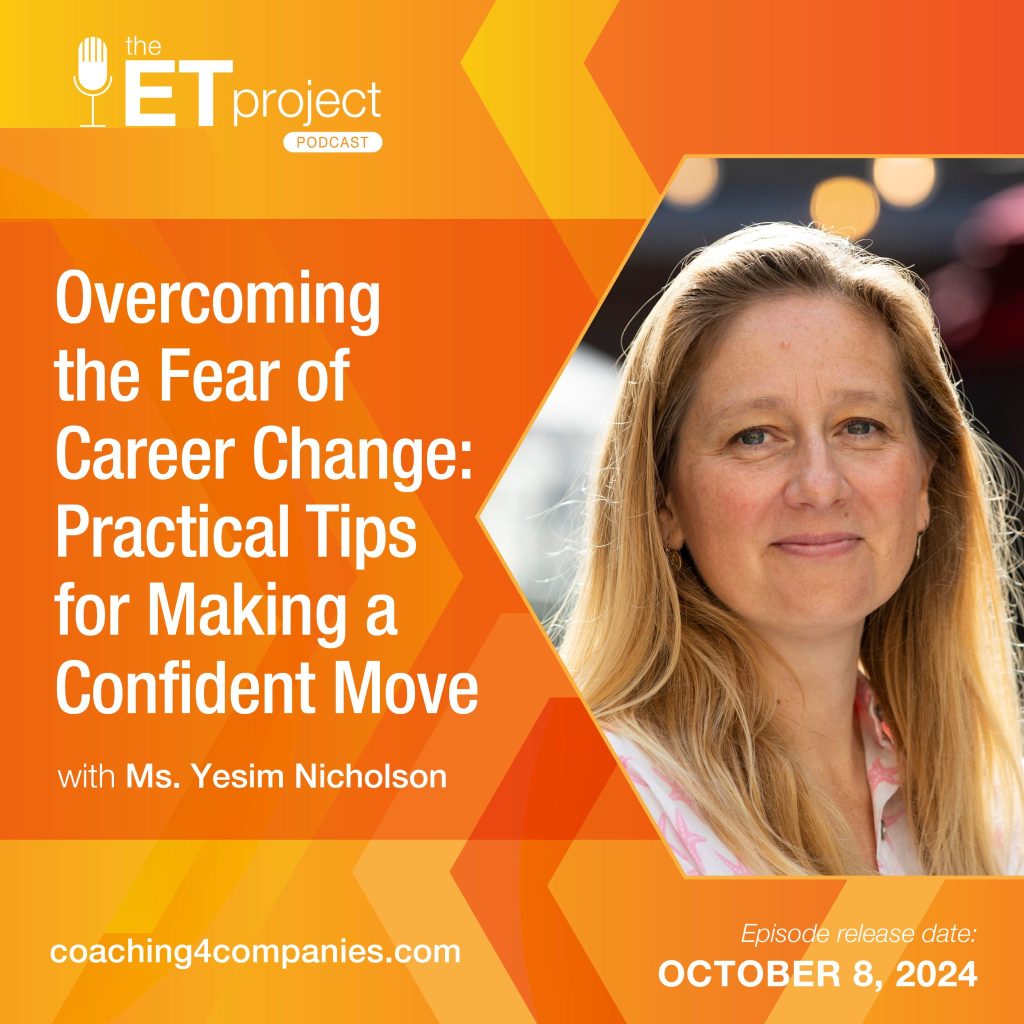
0:00:00.0 Wayne Brown: Hello, I’m your host, Wayne Brown, and welcome to The ET Project. We’re delighted to be delivering this podcast for executive talent all over the world, whom we’re affectionately referring to as Team ET. Today we’re visiting the Cotswolds in the west of the UK for our first time on this show. And speaking with our guest longtime coach, as well as author Ms. Yesim Nicholson. Yesim is an international career coach and founder of Yes Career Coaching, a platform that offers group and individual coaching for people who dream of making a career change.
0:00:41.9 WB: She also hosts the podcast, Your Big Career Move, which is available on YouTube, Apple, and Spotify, where Yesim chats to inspiring guests who have successfully transitioned to a different field, industry or role. Her belief is that everyone deserves to find meaning, purpose, and fulfillment in their work. However, making a big career change can be daunting, but it doesn’t have to be. Yesim helps people who feel like they’re not in the right job to transition with less risk and a heck of a lot smoother.
0:01:14.8 WB: She’s passionate about assisting people achieve their career goals and aspirations. Author of the very interesting book, Ready to Quit Your Job? Which is available on Amazon and through her website, we spend the majority of our time dissecting the messages woven throughout this book. So bring your pen and pad in preparation for plenty of notetaking with that team. And this episode today, Yesim and I will be discussing actionable strategies, insightful tips, and inspiring stories that will empower you to make meaningful shift, should you be looking to change your career, we hope you enjoy.
0:01:53.2 Speaker 2: Welcome to The ET Project, a podcast for those executive talents determined to release their true potential and create an impact. Join our veteran coach and mentor Wayne Brown as we unpack an exciting future together.
0:02:10.0 WB: Welcome Team ET to today’s episode of The ET Project. We’re gonna be exploring the transformative world of career transitioning. Well, it’s sort of the prelude to the transition, I guess, and we’ll probably uncover a lot of secrets about how you can navigate professionally the change and do it with confidence and clarity. So in the episode we’ll discuss some strategies, some tips, we’ll probably even have a couple of inspiring stories, I’m guessing, based on the conversation I just had with our guest prior to hitting the record. The aim of course, is to empower you to be able to make some meaningful shifts in your career. And whether you are contemplating a new direction or you’re seeking to enhance your current path, then I’m hopeful that our conversation today is going to equip you with some tools and most definitely the mindset that you need to succeed. Here today is you all have heard me say in the intro…
0:03:12.4 WB: Helping us unpack this journey as our guest, as well as the author of an excellent book that’s titled, Ready to Quit Your Job, Ms. Yesim Nicholson. And we’re gonna dive pretty much straight into it, but hopefully we’ll answer some of your questions and eliminate the doubt that you’ve had that have probably been holding you back from making a career decision and perhaps even more importantly from taking action. Yesim, welcome to The ET Project. Wonderful to have you here.
0:03:42.6 Yesim Nicholson: Thanks. Yes, thanks for having me. It’s great to be here.
0:03:45.1 WB: You are sitting in Cotswolds. Many of our listeners will know where that is. Many won’t. So I’m wondering if you don’t mind, just bring us into your living room and give us a short introduction about the environment. What’s it look like out the window today?
0:04:04.1 YN: Well, today, surprisingly for the UK it’s a little bit sunny. It, the sun does shine in the UK sometimes, it’s rare, but it does happen. And today is one of those days. Some, like you say, I’m in the Cotswolds, I’m in the Cirencester, which is the capital of the Cotswolds. And the Cotswolds is an outstanding, what’s it called, an area of outstanding beauty in the UK. It’s a very pretty part of the country. We’re about an hour and a half from London, west of London. So I feel like we’ve got the best of both worlds. We’ve got, it’s nice and quiet and very civilized and safe and clean and lovely, but close enough to cities to sort of enjoy everything that a city has to offer as well.
0:04:47.0 WB: Right. It is a beautiful spot. My sister likes going there a lot, so I get to see a lot of the pictures that her and her husband bring back. Let’s keep going with understanding a little bit about who you are and perhaps the journey you’ve been on professionally. And what inspired you to become a career coach.
0:05:07.9 YN: Yeah. Where do you want me to start? I mean, the inspiration behind, I qualified as a coach, gosh, about 20 years ago now. And it’s just something that I’ve always enjoyed. I love hearing people’s dreams and aspirations. I love being part of the journey of taking a seed of an idea and making it happen, I find hugely exciting. So it’s something that I’ve sort of the skills that I’ve used on and off for the last 20 years. And then more recently I’ve done quite a few different jobs. I’ve experimented ’cause I didn’t really know what I wanted to do when I came out of uni. Like a lot of my peers, we just sort of came out and went, oh, what can I do? And I, again, like a lot of my peers after university, I went into the corporate world and did that for a few years and it was great. I got to travel the world. They paid me good money. I met all sorts of amazing people. Some of my best friends are from that job.
0:06:13.2 YN: But after a few years of being there, I knew it wasn’t right for me. And since then, I’ve really been on a journey of just following, okay, what’s the next thing that excites me and where can I best use my skills, and so on. And so there’s been a lot of change. And one thing I noticed getting to midlife is that I was surrounded by people my age who were really, really miserable in their jobs. To me, I’m like, well, if you’re not happy, then do something about it. But I know that it’s easier said than done. And so after countless conversations, I was like, well, maybe this is something that I can genuinely help people with, on a larger scale. So yeah, so that’s how this business started is, just through conversations with friends. And now I run, Yes Career Coaching where I help people to explore what might be possible, having worked in the same industry for two decades, three decades, helping to explore what might be possible for them. And that’s how the book then came about and the podcast. And, now I spend my days talking about career change, and I love it.
0:07:22.3 WB: Where did the business name come from, is there a story beyond the name?
0:07:27.8 YN: I mean, the first three letters of my name, my first name are Y-E-S. So thanks to my parents, they give me very positive start in life. And, I don’t know, it’s just yes is a good word, isn’t it? We have positive associations with yes. And like anything is possible. So that’s how Yes Career coaching came out of it.
0:07:50.3 WB: Very good, and the podcast name is your big career move, if I’m correct.
0:07:54.3 YN: Yeah. Correct.
0:07:55.1 WB: I thought your YouTube channel’s by the same handle at Your Big Career…
0:08:00.4 YN: Yep.
0:08:00.8 WB: Let’s shift a little bit now onto the book and we’ll start tackling some of the questions and the challenges that many of us probably face during our careers. Specifically in the case of the book, the choice of whether to stay or leave. There’s a verse from a song, I’m guessing, Will I Stay or Will I Leave? And it’s very appropriate for the book. It’s very appropriate for this topic. Who was the group again? Do you remember?
0:08:30.2 YN: You know what? It’s just escaped my mind. But luckily for us, I have a copy right here.
0:08:34.9 WB: Yeah, the book?
0:08:35.9 YN: It’s The Clash.
0:08:37.1 WB: The Clash. Thank you.
0:08:37.8 YN: Do you want me to sing it to you?
0:08:40.5 WB: Oh, please.
0:08:41.6 YN: I’m just joking. But the line there, should I stay or should I go now? If I go there will be trouble, and if I stay, it’ll be double. It’s just one of those lines that I really love. And it just seemed like the perfect opening to my book.
0:08:56.4 WB: The book is called Ready to Quit Your Job. Is there a key message that you hope readers will take away from?
0:09:03.5 YN: Yeah, so actually the really important thing about the title of the book is that there’s a question mark at the end of it. So it’s ready to quit your job. And the whole premise of the book is that I’m definitely not advocating that everybody should just go and quit their jobs. Everybody that’s unhappy just quit. Definitely not. I think we have to be pragmatic. We live in the real world. And we do have to be intentional about what we are gonna do career wise, because most of us don’t have unlimited funds, and we do need funds to eat and keep a reef over our heads and so on. So really it’s looking at, I think hopefully I take the reader on a bit of a journey, a bit of a journey of exploration of, I think it forces people to just sort of stop and take stock of where they are and do a bit of self-reflection.
0:10:02.1 YN: And then I say that there are four outcomes of the book. So the four outcomes are, you’re gonna be a remainer, a tweaker, a toe dipper or a leaper. So if you don’t mind, I’ll just explain very briefly what they are please. So the remainer is somebody that reads the book or I have an online Greek coaching program. They sort of go through all the content and they go, do you know what, actually I’ve really learned that I actually work for the right organization. Their values really align with mine. And actually I really like my colleagues and these projects that I’m involved in, they’re actually really dear to my heart, etcetera, etcetera. And they sort of have a bit of an awakening, which sounds a lot religious, but they have a bit of a sort of wake up call and go, do you know what?
0:10:55.4 YN: And they just then approach their work with a totally different mindset and they show up as a better version of themselves. So that’s the remainer. Then you have the tweak and the tweaker is somebody that realizes that actually sort of 80% of their work is actually fine, but it’s just the fact that they are making up. It could be that they work, 8:00 to 4:00, but actually if they could just work 10:00 till 6:00, that would make all the difference to them because it means they can take their kids to school or whatever it is. Or they might get involved in a slightly different project at work, or they might take on more responsibility or relinquish some of their responsibility and they’re basically tweaking their existing work situation to make it work better for them. Then the third option is the toe dipper.
0:11:49.5 YN: The toe dipper is somebody who knows that they wanna make a change. Eventually they wanna take a, a leap of faith, but they’re gonna do the transition much more gradually that because they want to be safe about making that transition. So they might start operating a side hustle in their spare time. Or they might attend a course to develop their skills or whatever it might be. So they’re dipping their toes in different areas that interest them with the view of then making the transition at some point. And then last, but not least as the leaper, and as the name suggests, it’s somebody that goes, yeah, I absolutely know that I don’t wanna be in this job. I wanna be doing this instead, and I have got a plan and I’ve got some financial backing and I’m just gonna do it.
0:12:42.3 WB: I would imagine all of us fall into one of those four categories multiple times during our career.
0:12:50.1 YN: Definitely.
0:12:51.4 WB: Yeah.
0:12:51.7 YN: And we move through each of those sometimes as well. And we flip flop between different ones.
0:13:00.3 WB: One of the things that I was thinking about, and you cover it in different ways in the book, is that the self-assessment process is very closely linked to a number of other factors, such as what’s your mindset in that moment? How resilient are you as an individual in that moment? What’s the fear factor impact around the idea of changing jobs? So there’s a whole raft of associated areas that you touch on in the book as well. The fear factor is quite an interesting one, and I wonder, is there anything, when you’re working with your clients and they’re talking about they’re frightened of making the leap or they’re frightened about considering the resignation or whatever, how do you guide your clients in those situations?
0:13:50.2 YN: Yeah, I mean, I love dissecting fears ’cause sometimes our fears just come from our belief system. Well, often they just come from our belief system, and our beliefs are often based on stories that we’ve just told ourselves again and again and again. And sometimes that story is something that somebody told us when we were three years old or five years old. It’s then just been on repeat. Somebody I was working with recently, he said, well, I’m very lazy. And I was like, okay, so what are you basing that statement on? And then it’s really fun. You’re a coach, you know how fun it can be to really just start unpacking that. Well, where does this belief come from that you’re lazy? And if you genuinely believe that you’re lazy, how does that impact everything that you do?
0:14:43.0 YN: How does it impact what you’re out in the world? How does it impact conversations you’re having with people? How does it impact how you feel about yourself? How you show up in the world? So fears are like that. It’s really fun to unpack what the origin of that fear is, and whether it’s based on something that’s real, or something that we’ve just kind of made up for ourselves, or somebody else has instilled a fear in us. So really, it is just unpacking that and working out, is this fear or this belief something that’s gonna work for me going forward? And if it’s not… I mean, fears are there for a good reason. Fears are there so we don’t go and kill ourselves, basically. It’s a good thing to have. We should all have some fears, but then there are some fears which, at the complete other extreme, are ridiculous, and holding us back from being who we want to be. So it’s really fun to unpack those and play with them a little bit, turn them on their heads.
0:15:58.8 WB: For sure. Absolutely. And to that point, the opposite is almost having a positive mindset or having a positive outlook. Many people have the rose-colored glasses on permanently. That can also create the negative environment unintentionally, but it can also create a negative environment. When you find people that do struggle with their mindset, is there techniques that you have within your practice? I know you touch a little bit on different things in the book, but are there things that you use or techniques you use with your clients to help them adjust?
0:16:38.6 YN: Yeah, definitely. Mindfulness and meditation, it’s a buzzword. I remember the first time I attempted meditation, I found it all quite hilarious and a little bit hippy, airy-fairy. Definitely tried it and then dismissed it for a few years and then came back to it and I see for myself how it’s had a massive impact on me, and I see people around me who have adopted some mindfulness practice. It really is transformational. I’m really up for being intentional and starting your day with, okay, what’s my intention today? Plant the seed and then look back at the end of the day as well and go, okay, what have I reaped today? What’s gone really well?
0:17:41.0 YN: But it is a practice. It’s not something that happens overnight. Like I said, the mindfulness, the meditation, I meet a lot of people that go, oh, I tried that, it didn’t work. When you say you tried it because I know I’ve experienced it myself. I know I tried it and then was like, no. It is something that you have to work on. It’s like being as a kid, if you’re pushed into a pool, you’re probably gonna drown because you don’t know how to swim, but you build up that skill over time. And after a while, you’re doing breaststroke and front stroke and freestyle, whatever. It’s the same with meditation. You start small and build it and build it and build it until it just becomes something that’s very much part of you. So yeah, huge fun.
0:18:30.0 WB: I had a different story, not along the same lines, but I also had to leave it and come back to it. I know where you’re coming from. I hear that from a lot of people as well. Let’s imagine now that we’ve got ourselves mentally prepared, we’ve done our assessment, we’ve nailed those limiting beliefs, we’ve got the right mindset, we’re in a positive mind frame, but what do we do next in terms of the journey?
0:18:56.6 YN: Yes, lovely question. A lot of people that I work with know that they’re not doing the right thing for them anymore. They’ve done a job that’s perhaps served its purpose for the last 10, 20 years, but now they’ve got to a point in their life where actually it’s not gonna serve them anymore for whatever reason. It’s not gonna work with family commitments or it’s not aligned with their values anymore, etcetera. So they know they need a change, but a huge obstacle is, well, what the hell do I do instead? I’m not really sure. I don’t really know what I enjoy anymore. I don’t know what gives me joy. I don’t know how I can contribute. It sounds like a very dire place to be, right? Like, oh, I really don’t know what to do. To me, that’s really exciting. I’m like, well, if you don’t know, let’s start exploring. I do a little exercise with people where I get them to every day, just at the end of the day, just take a few minutes to reflect on the day.
0:19:57.9 YN: What are the things that made you feel excited, happy in the flow you know gave you butterflies, made you feel useful, whatever it might be. And really just start journaling those little moments throughout. Sometimes big moments, but little, even what might seem like insignificant moments throughout the day that lit you up. So it’s doing things like that. Then it’s exploring things, like one of my favorite stories is about my dad actually, that he was a hotel manager all his life. And then he sort of, he sort of semi-retired. And then in his mid 60s he started going to a pottery course. He started making, I don’t know, all sorts of interesting things right out of ceramics and then behold he’s really, really good at ceramics, but it’s not something that he’s ever done. But now he’s like, he did his first exhibition at the age of 70 or 71 or whatever it was, and people are buying his creations. And honestly, the joy that he gets from that is incredible. I talk about him in my book as well, and he’s not the only one.
0:21:13.7 YN: I come across lots of people who have this skill or this passion for something that they just haven’t even, they didn’t know it was there. It’s in there somewhere, but until you experience it, you don’t know that you’re going to love it. So I really encourage people to try out new things, go on a new course, have a conversation with somebody that you maybe wouldn’t normally talk to and just explore, like, just go outside of your normal boundaries and discover what is possible. I think it’s the most exciting, as you can probably tell, I get very enthusiastic about this, but I think it’s such a fun thing to do, especially if you do have a job that’s giving you that stability of an income, you know that you’re gonna get paid at the end of each month while you’re doing that. Just start exploring other things. It’s really exciting. There’s so many fantastic things going on in the world, and it’s just, see what’s gonna capture your imagination.
0:22:14.1 WB: Well, when you were talking then a thought came to mind is, I like to play devil’s advocate, or I put the black hat on metaphorically every once in a while. Often when we look at methods and and processes, we see it as a linear process. We see it as a perfect line in the sand and everything’s going well. Life is seldom always rosy. I’m sure there’s some common pitfalls that happen for people as they’re on the journey as well. Do you come across any of your clients that stumble as they’re trying to find their feet and trying to find that pathway?
0:23:01.4 YN: The biggest stumbling blocks that I see people encounter is first of all themselves. Their biggest obstacles is often themselves and the stories they’re telling themselves as to why they can’t do something. And the second one is somebody in their lives that’s telling them they shouldn’t do it. So it could be a spouse, it could be a sibling. It could be a parent who’s saying, oh, George, you are really good at, you are a great barrister. You’re earning great money, you’ve got a lovely lifestyle. Your family depend on you. Is it really wise to go off and become an artist or whatever it is that George wants to do. And they plant these seeds of doubt and they plant seeds of doubt, but beyond that, we have this thing where we don’t want to let people down. We don’t want to disappoint people. We want to please people sometimes, not always, but we want to please people.
0:23:01.5 YN: So I think it’s I and there are some people who will, I call them the chief dream squisher in my book, the CDS for short. It’s somebody that, and everybody I’ve ever spoken to has at least one person in their lives who’s their chief dream squisher. They know that if they tell their dream to this person, it’s gonna get squished in an instant. So my advice is always, work out who those people are and maybe spend less time with them, or don’t tell them your dreams. It’s really simple, talk to the, I mean, we want, we do need somebody who’s going to be real with us and is gonna ask us challenging questions so that we’re realistic about things. But we don’t want somebody that’s gonna go, oh, I wouldn’t do that if I were you. Oh, no. Oh, I’ve heard somebody else that tried to do that and they failed. We can do with less of that. So it’s really just choosing, being very deliberate about who you choose your dreams with, who you share them with, even.
0:25:18.1 WB: For sure. Right. You’ve mentioned a few times about having a coach or having somebody, whether we use the word coach, or whether it’s a mentor, whether it’s an accountability partner, whether it’s your spouse, whoever. How important is that for this particular journey?
0:25:38.4 YN: I mean, the people around you play a huge, huge role in any career transition. So again, I do urge people to be very deliberate about who they’re spending time with. So there are people that are gonna take you closer to your dream, and there are people that are gonna take you away from it. And being really deliberate about who you spend time with is going to have a massive impact. And actually, I have to say that the number one thing that I see that enables people to make a really successful career transition is a supportive partner. It’s very, very difficult to make the transition if you have a partner who’s totally against you making that change.
0:26:27.0 YN: And so I have to say, almost without exception, the ones that make a very successful transition do have a partner that’s their number one cheerleader and wants them to succeed. But it is having a spouse or a very close friend that is, if you’re not in a relationship, having a very close ally, basically, that’s there with you on the journey. And then it is, like you say, I think having a coach or somebody who’s gonna ask you, again, I keep using this term, but ask you all the right questions and is going to listen to you and not be judgmental and not have their own agenda to push. But they’re literally their critical friend that wants the absolute best for you and is gonna ask you the questions that will help you along the journey. And I think it’s also really important to have role models. Who are the people in your life that are already leading the life that you would love to live? And it might just be elements of their life. So it might be, you look up to your neighbor who somehow gets to travel for six months every year, or it might be, your friend who only works, I don’t know, three hours a day, or it might be, somebody else, that is involved in lots of different projects. And gosh, wouldn’t that be exciting to not just have one job, but to have three or four things on the go.
0:27:54.7 YN: So it’s really just picking out elements of other people’s lives. And they can be people you know personally, or they can be people, sort of influencers or, I don’t know, people that you’ve heard of that you can maybe follow on social media or whatever, and pick out elements of their lives that would be quite cool if you could have that in your life as well. And just, have them as your inspiration, basically.
0:28:22.4 WB: Right. Is there anything we haven’t touched on in the book that you think is really important for the listener to hear about?
0:28:32.8 YN: I don’t know why this has jumped into my head, is the importance of sleep. Some of your listeners might be like, come on, sleeps, sleep what’s sleep got to do with a career change? And actually, it’s got a lot to do with it because if you’re having poor sleep, it means that you’re not waking up refreshed. You’re not waking up in the best possible way. You’re not gonna have a great day. That’s gonna impact your mood. That’s gonna impact your thoughts. That’s gonna impact your beliefs. That’s gonna impact everything around you. And it’s that domino effect. If you haven’t had a good night’s sleep, you’re gonna eat junk food. You’re gonna, so it’s like everything starts with good sleep. That’s my definition of success is a really good night sleep. If I’ve slept well at night, that means that I’m not worrying about stuff. It means I’ve eaten well enough for my body to sleep well. I’ve drank enough. I haven’t pissed anybody off that day that I’m worried about.
0:29:26.1 YN: So it’s having a really good night’s sleep is just a really great baseline for making a good decision about your career, and because it can impact everything. Your health, if you don’t sleep well, it’s gonna affect your health over time. And if you’re in bad health, that’s gonna affect your work, which is gonna affect how you feel about your career and on the whole. So it’s all, everything’s linked. That’s why my book touches on everything because it’s, you can’t separate your career from the rest of your life. You are your career and your career is you.
0:30:04.1 WB: Shifting away from the book for the moment before we wrap up, where do you see coaching in general career coaching? Is there any trends you’re seeing over in the UK with the whole AI space? Do you see any trends evolving in the UK at the moment?
0:30:23.4 YN: I don’t know if I have noticed enough of a trend to comment on it. Are there lots of coaches? Yes. Do we need lots of coaches? Yes. Are all coaches good at what they do? Maybe not.
0:30:40.0 WB: If anyone’s listening to my questions today, you would answer no. [laughter] My questions have not been very good, but anyway.
0:30:49.4 YN: They’ve been excellent.
0:30:50.7 WB: To get through. So I appreciate your tolerance of that. What about technology then? If we’re talking about trends, what about AI in general and the impact that that might or might not have on the coaching world? Do you have a view on that?
0:31:06.1 YN: Yeah. I do. I think, I’m really torn on AI because I do use elements of it in my work. And it saves loads of time, for sure. So when I’m putting together my podcasts, for example, I can ask the tool that I use, I can ask it to suggest some teasers, some reels from the interview. And it saves me hours and hours of trawling through the interview. And so I do use it for stuff like that and I can see the benefits of that and I know that people are turning to it for coaching and in all honesty, I think probably it can ask you good questions, but what’s missing for me is that personal connection. And I think that’s why I love coaching so much. And I think it’s so rare now that, I even know lots of coaches who are really terrible listeners when they’re not in coaching mode, if you know what I mean.
0:32:07.3 YN: So they’ll have a conversation with a coach, they’ll tell me they’re a coach and then they’ll talk at me for an hour nonstop. And I find that quite interesting because as a coach, as you know, as the first thing that you’re taught is to listen, listen and listen some more, and I think we’ve lost that art as a species, we’re not very good at listening anymore. And I think having that connection with somebody and having somebody really uninterruptedly listen to you for an hour or 45 minutes or even 10 minutes, is something that’s lost. And I think that, I don’t know if you can get that with AI, I think it’s pure joy when somebody really listens to you and really takes in what you’re saying and doesn’t respond with, oh, you’ve got a headache. Oh, I’ve got a migraine. But gosh, I’m sorry to hear you’ve got a headache. What might, what do you think might be causing it? Is really refreshing, I think. I don’t know. What’s your view?
0:33:26.7 WB: Similar in many ways with you. We incorporate AI, so we offer both the AI app or people who want the flexibility, but we tie it together with the human coaching as well. So we offer a bit of both. I think for better or for worse, it’s here to stay. And I believe that it will evolve at the moment. If we look at the AI that we have, it’s really just a closed loop, self-feeding funnel at the moment with generative AI. So it’s got the base and all that’s really happening is we’re adding input and it’s trying to grow from that amount of input. Until we get to that really AGI level where it starts to become self-generative, then I don’t see it’s going to go a lot further. But I’m not an expert.
0:34:26.2 YN: That’ll be interesting to see. Won’t it? It would be interesting to see what can AI do that a human being can’t?
0:34:35.3 WB: Yeah. There’s a lot of predictions out there, of course, that singularity is on the horizon. Try, let’s see, I guess it will definitely change everything. It’s already changing everything, but it will change it in many different ways, I think. So what, what’s the plan of the future for you and for Yes Career Coaching? Are you looking at anything on the horizon yourself?
0:35:02.7 YN: Well, there may or may not be a second book. [laughter]
0:35:05.4 WB: Come on.
0:35:07.8 YN: I’m just in the very early stages of starting to research another topic that’s very dear to my heart, which has come off the back. It’s funny, when I… Before I wrote this book, I never thought I would write a book. I just didn’t know, just wasn’t something that I thought I would do. And I remember listening to an interview recently with some… With an author who said the same. He said, I never thought I’d write a book. And then I did write a book, and then as I was writing the first book, I thought, I’m never gonna have anything else to say. This is the only book I’ll ever write. And then he did go on to write a second and a third and a fourth book, and I’m finding myself in exactly that. I was like, I’m never gonna write a book. It’s not on my radar. Then I did write a book, and then as the first book was coming to an end, I had this idea for a second book, and now I can’t stop thinking about that. It’s quite interesting. It’s quite an interesting thing to go through. So I’m just in the sort of very, very early stages of researching what might go into that book. So there’s that. And then I really love my coaching. I love working with people. I love my podcasts, so yeah. More of the same for now. Watch the space. Ask me again in a YES Time. Yeah.
0:36:32.8 WB: Well, on that note. Where do people go to watch?
0:36:37.9 YN: Yeah, the podcast is called Your Big Career Move. And it’s available on Apple, Spotify, and YouTube. And my website is yescareercoaching.com. And I’m most active on LinkedIn, so if anybody wants to connect with me, I believe there’s only one Yesim Nicholson in the world, so it should be relatively easy to find me.
0:37:04.5 WB: Very good. Maybe last question, final piece of advice for the listeners. Anything you would leave them with in relation to our topic?
0:37:15.1 YN: Yeah, I think if you are listening and you are not happy in your job, explore why you might be feeling discontent and see whether it is the job itself or is it other stuff that’s happening in your life that’s making you feel a bit rubbish about the work that you’re doing. If you explore everything else in your life is great and it really is just the job… The environment that, I mean, the environment you’re in is hugely important. If you’re surrounded by the right sort of people who have the same values as you, the same work ethic, the same sense of humor, even, makes a huge difference to your day to day. If you feel like you’re in the wrong place, then just start exploring. Just explore what might be possible. And I promise there will be something, there’s something on the horizon for you that is going to make your working life much more fun. And we spend such a huge amount of our lives doing work. You might as well do something that you feel excited and passionate about. What’s the point? Otherwise, you’re just, it’s a waste of your talents and your passions if you, it’s sitting around doing a job that you don’t enjoy.
0:38:33.1 WB: Thank you for being a guest on The ET Project.
0:38:36.3 YN: My absolute pleasure. Thank you for having me.
0:38:39.6 S2: Thank you for joining us on The ET project, a show for executive talent development. Until next time, check out our site for free videos, eBooks, webinars and blogs at coaching4companies.com.
[music]