[music]
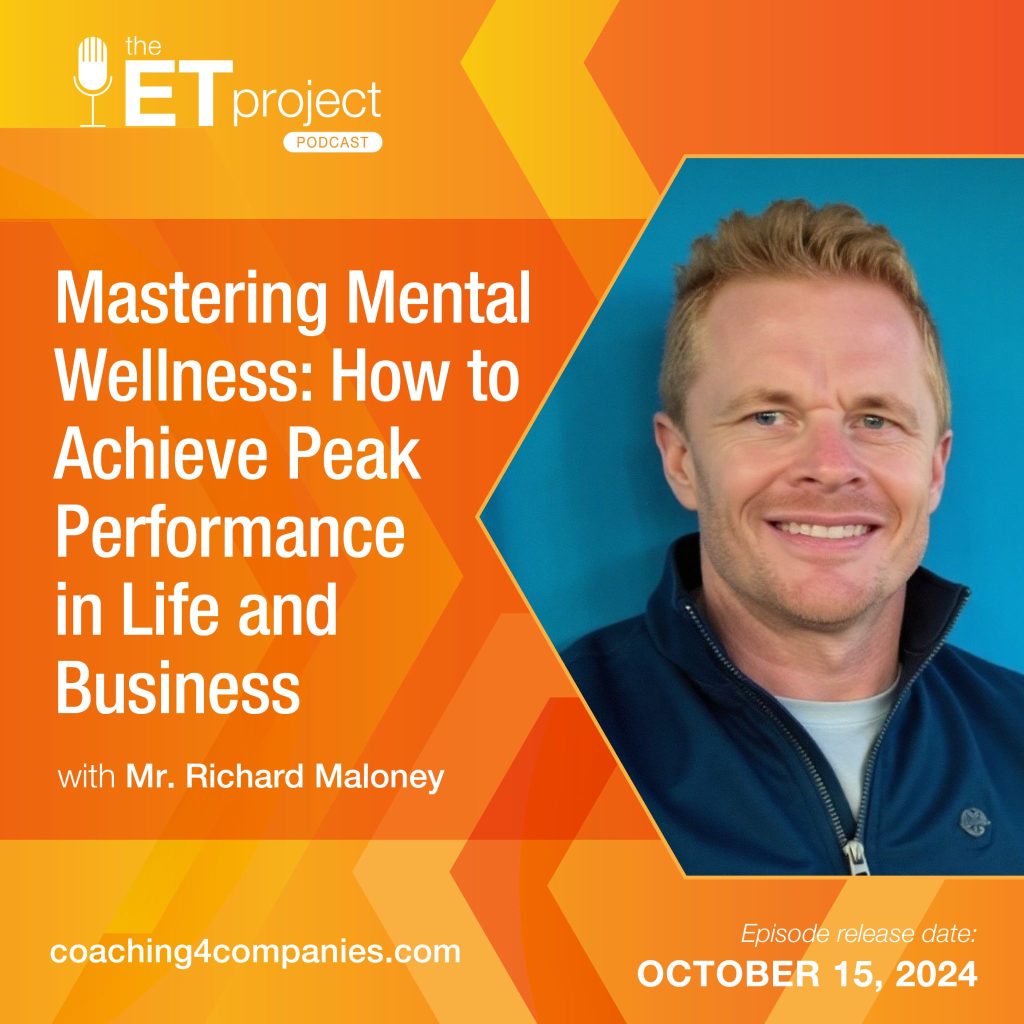
0:00:04.5 Wayne Brown: Hello. I’m your host, Wayne Brown, and welcome to the ET project. We’re delighted to be delivering this podcast for executive talent all over the world, whom we’re affectionately referring to as Team ET. Today we are visiting Melbourne, Australia and chatting with the founder and CEO of Quality Mind Global, Mr. Richard Maloney. Allow me to start by sharing some very impressive stats related to his business achievements. Richard has worked with thousands of entrepreneurs, employees and business leaders all over the world, enabling them to unlock their true potential and achieve greater business and life success. He’s been associated with multiple elite Australian sporting organizations. He’s helped shape over 35 championship winning sports teams. He’s trained over 700 business owners and over 1000 athletes, enabling them to harness the energy of success and evolve from good to amazing. He’s trained professionals in over 50 countries and has been a keynote speaker in 12, and he’s the author of “The Minds of Winning Teams,” “Injury Free” and the book that we’ll spend a lot of time dissecting called, “Stress-Free: How to Thrive Under Pressure in Unprecedented Times.”
0:01:21.8 WB: The interesting thing is that as successful as Rich and his company are today, he went through a dark period and needed to open himself to a wealth of self exploration and discovery before the transformation was possible. So team, if you know you are capable of more, but for whatever reason find yourself continually self-destructive before that crucial moment, then this episode is a must listen. Grab a pen, a pad, and get yourself comfortable to take plenty of notes and then take immediate action straight after the episode ends. Please join me now as our expert, Mr. Richard Maloney, and I dive into his incredible story and discover powerful lessons of ability and agility, vision and a whole host of great tips for every leader.
[music]
0:02:15.6 Speaker 2: Welcome to the ET Project, a podcast for those executive talents determined to release their true potential and create an impact. Join our veteran coach and mentor, Wayne Brown, as we unpack an exciting future together.
[music]
0:02:32.0 WB: Welcome Team ET to another episode of the ET Project, where we explore stories on resilience, passion, transformational leadership, if you like. And today we are thrilled to have Richard Maloney, founder of Quality Mind Global. Richard’s journey from overcoming, let’s say, some tough challenges during his childhood teenage years to harnessing his natural talent, and we’ll talk more about that through Australian rules football, is nothing short of inspiring. He’s challenged his experiences into a mission to improve wellbeing and performance on a global scale, which I love. So Team ET, let me share you a little confidence before we get into the conversation with Rich. When I was first made aware that I was going to have a chance to sit down with Rich, my immediate thought was of a potential clash of the football codes. So my background is Aussie, Rich comes from Aussie rules. I thought, “Man, this could be a Clash of the Titans, right? Two Aussies sitting down, battling out different codes.” However, as I started to dig into who is this guy and what’s his background, his achievements, his approach to life and business in general, I realized just how many similarities we’ve shared through our own journey and how much respect I have for this guy and what he is doing. So I can honestly say that I’m super pumped for this conversation.
0:03:58.9 WB: So team, please join me in welcoming Rich to the show as we dive into his incredible story and discover some powerful lessons, probably about adaptability and vision as much as anything. And one of my favorites is a thing that I read about in his book. It’s a thing that he refers to as our two minds. So Rich, with that, welcome to the ET project. Great to have you on the show, my friend.
0:04:24.0 Richard Maloney: Well, Wayne, having known that you’re from now the code, I was very excited. Now we’re gonna have to call it a quick show, buddy, but now I’m really excited to be here and thanks for the opportunity and the invitation, and happy to get underway.
0:04:38.5 WB: As our listeners are going to be able to hear, they’re listening to two Australians talking. So this is… [laughter] We’ll probably drop into some Aussie slang as we get into the conversation, but here’s a true story for everybody. About, I don’t know, an hour and a half ago before we hit the record button, Rich messaged me, basically said, “Hey, Wayne, I’m trying to prep for today’s chat and I wanna be at my best for the listeners, but pal, I’ve got no idea what you wanna talk about. [laughter] And the reason that Rich was in the dark was because, as of this morning, I was suddenly unclear myself. Now, don’t get me wrong. I have a standard routine I follow, I start by always doing my research, and then what I try and do is I try and align my own background in some way, shape or form to suit with the guests.
0:05:33.0 WB: So all good so far. We come from Australia with a similar code or similar footy background sort of thing, that was all good. And then about 9:00 PM last night, as I’m wrapping up my preparation for today, I come across Rich’s book called “Stress Free.” [laughter] So this is 9:00 PM and I thought, “Okay, it’s a challenge but not a major, if anything, probably gonna help our conversation.” And then this morning I’m out for my morning walk, and lo and behold, I happened to cross a podcast that Rich was a guest on in August. And by the way, for any of the listeners, do yourself a favor, have a listen to it. It’s called the Overly Excited Podcast, a couple of Aussie lads’ hosted podcast. I have never laughed so much in the last year, [laughter] I was in stitches. However, the consequence of that was, have you ever seen a presenter standing on stage? They’ve got their cards full of questions. They’re ready to address the audience. And they have this epiphany that, you know what? This what I probably actually want to talk about. And that’s what happened to me after listening to this podcast, Rich. So here we are now. [laughter]
0:06:51.5 WB: I’ve listened to it, I’ve gone down memory lane, I’m still stuck there in my mind, and we’re about to start our conversation, so here we go. And apologies for that long-winded intro there, Rich, but that’s literally what happened to me, so I thought I’d just share it. I have to say, I’m pretty exhausted right now so take over.
[laughter]
0:07:10.1 RM: Where do you wanna go, Wayne? Lovely to meet the listeners, and I emailed Wayne deliberately because it’s all about you, the listener. So I’ll give you as much as I can in this short little while, and looking forward to have this conversation.
0:07:28.6 WB: Let’s start with where we normally go, if you don’t mind telling us a little bit about the journey. Anything that you feel is relevant in the lead-up to where you are now with the business and the way the business is operating, whether that’s your childhood, your teenage years, your football, whatever it might be.
0:07:48.6 RM: Well, I guess I’m in the game of mental wellness. Equality Mind is a mental wellness technology, IP and coaching company. So we have a group of 47 coaches now from eight countries, and they more or less follow my systems, use our technology to help everyday people, a lot of executives, mums and dads, young athletes, transform the way they process reality and really reach their dreams far quicker. So here I am, 49 years old, three beautiful daughters living in the Bayside of Melbourne. And people say to me, “Rich, what gives you the right to work in this space when you didn’t even finish school?”
0:08:31.5 RM: So more or less, I was a young man coming through the AFL system. I was always going to get possibly picked up by an AFL club, I did. But prior to that, I had a lot of challenges. I didn’t fit in society. I went to a grammar school that caned me weekly. I combated the system. I was one of those young men who always asked the question, why? What for? I need proof, and so forth. So you could say back in those days I caused quite a stir. My report cards were always C, C+, happy to get a B, and because I more or less was bored. Sport was an outlet for me, and it played a critical role. As I grew up, I sort of hit the skids pretty hard there. I got asked to leave one school, got asked to leave another school, and then I nearly committed myself into the end-of-life scenario on a couple of occasions. So there was a line in the sand moment at the age of 16, 17, where I convinced myself not to.
0:09:37.9 RM: I knew the tree. I had the rope. I was on my way out, and whatever reason, I didn’t. And then I went to St. Kilda as a young athlete, which is in the AFL here, and quickly demoralized. You could say I wasn’t mentally ready to cope with the pressures and I wasn’t mentally resilient up until then anyway. And so once that ended, I had a whole identity shift. I didn’t know which way to go, so I took the surfboard, grabbed the Red Heeler dog and the blue van, and shot off to Queensland and surfed and played football at semi-professional level, and that’s where it began. And so I went to a stage after I was going to knock myself into that stage of, “What am I here for? Who the hell am I? And what is this human existence all about?”
0:10:32.6 RM: And so then I just followed the breadcrumbs, actually, Wayne, and was going to understand religion, quantum physics, understand all aspects of existence, hanging out at retreats and having mentors and gurus and reading books. And the first time I read a book actually, I went to the New Age bookstore, and I was hiding this ’cause I was so concerned that my mates at the football club would know that I’m meditating in groups. And as you can see, I’m a redhead, and so we didn’t mind a bit of a fight or a punch-on occasionally back in the day. And so I was really heading down a wrong path until I figured it out that there was a bit more to life. And so that gives you a start of how it started.
0:11:18.2 RM: And then I fell in love with the mind. I fell in love with how to unhack myself, and then I just kept working away at it over the course of the years. And then I just started to become a coach after a lot of success in my boarding career at some professional level and working at quite a few elite teams. And then it just unfolded, and here I am at Quality Mind. This is my second company. I built and sold another employee engagement business to an American company, when that was quite simply systemizing sports championships, realizing Australia was too small and then I partnered with an American company and they bought it off me in the end. And we had 700 licensees following my system, so I was traveling four months of the year with interpreters in training rooms for a long time. And so now we’re here with Quality Mind, and probably at the right time, I think you’d agree with the way the world’s going.
0:12:16.9 RM: And it’s about having fun. It’s about not taking life too seriously, but having enough nuance to go, “Hang on, I haven’t got what I want right now. Why is that? I’m not entirely happy with the way I process reality and my friendships and my money and my wealth and my health and these sorts of things.” So we help people put the jigsaw puzzle of the mind together very quickly and we use technology along the way. Does that give you a bit of a starter?
0:12:43.2 WB: Beautiful. There’s so many threads there that we can pull on. Let’s go… Before we jump deep into the business and start talking about it in more detail, let’s explore more around the football period. I think you were talking at the end there, well, that transition started when you moved to Southport, right? So I’m a Brizzy boy. I grew up on the North Coast, not the South Coast of Brisbane, so not the Gold Coast, but I had relatives in Southport. So I know where you were and where you were playing. What was life like? You talked about it didn’t turn out the way you expected. What was that about?
0:13:29.8 RM: Yeah. It was a time of uncertainty, but it was also a time of excitement because I had forged myself a new path, and the new path was laden with excitement because I was heading down a road I’d never traveled, and that is into a spiritual aspect, into a quantum physics aspect, into a mental wellness aspect. I was quite lost too, you could say, because when you go, when you start down this, people will call it a new agey sort of path, I just call it an introspective path, is you probably don’t have your feet on the ground so much and so you’ve got to get grounded. But it was exciting, Wayne, because I was on my own, I had to take full responsibility, ’cause I was in a lot of fights as a kid, I was in a gang, I was locked up a lot on the weekends, only for silly stuff, nothing significant. And it got a bit boring after a while, and so I had to grow up, and I decided to grow up.
0:14:40.3 RM: In fact, my grandmother played a significant role in that, helping me with some sharpshooting conversations, and then I just more or less went, “I wanna take control of my life.” So I got to the age of 27, 28, I was like, “What am I gonna do?” And I went to a futurist, a futurist helped me unpack that, and I didn’t know exactly what it was, but I was taught not to worry about the how or when, just know where you’re heading roughly. And I knew roughly I wanted to head in this space, but I wouldn’t have known that I’d done it the way I’ve done it. And it hasn’t been easy, don’t get me wrong, the path of an entrepreneur. And we’re working now with high-level executives, and it is really challenging, but it’s rewarding now. And so that’s the excitement behind it. Then I went to Subiaco and captained a club over there, the Subiaco Football Club in the WAFL, and we had some success there. And then I worked for that football club and multiple other clubs after that. So I just followed my passion, Wayne. Quite simply, I followed my passion. And I didn’t know the journey ahead, and there wouldn’t be too much I’d change. Honestly, there are some things I’d change, definitely, but not a lot.
0:16:02.2 WB: I know you speak in certain areas, you talk about during the football, when you first had the opportunity to play at a senior level, you came into the arena, if you like, with high expectation, based on your background, you’d received lots of acknowledgements, awards, etcetera, but when you hit that high level, something changed and you weren’t the best anymore. How did that play into the journey that transpired?
0:16:35.5 RM: So one, I don’t think I was 100% committed to the cause, I was always touted as that young man that was going to easily walk into a club, somewhat. There was also question marks against my commitment, my attitude, I would assume from the recruiters, so that unfolded. So in essence, the pressure, quite simply it was that. It was the pressure that got me. And if you can’t handle pressure, quite simply you’re precious. And I was precious. When pressure came on, I capitulated. In fact, for a young man who really went through his childhood, winning nearly every award in the competition until about under 16s, and he never had an injury, when the pressure went on, I started to see that I started to crack in injuries, I started to see other players that I was playing with crack with injuries, and I thought there may be a connection to the mental well-being, to the way you process, all the confidence you have, and then I’m sort of a firm believer now.
0:17:34.0 RM: In fact, I wrote a book about it, “Injury Free,” about that, if you can’t handle pressure. And I’ve worked with athletes all around Australia with this, and we get them into the best form ever, because there’s an insecurity, there’s a lack of self-worth, there’s low confidence, there’s not a great belief. So when you go to the AFL, you think, “I’m gonna do it, it’s gonna be easy.” Well, you’re now amongst the elite, and then you get found out pretty quickly if you don’t have the skills and tools to cope in that type of environment.
0:18:07.0 WB: I know when we talk with a lot of our clients, and we do a lot with executive talent, we often say that we all have a degree of natural talent, but the natural talent only takes you so far. And you reach a point where those who have that right attitude, they have the commitment, they have the dedication, etcetera, will catch up to you and overtake you if you’re not aware of it. I’m wondering how much that was a factor for you.
0:18:44.6 RM: Well, I think having worked now with hundreds of athletes, world-class boxers, lots of all-Australian footballers, you can’t do it on your own. You really need a support team around you, because as you said, certain skill sets. It’s very rare to get someone who can just whistle through the elite life by themselves and not ask for… Or at least fall in a hole and get pulled out by someone else, right?
0:19:09.4 WB: Mm-hmm.
0:19:12.8 RM: And so that’s key. In the AFL and rugby and any sport around the world, the biomechanics and the chemists and the physios and so forth, they’ve got the human body to 100% capacity just about now. When I was a leadership coach in the Western Bulldogs in the AFL, I used to ask the head of human science in that, “How do you know when someone’s about to get injured?” And they couldn’t really pick it. They’d get them to acidy and they’d back them away, but then bang, a hamstring goes and so forth. They still don’t know, but when you bring up the mind, when you bring up the inner self-worth, when you bring up the intuition, when you bring up the master within you to learn and to listen and to understand your body better, you remove your ego and you let the master, we call it the child of master, innate master come within you, which is pure intelligence, you can get connected to yourself on a whole other level, which prevents injury. And so you’re listening on another level.
0:20:16.3 RM: And so that’s sort of the element I went down. That’s what I teach with my athletes and executives and people with health issues. We’ve helped people that are in serious sickness, not far to go, but before it’s over, and helped them back as well, because the body… Sorry, we’re going off course here, but it’s sort of the right place. But the body is a reflection of the mind as well, so it’s all related. So body, mind and soul, all connected, all working at 100% capacity, then you’re really in your peak element to live the life you wanna live and reach your dreams at the same time. Because I’ve seen unbelievable things take place very quickly when people do this from out in God and trodden down AFL career over to premiership captain or Australian in a matter of a couple of years. It’s just unbelievable.
0:21:07.3 WB: I’m a big believer myself. So I’m a cancer survivor and my surgeon said to my wife, “It’s so advanced, we don’t give you a lot of hope.” I’m a firm believer in the mental capacity to play its hand if you allow it. And that’s, to a point, what you’re talking about to a large extent. I noticed when you were talking about you were in Southport, I think it was, and you were starting on this transition from the sports player to the business person, the entrepreneur, and you were developing your interest in the spiritual world and that journey. I think I heard you talk about somewhere you found a mentor, and I’m just curious how much that person played a role.
0:21:55.3 RM: Significant. So I was seeking guidance probably without knowing it. I was on the hunt. I was devouring every type of information I could in this space, and I couldn’t get enough of it. And so I stumbled across this elderly gentleman who would’ve been in his late 60s and he had a very deep connection to himself. And he and I met quite often for an nearly three or four years, maybe every three weeks. He resided up on the Gold Coast and still does, and it’s a mind blowing experience to sit in his energy as well on you. And he taught me a lot about myself, and that’s when I started to really change. I ate it up. I absorbed it. But when you’re in the room with, I would say someone of that level of energy and genius, and it’s a very weird thing to say because maybe it was just my immaturity at the time, but I’ve never really met anyone like it since, who I can actually… I walked out scrambled.
0:23:11.3 RM: In fact, a lot of my athletes, particularly new clients, they will walk out scrambled and they’ll take notes down and there’d be head crackling going on in the brain. And that’s exactly what happened to me. That’s what I do now to my clients because you have to break it to recreate it somewhat. And so that’s what happened with this gentleman, Bruce. And so I just went on this journey to get away and then he sort of gave me what I needed to sort of move into this space. I’ve had another one since then. I had a… My sister was getting coached by a leadership coach who was teaching meditation in corporate and government. So then I rang him up out of the blue and said, “Hey, listen, I could really do… Could I buy you a coffee?”
0:23:57.3 RM: And then I met with Steve and then some years later, maybe a year and a half later, after dragging him out of the office for a coffee and learning a bit about that, he employed me. And so I became his middle management coach traveling all around Australia, it’s a corporate and government middle manager coach. And I was running cultural classes, meditation classes and all those sorts of things. So it’s always paid off for me to just reach out and ask for assistance with someone who he was and in their own way that has the ability to help me fast track myself.
0:24:36.3 WB: Yeah. You remind me of a quote, and I think it was by Lao Tzu, the Chinese philosopher, something away when the student is ready, the teacher will appear. And I guess you’re right at that point. You being the student and you were lucky enough to stumble on the mentor and the rest is history, as they say. So, yeah, very nice. As you look now where you are today and you look back at that period, any major learning that you now take with you as part of your program with your clients to help them either transition themselves or avoid the same pitfalls that you were in?
0:25:24.1 RM: So the systems that I’ve designed, so we want run one hour a week group coaching. Okay? And then that’s for everybody that wants to just improve themselves. It doesn’t matter where they come from, because we focus on neuroplasticity, neuroscience and understanding how to create significant change in a short amount of time. And so but the process that we put people through, our clients through, is a blend. It’s like positive psychology, neuro-linguistic programming, ancient philosophies, HeartMath technology, and I also should say teachings, which is heart coherence, which is modern data science. We’ve got a lot of my tools and techniques that I’ve used over the course of years, so it’s like a mosaic of the mind pulled together. And so we just take them on that journey, but there’s… Because you can’t, in my opinion… So there’s education and transformation.
0:26:19.3 RM: So I was doing education with these guys and they would do a meditation course, or they would get some coaching and yeah, you’d have some significant change, but you hadn’t created new habits along the way. So you’ve gotta create new habits, you’ve gotta change your subconscious mind if you want to create sustainable and long lasting change. And so these parts were pulled together over the course of many, many years of trial and error and research and development before I could actually hand on hand say that’s the way to go. So in each weekly session, there’s multiple different layers to it ’cause you can’t feed a baby a steak. You’ve gotta edge people up along the way and they will grab onto what they need to at the right time because it’s not really… It’s more mentoring forward, say, “Listen, I’ve got the fast track here for you to elevate yourself into the best version of yourself very quickly, you’ve gotta walker.” Alright? And that means, when it comes to neuroscience, that means you to activate the brain into… Because you are what you think.
0:27:17.2 RM: Your life flows where your thinking goes. And so ’cause of that, we have a future focused sort of program. We don’t really dredge the past up because what’s the point? And so we take people on this journey. So the requirement of that is, for neuroscience, well, it takes seven to 30 minutes a day on focused intention on where you want to take your life and understand how you’re feeling and thinking. And so once you understand the side problems, it’s quite a lot of fun. So you go, “Okay, we use technology seven to 30 minutes a day, activate the app, figure out if I’m feeling off, I’m thinking off, I’m feeling off, I’m thinking off. So then what am I thinking?” And then we change the script and then we change the feeling.
0:27:55.5 RM: And after a while, after 21 days, the record gets scraped. And that means just if you constantly said, “I’m no good, I’m not good,” or whatever it may be, then that… And you can start saying, “Well, I’m actually great. I’m actually happy with life. I’m happy with life. I’m happy with life. I’m excited by the day. I’m excited by the day.” The record scratches to the point where it starts singing that song. And then after 63 days, the record set 63 days plus. So it can come to 100 days, it just depends on how scratched the record is or how the program is. And then after a while, people start seeing significant shifts in themselves where they’re like, “Geez, I’ve just changed.” It’s like learning to drive a car, Wayne. You got the lessons, back in our days we had the clutch and the pedal and so forth, and then all of a sudden you were a driver.
0:28:44.8 RM: But you never thought back, “Oh, I learned to drive the car.” You’re just a driver. And that’s what happens with our clients. They just become another version of themselves because they’ve scratched and recreated their own song to life. And so to sort of say there’s certain elements, I would say neuroscience has a… If you don’t change the brain, you don’t change the body. So we’ve changed the way we process reality. We’ve gotta understand that everything out here is a reflection of what’s happening in here. And so it’s even like Jesus Christ and all the major philosophers of the world have always said the answer is within, but most people are looking for to change out here. The mirror reflection model I love is everyone is a teacher in front of you.
0:29:30.4 RM: So there’s not one person who passes in your life that isn’t a teacher to you, but they’re hidden in disguises as another person. But in essence, we’re all one. And so if we’re all one, then there has to be a connection between people in your life because they’re in your life for a reason. So what’s the lesson that I’m here to learn? And after a while, you’ll find that once you got that lesson from your teachers, which is your friends, family, colleagues, business partners, kids, you’ll find that that issue will disappear and then the next one will come up until you keep working on yourself enough to become free and in flow. And when you become in flow with life, life flows to you as opposed to you chasing life because you’ve got the master key now of understanding that everything’s perfect, nd it sounds woo woo wa wa, but it’s all about taking action too.
0:30:22.7 RM: But that’s reality. When you get in flow like a footballer, when they’re in flow, we teach footballers and boxers and athletes to get in flow. How do they get in flow? How do they get on that ground and absolutely maximize that two hours or one hour in the best of their ability? Now, a lot of that flow for performance, elite performance, actually starts on the Monday. So getting your Monday, Tuesday, Wednesday right by getting in flow then and then going to the game empty. And then once you hit the track, then you find that you’re running on a sixth sense, you’ve got more energy because the mind’s free and you’re playing with more fun and passion. And so it’s probably a heading, ’cause there’s a big question you ask me is, ’cause how many things could I say are the key things? There’s just so many. And that’s why I said you can’t feed a baby a steak because over the course of our 12 week programs, we’ve got another 12 week, then we’ve got biohacking programs. There’s just probably 80 different elements to it that’s either activities or an activation or an awareness factor or so forth.
0:31:30.2 WB: Very good. Let’s jump into one of your books. I know you mentioned “Injury Free.” I haven’t read that one, I’m sorry. The one I read was “Stress Free.” Well, let’s jump into that a little bit because it really, for me, helped frame the business you’re in and what you do. I don’t want to go in too deep, we want people to buy the book. But yeah, if you can just sort of paint a bit of a broad picture about what it’s all about and where it came from. What was the purpose behind writing it?
0:32:00.4 RM: So the purpose was initially to help people out who were entering COVID with me. And I was like, “Okay. Well, I have the information. I’d love to share with people who are now lonely or caught in a part of the world that they can’t escape.” And then, so yeah, the essence of the book is quite simply how to thrive under pressure in unprecedented times, not just COVID. But quite simply, it’s a reflection of my entire management of myself, but in a way that’s put in little actions and activities and a bit of awareness all along the way. But conquering yourself is the number one thing in life, in my opinion. Emotional intelligence, introspection depends on what your goals are and who you want to become. Myself, I enjoy being not perfect too.
0:32:49.8 RM: I enjoy being perfectly imperfect. I enjoy being human knowing for well that I don’t know why I’m here. And I reckon it’s a good thing because we’re in the veil of forgetfulness. And that’s a really perfect thing ’cause if we actually knew who we are and why we’re here, well then you would put your feet up and smoke a cigar and fill yourself up with a beautiful grain Shiraz. But we don’t know. And I love the puzzle behind that, because I am just going day by day. Sometimes I do the right thing to myself and sometimes I’m learning. And so understanding, I guess, it’s seeing yourself more universally and the more you step outside yourself and understand who you really are in a way that’s not really understood ’cause we don’t really know. We know that we may now be part of some universal connection and this and the other, but the fact is we’re not supposed to know.
0:33:44.9 RM: But then and sort of unpacking what you’ve become, “I’ve become this way. I get triggered with this. I’m not eating well. I’m judging myself on this,” and say, you’re not happy with what you’ve become. So the more we pull back to who we truly are, then magic starts to happen, and understanding within us that we’ve actually got three minds. And that really means it’s like, so we’ve got a child mind, which is really the mind that is the control freak, it’s the eagle, it’s the monkey mind, whatever people wanna call it. It’s a child mind, and that’s… The role quite simply is to keep you safe. But see, we’ve given it far too much power. And so we understood at the age of 16, 17, 18 that, “I’m pretty safe now. I know how to cross the road. I know who’s full of shit and I know who… ” That still bothers me. It’s not bothering you, but you’re asking people like that, but you get my point. And so but ’cause we haven’t harnessed the ability to understand that that 14-year-old now needs to be parked a little bit ’cause on the other side of that 14-year-old inside us is a master within us. And that master within us is our pure intelligence, is our quiet spaces. It’s why meditation seems to go the test of time for the last two, three hundred, four hundred years, ’cause it works.
0:35:02.1 RM: I’m not saying you need to meditate every day, but at least absorbing and connecting to who you truly are. And this is about understanding your gut feeling, it’s understanding the innate wisdom that comes through and listening to it occasionally, which has a different language to it somewhat, it’s not just linear. And then getting in touch with this master within us. But to do that, ’cause there’s mind one, mind two, you’ve got to sort of sit in the coach’s box and go, “Okay. So here’s my thoughts. My thoughts are carrying on. I’m worried about the future. I shouldn’t send that email. They don’t like me.” So there’s your 14-year-old running your show. So most people really don’t realize that their 14 year old, they’re being mentored by a 14-year-old or 15-year-old, whatever you wanna call that mentality of that age.
0:35:46.1 RM: And so once they start realizing that the mentor within them is a child, then you can start peeling that back. And after a while you start moving your attention away from the child mind and into this more masterful mind. And you get more energy from it, you get more empathy, more understanding, you live more a heart coherent life, you don’t judge as much and you’re sort of working with… And that’s who we truly are ’cause we come from the essence of love, that is cool. When a baby comes out, it’s pure love. You can feel it when a puppy is here. It’s another feeling. So going back to that energy. And also there’s a whole well of energy in this masterful self that is untapped. And that’s what I do with athletes, is once they start really edging into this master self, there’s a whole nother level of energy. And that energy is suppressed ’cause the child is taking the show. Does that make sense so far?
0:36:43.3 WB: Yep.
0:36:44.1 RM: So the child master… So what I’ll say is get in the coach’s box and see where you’re feeling and what you’re thinking and just know where you are. And all of a sudden you can start navigating where you wanna spend your time. And after a while, after really kicking the neuroscience and you spend more time over your mastermind and you master your innate intelligence, it’s a lovely feeling as well, but it takes them to be weird at the start, then you actually turn into your master self because it’s a focus on the 21 days, seven to 30 minutes a day. All of a sudden we’re building more masterful people around us and the child mind pops up occasionally, but not as much. So instead of worrying about something for days on end, then you get to the point you worry about it for two hours and you get to the point you worry about it for 20 minutes and then you get to the point you worry about it for two minutes and then you’re sort of mastering yourself. Does that sort of give you a feel?
0:37:31.0 WB: Yeah, for sure. Without going too deep into it. That’s where your app also plays a big part with the, I figure they’re actually called the thought…
0:37:39.2 RM: Thought chopper.
0:37:40.0 RM: Thought chopper, yes. And you start to then overwrite or if you put it into neuroscience terms, we start to look at the neuroplasticity and rewire the habits or the hardwiring that is there already. We start to be able to change that by overwriting those negative thoughts with positive statements. Is there anything in the book in particular that jumps out as you’re thinking about it that is relevant to the whole business that you’re in at the moment?
0:38:15.9 RM: I guess there’s many things, but there’s only one, and this is… Your listeners can get this for free as well if they want is we use a school card, like a life school card, so having your body, mind and soul really aligned. And it is really the fastest way to get it in flow. So this is nine quick questions, they can have a play around with that. They can get a free report emailed to them straight away. They’ve also got a free coaching session if they want to sort of jump into it further.
0:38:44.9 WB: Gotcha.
0:38:46.6 RM: But that can give you a visual. And a visual means it’s a pie chart sort of thing and then you can see where the compression is and you can see where you’re doing well. So we really measure on that as well every couple of weeks with our programs to see, “Okay. Look, I’m lacking in this area of excitement,” or I’m gonna see, “Myself talks bad. I’m not letting go on forgiveness of self and forgiveness of others.” So you can see where you need to win and if you want to improve. Because once you get the pie chart out, your life gets in flow. [chuckle] It’s crazy. So after I started to get all these athletes in flow and I started to see, “Okay. So what areas have improved in those nine areas in that scorecard?” So that’s available to the listeners and you can see it in the book, there are other clients that have gone down the track and played with that. But there are other aspects of that, but I think for the matter of time, that’s the starting point.
0:39:42.9 WB: I did mine last night, by the way. And thank you, now I have many areas to put some extra focus into. [laughter] So we could be talking. There is an area in the book, by the way, that I did wanna just highlight for our listeners, ’cause our listeners, Richard primarily, are leaders at some level. You have an area in there under the fourth star, which is dream. And it’s talking about building a stress-free dream team. And it’s focused specifically on leadership in this context. And so there is a great section in there to read if you’re a leader about things that you can do to immediately alter the state of that team environment and to build it and create that fun, that engagement, of course, as we’re all trying to reap the benefits of having a high performing team.
0:40:36.6 RM: Well, like engagement… And this is the other book I co-wrote with Marshall Goldsmith and Brad Sugars and Mark Thompson in America, in Vegas. So this is the “6 Stages to Building Highly Engaging Employees as a Leader.” We would work with sports teams and I’d fix the leaders and the club would’ve enormous success very quickly. And I don’t mean fix, I activated them. I just activated them. They’re dormant leaders there. And so engagement begins and ends with the managers and the leaders. So once you work with that level there, then you can get your team activated. ‘Cause with employee engagement, significant lows and only getting worse, sometimes it’s about the leader. Anyway, it’s good you did mention that there, but you can also get that as well. And that’s a great read ’cause that’s a video book as well with Marshall Goldsmith, who, if you don’t know, is a significant CEO coach in the States.
0:41:32.9 WB: Any final words of wisdom for our listeners that we haven’t touched on that you think is important?
0:41:40.3 RM: No. I just think if you are listening to this podcast, you’re obviously taking yourself seriously. And so you should… The responsibility of leadership in this day and age right now is more important than ever. And so designing it and honing in your skills as a leader… Because people are lost. There’s a lot more people out there that are floundering, that are hurting, and you need to lead by example. So I just want to give your listeners a high five and a high level of credit and appreciation for your being here, because it’s easy to do nothing, but continually look at yourself, continually ask for help, continually get mentors, continually keep evolving, don’t sit still. Because the other thing, and I’ll finish on this, is what I really enjoy the most out of what I do, Wayne, is when I help leaders become the best version of themselves, their family feel the impact of that, their kids, the legacy of the family changes from anxious to relaxed, from out of control to controlled. And then all of a sudden it permeates all the way through. So I’ve seen unbelievable stories happen very quickly. So take yourself seriously as a leader, but don’t take yourself too seriously as a human being because we’re all imperfectly perfect.
[laughter]
0:42:58.0 WB: Very nice. Thank you for that. Where can people go follow you?
0:43:03.6 RM: So the best place is qualitymindglobal.com. You can download the free scorecard there on that site, you can send it to me on LinkedIn, Rich Maloney. And so other than that, I can send out a link to the scorecard too, to your listeners. And that’s where you’ll find me. Wayne, it’s been an absolute pleasure and thanks to all the listeners that have been hanging around.
0:43:25.5 WB: Thank you, Rich.
[music]
0:43:27.6 S2: Thank you for joining us on the ET project, a show for executive talent development. Until next time. Check out our site for free videos, eBooks, webinars and blogs at coaching4companies.com.
[music]