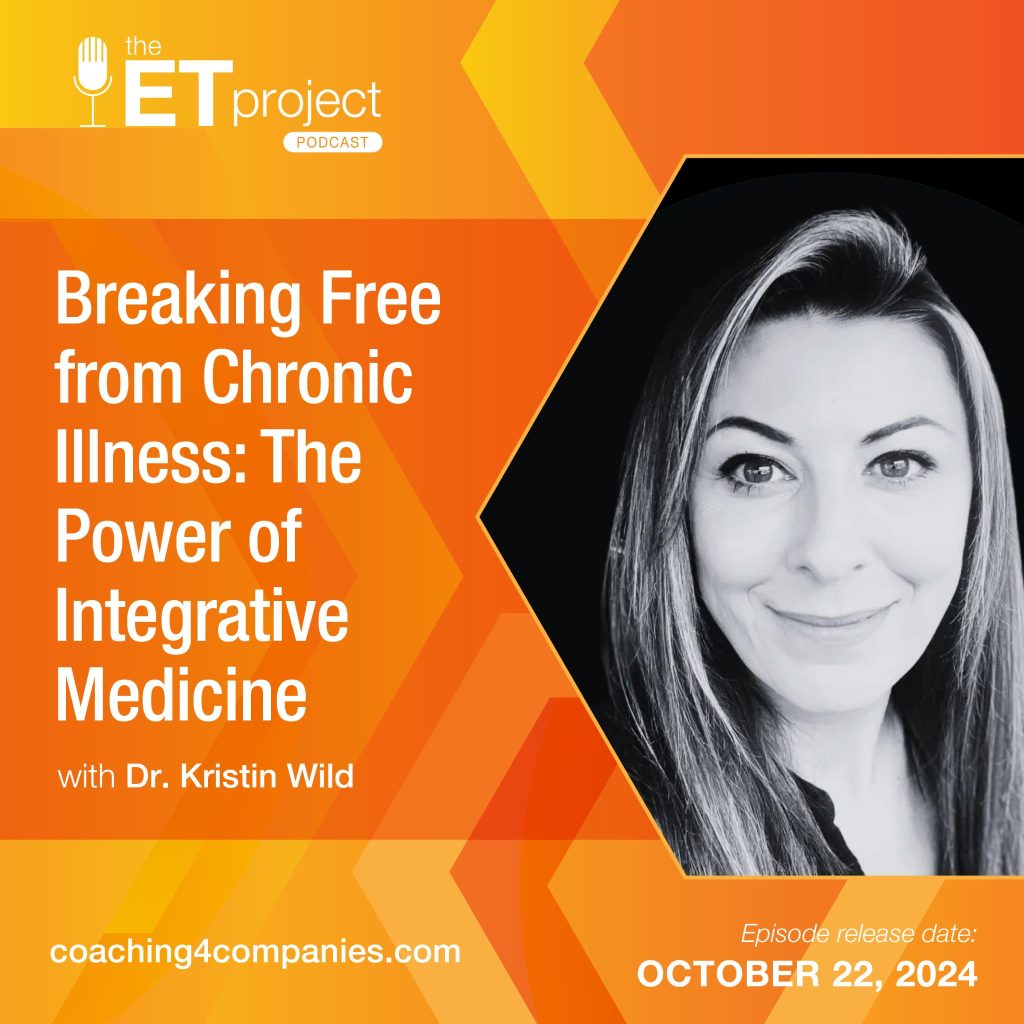
0:00:05.0 WB: Hello, I’m your host Wayne Brown and welcome to the ET Project. We’re delighted to be delivering this podcast for executive talent all over the world, whom we’re affectionately referring to as Team ET. Today we’re visiting with our guests an award-winning holistic health practitioner, educator and speaker who’s based in Kelowna, British Columbia, Canada, Dr. Kristen Wild. Dr. Wild is best known for supporting people experiencing chronic illnesses and mental health conditions and for her contributions in helping women and children escape and recover from domestic abuse. With a passion for holistic healing and a rich academic background, Dr. Wild is a vanguard in the field of wellness and health. As the founder of Modern Health Solution, she brings a unique blend of expertise, holding a bachelor’s, master’s and PhD in metaphysics, complemented by a diploma in applied psychology.
0:00:56.5 WB: A recognized authority and innovator, Kristen’s journey is both personal and professional. Having endured a decade-long battle with three autoimmune diseases that nearly took her life, she delved deep into self-study, formal education and hands-on experimentation. Through this relentless pursuit, she’s unlocked groundbreaking approaches to restoring health at the cellular level.
0:01:19.3 WB: Her pioneering work, including the development of therapy modality, awareness therapy, has earned her accolades and recognition as an award-winning health educator and speaker. Kristen’s expertise extends beyond overcoming autoimmune conditions to encompass quantum physics, natural healing and mental health. A sought-after guest in the realms of podcasts and television, Kristen’s insights and experiences make her a compelling and inspirational voice.
0:01:49.1 WB: She’s dedicated to supporting others in their journey to health, empowering them with the knowledge and the tools to navigate and triumph over their own health challenges. So team, this is a fun and informative journey, coupled with powerful insights into integrative medicine and exploring the convergence of traditional psychology and holistic practices. Join Dr. Kristen Wild and I as we unpack specific actions we can all take to improve our physical and mental health.
0:02:19.1 S3: Welcome to the ET Project, a podcast for those executive talents determined to release their true potential and create an impact. Join our veteran coach and mentor, Wayne Brown, as we unpack an exciting future together.
0:02:36.6 WB: Hello and welcome team to today’s episode of the ET Project Podcast. We’re gonna be having a fascinating conversation. We’re gonna be diving into the world of holistic wellness and exploring the transformative health and healing journey available for all of us, including you, the leader.
0:02:56.4 WB: All right, so today we’re gonna uncover some powerful insights, I’m pretty sure, into integrative medicine. We’ll explore the convergence of traditional psychology and holistic practices and discuss the profound impact that these approaches have on mental and physical well-being. So please get yourself ready to be inspired by our distinguished experts, experiences, challenges, and groundbreaking contributions to this field.
0:03:24.9 WB: Right now, all you need to do is sit back, relax, and prepare to be enlightened on how a holistic approach can elevate every aspect of your life. And here to help us unpack all of this is our incredibly gifted and extremely hardworking, I have to say, founder of Modern Health Solutions, Dr. Kristen Wild. Dr. Wild, welcome to the ET Project. I have a feeling that this is gonna be one of those conversations that people will be talking about at their virtual water coolers tomorrow. So welcome to the show.
0:03:58.3 KW: Oh, thank you so much. Thank you for the wonderful introduction. Glad to be here. These are totally my type of people, and so I’m looking forward to having this conversation.
0:04:09.9 WB: Yeah, likewise. I’ve been thinking about it a lot over the last couple of days, and you have such an interesting backstory. I wonder if you could share just a little bit of the background, particularly from the entrepreneurial side, prior to your transition into the field of mental health and wellness.
0:04:28.5 KW: Sure, yes. So I had no idea I was going to become the person that I am today. And I feel like there are many people that can resonate with that sentiment, where they started going in one direction and ended up in a totally different direction. And then in hindsight, I can see how each piece was a building block. So we really take it back. I’ll give you just a snippet timeline of how I came to be here, because it is a very unique experience, and it just goes to show when you follow your passion, you end up where you’re meant to be. And so when I was in my early 20s, I went to university. I was planning on going into medical school. I’d been planning on going into medical school since I was 11 years old. That was always the destination. And two years into my Bachelor of Science, it wasn’t sitting right, it just wasn’t. That direction didn’t feel right anymore. I started to think more as an adult. I want to have kids one day. I want a family. I wanna have it all kind of thing. And if I’m a surgeon, that’s not an option.
0:05:34.8 KW: It’s just not. And so I dropped out of school, much to my parents’ chagrin, and I moved to a neighboring province, went up north, and became an electrician. My family was like, what on earth is happening? It was like, she had such a bright future. And so, I became an electrician. And at the same time, being an electrician apprentice, I worked as a server at night in a restaurant. So I had this really weird experience of, by day, I had to have no makeup on and look as masculine as possible ’cause it was me and 600 dudes. And then at night, I had to get all dressed up in fancy and look very feminine. And so it was this very interesting experience. But, having those two experiences really brought me into what it’s like to be someone who works. You go and you do your job and you work, and how much tenacity that takes. And so I just have a lot of respect for that. And so from there, I caught the real estate bug. I had been working as an electrician at this point for four years. I had a really great job, very cushy.
0:06:50.8 KW: I’d still be at that company to this day if I had stayed an employee. And so I caught the real estate bug in 2007. You know how it went. It was amazing, especially here in Canada. There was so much money to be made. So I became a real estate agent. I started a property management company. I started real estate investing. I really started just nosediving that. I was obsessed. So I did that for about seven years. And then during that time, I had kids. I had started to develop this illness at the same time because I was just wearing myself down. I was successful. But when you’re a real estate agent, it’s evenings, weekends. You have to be on. And so I was doing it all, but I was not doing well doing it all. And so I decided to stop that, and I went and became a financial services manager for Mercedes-Benz.
0:07:45.0 KW: And so that was my one year of having a job. And it was terrible. I do not like working for other people. So this is what I know about myself. They didn’t do anything wrong. It was a me thing.
0:07:58.6 WB: Eleven years old, you already know you wanna be a doctor?
0:08:01.8 KW: Yeah.
0:08:02.3 WB: Was there a trigger to that?
0:08:06.0 KW: Well, ever since I was young, I’ve had that heart of service. When I was eight, I started volunteering at elderly homes. And then by the time I was 11, I was spoon-feeding people that couldn’t feed themselves and helping tuck them in at bed at night. I was just kind of made for it, you know? I came this way. I don’t know. I don’t know how to explain it.
0:08:27.1 KW: Fair enough. I did hear you talk about, and I’ll go deeper into this a little bit later, but you talked about your grandfather was a great influence on you. I was wondering whether he may have made that suggestion or planned to proceed early in your life, but it seems not.
0:08:48.6 KW: No, that was something that just came to me on my own. And I was fortunate that I did grow up in a family where they were very much about paving your own way. They didn’t really tell me who to be, which can be, it’s a double-edged sword.
0:09:04.7 WB: Absolutely. So now I’m sitting here trying to visualize you’re sitting in medical school two years into it. Now, that’s not a simple feat in itself.
0:09:16.2 KW: Well, it was my Bachelor of Science, so I was about to go pre-med. So I had not gone to medical school. I was definitely on track to go there. But no, so it was two years of my Bachelor of Science, getting ready for pre-med, and I was like, I can’t do this.
0:09:28.2 WB: Where did the electrician come from? It’s what I showed.
0:09:33.5 KW: Okay, well, that’s a story all on its own. So I’m a very stubborn person. So I was in Calgary, and I just decided to move to Calgary, which is in the neighboring province from the province that I’m in. I live in Kelowna, BC. And so I was off to Calgary, and I was having this dinner with people, and one of the people there at the table was an electrician. I said, oh, I wonder if I could do that. And he’s like, you could never be an electrician. And one week later, I had moved up north, gotten a job as an electrician, and I was like, see?
0:10:09.2 WB: Be careful what you challenge.
0:10:11.6 KW: Yeah, and then I spent four years of my life doing it.
0:10:11.8 WB: Now, I’m an electrician as well. So I did my four-year apprenticeship, and I can only imagine. So what year are we talking about here? How far back are we talking about?
0:10:24.8 KW: So that was from 2002 until 2006, I was an electrician.
0:10:25.1 WB: A little bit post my time. So I’m a little bit older than you, but I can still imagine what that must have been like for a female going into a very, very heavily male-dominated environment. It would have been shell shock initially, I imagine.
0:10:50.5 KW: Yes, it’s where I developed my sense of humour and that thicker skin, where it’s don’t take things so personally. It’s not that personal. And again, it was yeah, all men, they’re not used to a woman being there, and so they would say silly things. Some of the men would say, one time he said, I thought you women were going into carpentry these days. And I said, at our last Women Take Over the World conference, we decided, you know what? We need more women in electrical. And he was like, what? It was so. He didn’t have to go with it. It was like.
0:11:27.5 WB: This is, of course, a primer to them moving into real estate. Now I took a similar path, by the way. I also had a real estate business as part of my entrepreneurial journey. So seven years in real estate. Now that’s not a mean feat either, right? It is a fast-paced, no-nonsense, easy to lose a lot of money, easy to make a lot of money in the right climate. And it sounds like you got in at the right time.
0:11:50.3 KW: Well, I love real estate to this day. I still own a real estate company, and real estate still to this day has brought me more income than my job. To this day. It allows me to do what I’m passionate about. I love it.
0:12:06.4 WB: And I share that sentiment. So I know where you’re coming from. And once it’s in your veins, it’s hard to get out, right? And it sort of sticks with you. Yeah. What was the transition? How did you decide what?
0:12:18.4 KW: Yeah, so then well then I just then I just got really sick. And so I started to just get sicker and sicker and sicker, and I was less capable of having that level of ambition that I once had and succeeding in the way I once did. And so I worked for Mercedes for about a year, and It was just something that didn’t resonate with me as a person. And so I got sicker while I was there, because I was not in alignment with myself. It had nothing to do with anyone else or anything else. I was making choices that were not in alignment with who I truly was. I was trying to fit in. I was trying to do what you’re supposed to do in society, as we all go through that phase. And so because I was getting so sick, I was also building a massive property at the same time. And so I focused on that. And from there, I built another company on the side. It was called Zero Waste Supply Company, and we wholesaled and manufactured and produced all of these reusable items to replace single-use items.
0:13:22.9 KW: So that was amazing. That was a whole adventure on its own. While I was learning how to heal myself and learning about spirituality, through all of this too, interweaving, I’d been attending school. I have 10 years of post-secondary education through this as well. So through this, I was getting my PhD in metaphysics, which is one of the four pillars of philosophy, meaning the basic study, the basic nature of things. So that I studied this existence of our consciousness through the scientific lens. So that’s quite the field. And then also, yeah, was raising these kids. So there was a lot going on. In hindsight, I don’t know how I did it, but it happened. It was through the grace of God. And through that, I started to get some answers. It was 2018, I hit rock bottom. My organs were shutting down. I was told I needed four of my joints replaced. I had been living in what you could call a human torture chamber for a decade. It was relentless pain, relentless. It’s very hard to even explain the level of mental and physical anguish that you endure while trying to live a normal life. It’s very frustrating time, to put it lightly.
0:14:38.1 WB: You used the word normal. I would say it was quite extraordinary. Building businesses, going through such agony, and still doing it. What was the motivation behind all of it? What was your higher purpose that you were working towards at that time?
0:14:54.3 KW: I’ve always been driven that I have something to do here. Didn’t know what it was. I finally feel very aligned with that. I feel many people can relate to this. It’s just that I have something to do. And so that’s why you jump around and hop around to all these different things, trying to figure out what it is. Then you kind of finally do, and it starts going click, click, click. Then all of a sudden you wake up and you’re in it. And so, for me, I always just had that innate motivation. It was also my children. My children kept me alive, and that’s the honest truth. Because there was times where if they said, take this pill and it’ll all be over, I would have. Some people know what it’s like to live in the depths of hell, wide awake. And yet, in hindsight, it’s the greatest gift you will ever receive. It makes you so fearless. It makes you realize that the biggest problem you could ever have in your life is regret. That’s the biggest concern you can ever have in your life is regret.
0:16:00.4 WB: Was there any sacrifice you had to make during this journey? I’m sure there was so much going on in your life. There must have been some things that you couldn’t do.
0:16:06.9 KW: Yeah, take care of myself. That’s what I did wrong. That’s the one I had to learn the hard way until I was literally on my deathbed. And I was like, oh, wait, I’m a person. Maybe I matter. Maybe to help other people, I need to be healthy. And this is the lesson that a lot of people have to learn.
0:16:28.0 WB: Yeah, for sure. On this journey, I’m a great believer that we don’t do anything to our force if we’re trying to go on the journey by ourself. I’m not sure about yourself, but did you have any mentors, coaches, advisors? Who was on that journey with you at the time?
0:16:45.1 KW: So, that’s the thing is I haven’t, up until this point, really had an in-person mentor. It’s been books and teachers. Dr. David Hawkins is an amazing spiritual teacher. I recommend him to so many people because he was a psychiatrist who went through a spiritual evolution. So, he speaks logic, which so many of us, that’s how we learn. We wanna know the how, what, and why before we believe it. And so I listened to hundreds and hundreds and hundreds of hours of his lectures, among many other teachers. And I feel like I’m their student. They don’t even know who I am.
0:17:27.0 WB: Let’s touch on some of the studies and the research that has shaped at least the last part of your career and up to the present day. There’s a number of studies you’ve done. You mentioned metaphysics. I think you started, though, with applied psychology at some stage, right?
0:17:43.7 KW: Yes, I went back to school after I healed myself. I’ve been in remission for six years now. And after I did find healing and really get a foothold in that, I went back to school and got my applied psychology degree so I could explain to people this mind-body connection and how this psychosomatic connection is real. And to me, the body is a channel. When we clear that channel, when you literally clear the cells, they’re bogged down. They’re full of these receptors. They’re bogged down by heavy metals and cortisol. We have this very anxious society. What’s being released by your brain? Neurochemicals that are disease-feeding. And so, It’s really getting to the root. That metaphysics degree that I took for no reason came in handy ’cause it’s like, oh, we wanna get to the basic nature of this. What’s happening at the most basic component within the body? Once we clear that, it’s funny because you naturally become more spiritual because you’re open now to your higher faculties.
0:18:49.7 WB: Right. When I was reading about this, I thought, because you also did quantum physics and then you did the metaphysical. But it’s metaphysical science. So it’s, as you said, so I was trying to think philosophy versus quantum physics. It’s almost opposite ends of the pole, but there is that connection there.
0:19:11.5 KW: But they’re not because this is the thing, this is how scientists come up with theories is they philosophize.
0:19:17.2 WB: Is that a word by the way? Because I use that word that I often say to.
0:19:23.4 KW: I like it. Sounds good.
0:19:25.7 WB: I love it. Philosophize. I’m digressing now. But we do a little activity during our programs and I call it philosophizing where we play Greek philosophers and we walk around the room thinking about what we just talked about.
0:19:40.1 KW: That’s great.
0:19:41.3 WB: So I love that. I love that. Thank you. You’ve covered some really deep topics in your learning that’s led you into where you are today. Quantum physics is not for the faint of heart. Metaphysics as well, not for the faint of heart. You’ve done applied psychology and then you come up with this concept of awareness therapy. Could you share a little bit about what that is and what’s it involve?
0:20:08.1 KW: Yes. So, It comes from Carl Rogers Center-based therapy. So when I was studying, I really did like that concept where he says, awareness in and of itself is curative. So when something comes to someone’s conscious awareness, it’s because it’s now in their visible field. They have the power to do something about it. And I was like, that’s a really interesting concept. And now when we take it one step further, we don’t know what we don’t know. So sometimes we need to go to an outside source that might have some answers that we don’t have. And so it’s not that you’re not, you’re still doing that work. That awareness therapy is still this introspection. It’s all about the inside out. And yet sometimes you do have to go to your environment and say, I don’t know about this thing. Unfortunately, some people just go down the Google rabbit hole of information. And there’s a lot of information out there and not a lot of knowledge. And that’s something I had to discover myself as I went through this experience because I had no choice but to learn it. It was literally do or die. And so I was like, well, I’m here now. I’m still alive. I might as well try and figure this out.
0:21:20.0 WB: When you talk about inside out, so you’re talking about more self-awareness.
0:21:27.4 KW: It’s that introspection.
0:21:30.9 WB: Introspection.
0:21:32.4 KW: Being within watching your thoughts like you’re an investigator, not like you’re judging yourself. This is very different. So a lot of people need to learn that they exist, they’re a person, and they matter. And it starts with those inside thoughts. There’s so much internal criticism. It could stem from the past or even current relationships where you’re kind of in a victim role, right? Where you’re being criticized, put down and you’re not trying to cause harm to them, but they’re just at you. And so what happens is you can end up taking over for them when they’re not around and you repeat those into yourself. And so it’s really awareness about those thoughts and looking at them more of an investigator of where does this come from? Does this serve me? What happens to me when I believe this? And then flip what I call flipping the script, what would you say to yourself or to someone if they were three or four years old, how would you talk to them about that? It really changes your internal dialect. And you will notice once your internal environment starts to clear, so does your external environment, you respond to people differently. You don’t take things as personally. You learn to avoid certain relationships where it’s like, oh, I don’t need to participate in this. I could actually just say, thank you.
0:22:49.9 WB: That really then becomes the self-regulation part. Is that correct? Right?
0:22:57.2 KW: And this is the thing, you have so much internal peace, and it’s not that it doesn’t get disrupted. Oh, the challenges get harder. But the thing is you become more resilient. You become more powerful. And then when those challenges come up, a friend of mine always puts it like this. I love this analogy. It’s like mosquitoes. They’re annoying. Sometimes they bite you and it’s itchy, but you’re not gonna die. You’re not gonna die. And because you just have so much internal self-worth, internal knowingness, and you build that through belief systems, it can be created.
0:23:27.9 WB: I know you talk a lot about thinking, feeling, and then behavior. So the CBT concept. So you think we have the emotion, then we act in a certain way, and you then just throw in a word called resilience. I think that is often left out of that equation because we’re in this repetitive loop of thinking, having the emotion and then the behavior. And it’s all driven by what’s going on up here in the chemical releases and everything. How resilient we are to be able to deal with the day to day, the moment by moment is really a challenge I find for many people, myself included.
0:24:15.1 KW: Everyone, we’re all here together. We all know it’s crazy out there you guys.
0:24:22.2 WB: So if somebody comes to you, how do you help them with this process in the first instance? I know it’s a journey.
0:24:29.9 KW: It is.
0:24:30.9 WB: But how do you help them in the beginning?
0:24:32.6 KW: The foundation is mastering our thoughts. There’s no way around it. And I often say this to people, I didn’t make the rules, but I know how to follow them. So people get mad at me about it all the time. And I’m like, listen, I didn’t make this up. I just discovered it. And so and it is really the foundation of all health is mastering those thoughts. Because to me, if our brain is not operating properly, that animal brain is still there. It still exists. Typically when you develop a prefrontal cortex like we have, you don’t really need that part anymore. But it’s still there. So it likes to take over. And what happens is, is we get more into anxiety loops and these fear loops, it literally strengthens and becomes larger and less blood flow goes to the prefrontal cortex.
0:25:22.8 KW: We’re not making as great a decisions as we would like to. And this is again, why, for me it was so important to bring in the support system. Because if I had something like this, I would’ve avoided that, taking it to the brink. Because I just didn’t know. And that’s fair. Most people just don’t know what to do. So that support of handing the tool to people and they’re going to use it, how they’re going to use it. I don’t know if you’ve heard that metaphor, but there is a thousand ways to use a hammer. So each person’s experience through healing and going through that, it’s their own, but the feeling is the same. So a lot of the stuff we do is being empathetic in the feeling that people are feeling because even though my story’s not the same as yours, oh, we’ve both been through the stuff. We can connect on that feeling of that experience that we had. And then, okay, how do we flip the script on that is our terminology here, and how do we turn those thoughts around? So we’re now in a health building spiral not a disease feeding spiral.
0:26:35.0 WB: Right. Well that’s a great segue into the area I wanted to get into a little bit, is your business, Modern Health Solutions. When I was looking at your website, the team that you have is quite extraordinary. How did that all come about? How did you set out to build this business and bring this team together?
0:26:54.9 KW: By the grace of God I’m telling you. I still wake up every day and I’m like, is this real life? And it’s also not without challenge. This is why it’s very important. Even when I know we are speaking to people who are in leadership roles, it’s very important to be humble and know when to take the humility. And because we are all human. I’ve had so many, what we call tower moments recently, where it’s things just crumble away because we need to get brought back to our foundation, who we are, what really matters. This came together in a way that I couldn’t have planned it myself. It’s just the right people showed up at the right time. I’m just so fortunate because the people that first came into our program when we started, I was still like, me, I’m supposed to be teaching this and we grow into it. We grow into who we want to become over time. So one day you just wake up and it’s happening. And then you get introductions like I got today. And I’m like, me, they’re even talking about me? And we all go through that. And everyone of us has these talents and gifts to create something like this. This is just mine. This is was my talents and gifts being used to the best way they could. And it’ll keep evolving. And it’s the same thing for everyone has this in them.
0:28:21.3 WB: Right. There’s a term that is used fairly broadly globally. I would suggest holistic. For me, it’s referencing multiple factors being involved in the solution. Is that correct?
0:28:36.9 KW: It is correct, yes. It’s that whole person care. So at this point, we cannot deny. We’re energetic beings. It’s measured, people are winning at Nobel Prizes for this. So it’s a thing you guys. So it’s like, I don’t even need to prove it to you. If you wanna look at it through a scientific lens, 100% we’re electromagnetic beings. There’s something to that we can call that spirit. We can call it higher consciousness. We can call it an electric field. You can call it whatever you want. The fact is, it is. And so when we don’t take that into consideration, we only take into consideration what we see and physically feel. We’re missing the point because we are conscious beings and we have these very powerful brains. We are the technology. We are prepared and ready to expand and become more than we ever could have imagined we’re capable of becoming.
0:29:30.5 KW: And we are there, we’re essentially at the fountain of youth when it comes to health. But it takes the mastery of the mind. You pop all the pills in there, all the peptides, all the amazing things they’re doing to work with biology. This biotechnology is great. This is where we’re getting into integrative health. It’s really good technology that helps the existing human body as it is how nature created it. We’re there. And so we have to take into consideration all of these parts to be healthy and whole, and to have a nice time to love an experience in life where we feel good. We have to clean it up. It’s up to us.
0:30:08.6 WB: Well, when I was listening to you, I just had a flash of recollection. People like Wayne Dyer, some of these visionaries from earlier times were quite remarkable when we consider how accurate a lot of their claims or suggestions are turning out to be.
0:30:26.9 KW: Yes. The Hay House authors. So I went to an I Can Do It conference in 2015. It was it 2015. It was just before Louise Hay and Wayne Dyer passed away. I think it was the last live conference they did. I met Louise Hay in an elevator and it was so hilarious. ‘Cause I was standing beside her and I was like, I touched her arm. And I’m like, I love you so much. I love you. I love you. And she was the sweetest, just like so gracious about it. ‘Cause I was just like, star-struck. And she was like, just soaking the love in, just soaking the love in. And it was just like her, she is who she is. And Wayne Dyer was there. And Anita Moorjani, Greg Braden, Bruce Lipton, Caroline Myss was there, I believe. And these are my teachers. These are the people that a lot of this information came from Joe Dispenza. They put all a lot of this information together so that people that are doing what I’m doing, they’re able to take these pieces and connect them together to provide help in other aspects. So I feel super grateful for these teachers because they paved the way for so many, and then now we’re coming full circle, coming to where they were when they left off. And it’s just like next level.
0:31:43.3 WB: We tend to be skeptics at heart. But I feel there’s a, let’s say a movement towards acceptance at this stage.
0:31:51.7 KW: Again, we can explain this from a scientific point of view, which I would gladly do right now if that helps people because I know it helps me. And so right now we have huge solar flares coming from our sun. The day of this recording, it is record, record solar flares today and yesterday. And so what that does in our planet is it affects our electromagnetic field. This is why we’re seeing Aurora Borealis really low down and where people never really seen it before. It’s because these solar flares, that’s a lot of radiation. It’s putting towards our earth. People get nervous about it. No, it’s, there’s nothing wrong. This is good for us. It’s very healthy actually because what it does is because it’s affecting our electromagnetic field that comes into our earth. Our earth has its own resonance. It’s called the Schumann Resonance. Many people would’ve heard of it but if you haven’t look it up. It’s very interesting. And so it resonates with us. We are in tune with the Schumann Resonance. Where it used to be was more in this meditative state, unconscious kind of liminal state. Well now, because of all of the activity, it has risen to a brain state wave of more alert awakeness. It is literally waking people up, literally, because our brain is resonating with the earth’s resonance. And that’s what’s happening. It’s science.
0:33:14.9 WB: If I’m a corporate leader audience predominantly leaders or even an entrepreneur, how can I take some of what we’re talking about here and integrate, let’s say, the holisticness or the holistic practices into my life and gain the benefits that you’re suggesting?
0:33:35.0 KW: Yeah. And this is the thing about leading. It’s not about trying to control or convince any of the people that you’re working with. It’s about transforming yourself and being a living testament. That’s it. Focus on yourself. Focus on how you can do better, how you can be more loving, how you can be more forgiving, and more compassionate. And also a steward of that. So this is the thing, as people evolve, they think it’s often people would think of that as weakness. No, it is isn’t at all. You become stronger in your boundaries. You become stronger in what you stand for. And doing it in a kind and loving way. It’s a, I’m going to, I’m about to swear, so you might have to leave it out, but it’s called do no harm. Take no shit. And if you can master that in life, you have life dialed in, if you do that in every aspect. So as a leader, focus on that. Focus on that one thing. Do no harm. Take no shit. Because learning how to be compassionate and caring towards others, and also not allowing people to railroad you. It is a talent and a skill. And it’s the ultimate talent and skill. So just focus on you.
0:34:47.9 WB: I like that. Autoimmune disease. I wanna bring this into the conversation. It’s something that you suffered with, is that correct? Right?
0:35:00.3 KW: Yeah.
0:35:00.4 WB: Let’s define it first. What is autoimmune disease?
0:35:05.1 KW: So autoimmune disease is being an out of alignment with nature, in my opinion. It is being out of alignment with your authentic self, with who you really are to such a degree. Your body starts shutting down. And so this means with our food sources, this means with our movement, this means with our connection to the earth, because we are created of material of the earth. And when we’re disconnected, we are not getting the negative ions we require. So we have all these free radicals and positive ions all over our body that are not getting discharged. So, and the sun, it helps us release certain hormones and chemicals into our body for health. There’s reasons why we are meant to be connected with the earth and how it was intended by nature. We are so disconnected from nature and who we really are that we’re getting sick.
0:35:57.2 KW: And then because we’re getting sick, it compounds. There’s also a lot of fear mongering in social environments that’s producing the neurochemicals that are compounding it. Heavy metals, there’s all these things and it’s like, ah, there’s so many things that’s overwhelming. Yes, it is. But when we get down to the root of how we clear it becomes very simple because it’s all the same. It’s about clearing our diets, clearing our thoughts, changing how our thoughts are. And then the healing is a natural side effect. It is a byproduct just like the illnesses a byproduct. Right now they say in 2025 in the western world, so these would be commonwealth countries and America, they estimate one in two people will be diagnosed with an autoimmune condition. And 80% of those people are women. And so because of our tendency it tends to be women tend to be more of the one that will take on more and more and more that martyrdom and not realizing how far they’re going.
0:37:06.6 KW: And it happens to men too definitely. It’s becoming more and more men as well. Our society is very overwhelming. And we can fix that though. It’s not hopeless. And this is where we it gets compounded. ‘Cause you get in this victim mentality, been there myself, where it’s like, why is this happening to me? The mental anguish that comes along with it is really it’s the most severe part. So autoimmune essentially breaks down to fatigue, inflammation somewhere in the body. Brain fog is huge. You can’t think like you know you used to think differently, and now it’s like you feel like you just can’t think clearly. And there’s a slew of other symptoms as well that can come along with it. But those are really the foundational ones. There’s usually some sort of pain associated with it whether it’s nerve pain, joint pain, skin pain, pain in the brain, pain in the membrane. There’s usually some side of component with that. So most people are dealing with some sort of autoimmune symptoms at this point.
0:38:15.2 WB: I read a, well, I thought it was quite neat definition or description. It says, imagine that you’re an army and your body is sort of the complete army and the soldiers within the body turn against the body. It’s sort of like your defense mechanism starts to challenge your whole self, right?
0:38:41.3 KW: Yeah. Well, yeah. Think about that. When the neurochemicals from your brain and the foods you’re putting into your body are communicating to your cells, Hey, we’re in survival mode. We don’t have nutrition, we don’t have and there’s all this cortisol in here. Your cells go, okay, let’s downgrade the DNA, we’ll put out crappy DNA essentially so that we can survive. We’re in survival mode. And so that’s what the cells are doing. You’re made up of trillions of individual organisms to create this walking, talking, being is pretty amazing. It’s a miracle, really. And so what we need to do is clear those cells, clear those pathways so that nutrition can get in, so that those new healthy neurochemicals can attach the cells and say, Hey, we’re safe. The nervous system calms down and then what happens? The genes start to upregulate again. And we get that healthy gene production and those diseases that had popped up in the garbage DNA now disappear.
0:39:40.1 WB: There’s so much incredible potential on the horizon within the medical fraternity that I see at the moment. The use of placentas to help with that regeneration of the cells, etcetera. What’s the duration for this, the start to take effect? Like somebody who has chronic illness or even worse, like they’re suffering from stage four cancer. Is it too late for people at that stage to reverse the process?
0:40:19.6 KW: No. I’ve seen people come back from stage four cancer so many times that I’ve seen people come back from the brink of death so many times. You can’t convince me than anyone, I mean myself. I was there and a really good book for that is Anita Moorjani Dying to Be Me. She was stage four cancer. She died. And she talks about how she went to the other side and her experiences. And when you hear her talk about it, you can tell she’s telling the truth. It’s amazing. And she came back from the brink of death and fully recovered from cancer. So it doesn’t matter where you’re at or where you’re starting, even if it is your time to go. You can go in peace.
0:41:00.7 WB: Is there anything we haven’t spoken about today that you feel is important that would be great to share with the audience?
0:41:08.7 KW: I feel like it is important for people to really take it easy on themselves. We are traumatized generation raising traumatized generation, raising traumatized generation. And we are the generation intergenerational the people of this time that are the ones that have the gift of becoming aware and going, oh, this isn’t right. And we’re also the ones that are responsible for doing something about it. And that’s a big job. It is what we’re going through right now as a collective, as a humanity is not for the faint of spirit. And also just stay focused on the light. We’ll call it. Stay focused on your higher consciousness, your higher faculties, stay focused on God, on source, whatever it is that resonates to you, stay focused on that. There’s gonna be chaos all around. Ignore it. The best thing you can do to cope with this level of chaos or disturbance in your life is to avoid it. So move away from it and focus on that on the positivity, the good, what we’re building. There’s so much hope, there’s so much light. Global crime has been reducing year after year, yet we’re getting fearmonger more than ever. We’re becoming more peaceful as people. We’re evolving and it’s happening. So have faith and stay steadfast in that.
0:42:31.2 WB: Is there anything coming up in the future, in the near future? Are you working towards anything new?
0:42:37.9 KW: Oh my gosh, yes. So it’s one of those things, there’s many things on the agenda, but the things I’m most excited about is getting back to connecting with people. So I went very far into helping build private healthcare systems, etcetera. And that’s been amazing. And it’s really shown me a lot about who I am and what I’m capable of. And now of course, it brought me right back to where I started. And so I’m reopening my private practice part-time and I’m charging standard market rates because healing is for everybody. We’re also opening up programs that are no cost. So there’s all this time, I am looking for these avenues and channels of how to bring either no cost or low cost services and programs to people to really help them, help them heal. And I’m looking for all these avenues to do it. And I was like, one day I’m like I have a platform. I have an avenue. Why don’t I just do it? And so then I was like, oh, yeah, I can’t do anything alone. So I talked to my team, they’re all on board and it’s amazing. Again, something that just took off. And so we are gearing that up right now as we speak. This is all being brought to the public and I’m so excited about it. It feels so good.
0:43:55.0 WB: It sounds extremely encouraging and interesting. If I wanna follow and I wanna connect with you, how do I go about that?
0:44:06.8 KW: Yeah, you can go to modernhealthsolution.com and it’s solution without the S. I know when I named my company, you don’t name it something that you can put an S on the end but I did. And so it’s Modern Health Solutions singular.com. And that’s a great place to start for services in there. You can also go to drkristinwild.com. All I’s no E’s. And there you can see about other more corporate things that I do that are aside from Modern Health Solution and our real estate services, which I don’t talk about a lot, but it is a crazy good company. I love it.
0:44:43.0 WB: So where do you find about your real estate?
0:44:48.6 KW: It will be on drkristinwild.com. It’s a company called British Columbia Mediation and Consulting. So that’s mediationandconsulting.ca. So it is an amazing company. We build out feasibility studies and do create different options for land development so that investors can get the most money out of their land and you can do the most creative things.
0:45:14.5 WB: Thank you for sharing some incredible insights today. I really appreciate it.
0:45:18.3 KW: Oh, thank you so much, Wayne. So appreciate you having me on here and creating this platform. ‘Cause it’s not easy to do. I know that. So definitely appreciate all the work you do in bringing messages to people. That’s so important.
0:45:31.9 WB: Thank you for joining us on the ET project, a show for executive talent development. Until next time, check out our site for free videos, eBooks, webinars and blogs at coaching4companies.com.