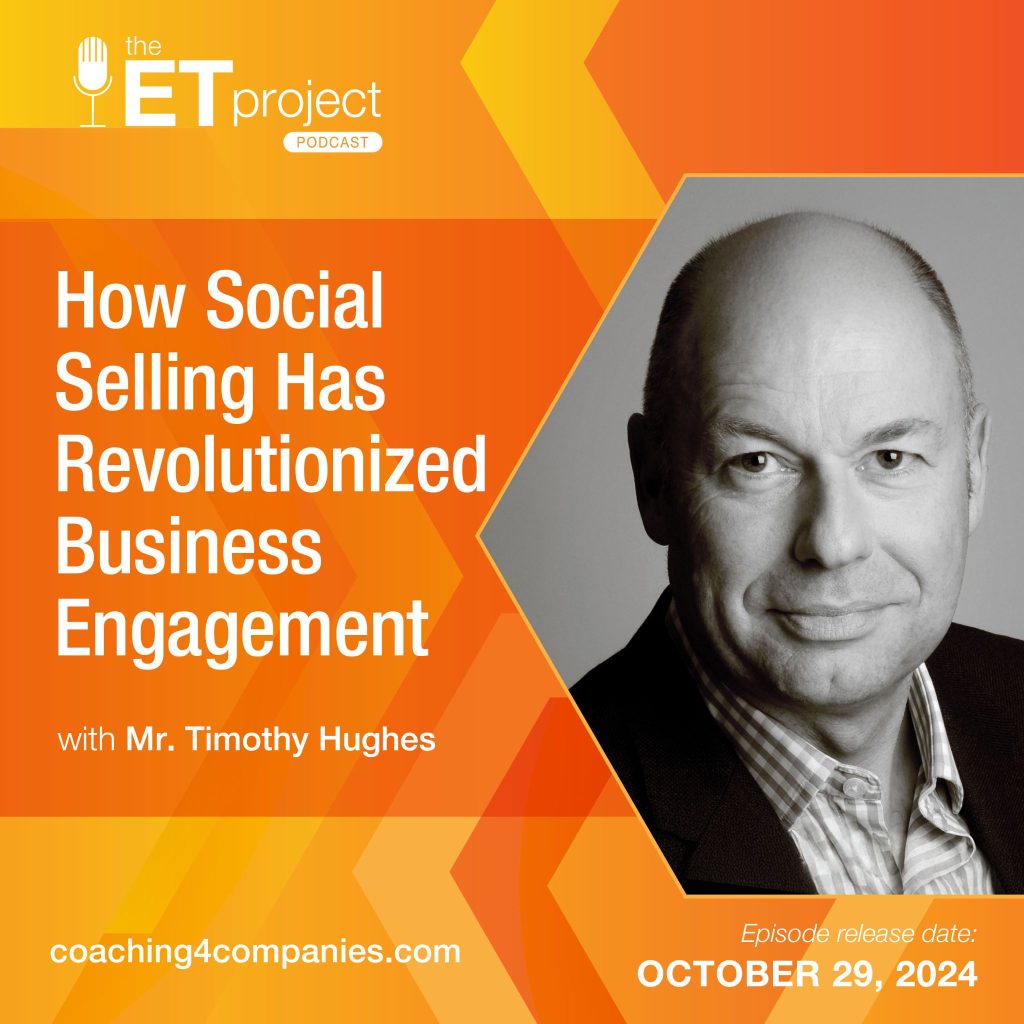
0:00:00.0 Wayne Brown: Hello, I’m your host Wayne Brown and welcome to the ET Project. We’re delighted to be delivering this podcast for executive talent all over the world, whom we’re affectionately referring to as Team ET. And today we’re visiting the old Blighty again to chat with Mr. Timothy Hughes, our social guru extraordinaire. Tim resides in London and is co-founder and CEO of the global social selling company, DLA Ignite. He was listed as one of the top eight sales experts to follow globally by LinkedIn in 2021 and has been ranked as one of the most influential people in social selling by Analytica. His book of the same name, Social Selling Techniques to Influence Buyers and Changemakers is what we spend a large portion of our time discussing. From defining changemakers through to providing key tips and suggestions on what you can be doing to ensure that your social community is being served with quality resources that bring value and thereafter the potential to engage with new business.
0:01:07.9 WB: And as Tim says, do you want to be part of the noise or do you wanna be heard? Here’s an extract from a recent post by Tim. What’s changed in 2024 from 1980? It would seem very little, but buyers now expect to live in a zero interruption world. And we still hate being sold to. In fact, buyers have become skilled at hiding away from suppliers. Data shows that buyers hide away from the suppliers until there’s 75% of the way through the buying process. That statement alone team is reason enough for you to join us through this conversation. So get yourself ready as we dive headlong into the virtual space. It’s probably a great time for you to have your social media platforms open so that you can be reviewing your own level of community as Mr. Timothy Hughes and I address the question, are you a social selling change maker?
0:02:09.2 S?: Welcome to the ET Project. A podcast for those executive talents determined to release their true potential and create an impact. Join our veteran coach and mentor Wayne Brown as we unpack an exciting future together.
0:02:22.7 WB: Hello team. Welcome to the ET Project podcast. Today we’re diving into the exciting and transformative topic. Are you a social selling change maker? Social selling, as you all will be aware, it’s evolved rapidly. It’s reshaping the way business connects with the market and drives sales. It’s not just about leveraging social media platforms either. It’s about really building authentic relationships and communities, establishing your authority and influencing buyers in very meaningful ways. And our episode today, thanks largely to our guests by the way, is going to be brimming with insights that you won’t wanna miss a moment of. So sit back, get your pads ready and as always, we’ll be letting our guide, our guest, I should say, guide us through the maze as we deep dive into the world of social selling and our guest, as you would have heard me introduce him in the intro, is none other than our social selling influencer extraordinaire, a gentleman that I kindly refer to as Mr. Vinyl, Timothy Hughes himself. Tim, welcome to the ET Project.
0:03:37.9 Timothy Hughes: Hi Wayne. It’s an honor to be asked to come on your show. Thank you so much for having me. I’m really excited to talk to you.
0:03:45.3 WB: Last time we spoke, I think you told me your vinyl record collection was around the 2,000 mark. Has it grown since then?
0:03:54.8 TH: I think it grew by one today, yes.
0:04:00.6 WB: Very nice. Do you actually get much time to sit back and listen? I know you’re extremely busy, but where do you find the time to sit back and enjoy the music?
0:04:11.0 TH: I sit and listen every evening. It’s part of what I do. I don’t watch a lot of television and so listening to music is what I like. In fact, last night I was invited to listen to go into Universal Music’s Dolby Atmos studio in London, where they were doing a playback. They’ve just brought out Dolby Atmos versions of the two albums, Thin Lizzy Jailbreak and Thin Lizzy Johnny the Fox. There was a Q&A with the guitarist, Scott Gorham. I was able to meet him and I got a selfie with him and asked him questions and stuff. It was pretty amazing.
0:04:58.1 WB: Very nice. Let’s jump into a little bit on the business side. If you don’t mind sharing some of your professional journey and what led you to co-found DLA Ignite?
0:05:08.8 TH: Yes. I’m a salesperson. I’ve been in sales for 25 years, business-to-business, enterprise. I’ve worked at Oracle twice. I’ve worked in their partners. I ran a partner for a little while as well. I was on the board in the UK and it would have been probably about 2013 or 2012 or something. I started getting bored with that and I decided I wanted to do something else, and I didn’t know what. I started getting involved in social media. The two things clicked, really. I then basically got my first book deal back in 2015. I produced the first book on social selling, which is this with the white cover, Social Selling Techniques to Influence Buyers and Changemakers. It was the first book published on social selling. I did that with a co-author, and we were battling away, making sure that we were the first.
0:06:12.4 WB: What is it that the business does and what’s the value it brings to the market?
0:06:17.1 TH: We’re an agency that focuses purely on social media, strategic social media, and helping organizations. What we do is that we empower people to use social, so we train people. We focus, as I say, mainly around social and social selling. Even though we deal with sales, we’re not interested in doing compensation or territory planning or anything like that. We just focus on social and we’re the only company in the world that does it, but actually wider than that because social can actually impact far more areas than just sales. I know we’re talking about sales today, but it can impact HR. We know that your employees are on social, your future employees are on social, your prospects are on social, your customers are on social, your investors are on social, your future investors are on social. It can actually impact the whole of the business. So what we do is that we transform organizations using strategic social media. Again, we’re the only company in the world that can do this.
0:07:26.1 WB: It’s really interesting. During the research around the company and yourself, there’s a lot of things I never realized where the social has infiltrated to the extent that it has. As a thought leader in social selling, you’re one of the leaders worldwide in understanding the application, understanding the impact it can have. With the market being so dynamic from a technology point of view, have you seen the social selling landscape evolve dramatically in recent years, or is it just progressing as expected, I would say?
0:08:02.5 TH: Well, it’s progressing. My business partner is called Adam Gray. We set the company up, DLA Ignite, eight years ago, and we said that social media would become strategic for organizations. And what would happen is that gradually people would take up social media. We were laughed at. We were told it was a fad, it would go away. And now 63% of the world’s population is active on social media. When I mean active is the average person spends two hours, 23 minutes a day on social media. And we’re having conversations like this. And in the past, we called it social selling. Now it’s selling. We live in a world of zero interrupts. No one’s interested in your spam emails. No one’s interested in cold calls. Nobody’s got any pipeline. And the only way that you’re gonna get pipeline now is through using social and using it strategically rather than… So many organizations are just either spamming with it or using it tactically, and they’re not getting very good results. And it’s just like using any other sales methodology. They need to actually come into 2024 and actually realize that 1980 and 1990 sales and marketing methods are no longer really relevant.
0:09:26.8 WB: It was gonna be one of my questions about how much has it changed in the last couple of years since you released the second edition? It sounds like it’s continued to change and evolve because I know in the second edition you talk about there is still some balance between the two, but it seems like it’s gone further past that point.
0:09:46.5 TH: Yeah, we saw a change take place during COVID. And certainly what we’ve seen is with the change with AI. What’s happening at the moment is that the people out there are being promised that they can somehow or other get meetings with people by using AI. Currently, people can’t get meetings. Why? Because no one’s interested in what you’re talking about. And everybody goes to the market and says the same thing. Why my product? Because we’re great. And the promise that AI is giving you is that we’re gonna be able to create more and more content of the same content that isn’t working right now.
0:10:34.3 WB: More noise.
0:10:35.3 TH: Yeah, so basically what people are gonna create more noise. So you buy the app, the competition will buy the app, and there’ll just be more and more noise and it won’t cut through. People aren’t interested in your products. People aren’t interested in your services. They’re not interested in all this brochure and brochureware that’s being pumped out onto social media. In fact, all of that is pushing your customers away. People are spending billions in basically trying to push their customers away when they think it’s actually trying to actually get them meetings and it’s just not working for them.
0:11:09.9 WB: How large scale is the realization that companies need to be making this transition to social selling? I come from a very traditional industrial industry and my experience is that it was very, very minimal.
0:11:23.8 TH: Yes. When Adam and I started the company, we thought it would take 18 months before everybody would work out. And here we are eight years later and people still think that going back to 1980 and making loads of calls, going back to 1990 and sending spam emails, and this is gonna help them. We know that the data shows that sending spam emails has a 98% failure rate. We know ’cause the data shows that making cold calls has a 99% failure rate. And people think, well, what we’ll do is we’ll make more calls and we’ll send more emails. Really? There isn’t a correlation between it. It’s just not working for people. And we’ve seen all the layoffs that have taken place and we’ve seen the IT industry shrink because they’re still wedded to the realms of 1980 and 1990.
0:12:22.8 WB: Exactly. So that’s the old methodology, the old mindset.
0:12:28.0 TH: Yeah. When I started selling in the late 1980s, you could make cold calls because there wasn’t the internet and actually people wanted to talk to you ’cause you could tell them what was going on. But that’s not the case anymore. You’ve now got access to an infinite amount of information. If I wanna know about your products, I can go onto your website and I can find them. And that’s what people are doing. We now know through research from Sixth Sense that buyers are now 75% of the way through the buying process before they contact customers. They actually know which product they want to buy. They may contact three people ’cause what happens is you get three prices. But at the end of the day, most buyers, when they’re contacting people, they know what it is that they want. And what salespeople have to do is get back control. How to get back early. We’ve been trying to do this for all of sales. Certainly the time that I’ve been in sales, get back early into the sales cycle, take control, influence early, and do all of those things. And they’re just not doing it.
0:13:41.3 WB: The concept of the buyer’s cycle and trying to get in at the latent pain stage or thereabouts, it’s pretty much dead now. So you feel that we’ve reached that tipping point where social selling and the whole social environment has really started to educate the buyer to that point where if you’re not doing it through the social and you’re building those communities, you’re really missing the mark.
0:14:12.5 TH: Yes. This is not, ’cause a lot of people that will come on your show and talk about their opinion. What I’m doing is I’m using data to back that up. We’ve been running a benchmark now for the last… So in September, it’s September 2024, when we’re recording this, it’s 20 months old, where we measure our customers. So the average person using our social selling methodology, SDR, who’s using it, is getting two meetings with our ICP a day. The top ones are getting 25 a week. You cannot get that level of response from cold calling or sending spam emails. Now, as I say, this is data. We’re not using spam. We’re not using any automation. We’re not using any expensive sales technology or anything like that. This is purely by teaching people how to use social media strategically, how to understand the psychology of the modern buyer, and how to go through a process which they follow every day. That’s the sort of results that they can get. You cannot get that anywhere else.
0:15:20.5 WB: What about things like going to networking events? How does that compare and stack up to the social selling?
0:15:30.9 TH: Well, I don’t have any figures for that. I wouldn’t be able to compare that. But I’ve seen somebody on LinkedIn basically going, Yahoo, I can get 10 meetings a month by using cold calling. Wow, I can get 10 meetings a week using social selling. Why would you do something that got you a least result? Why would you want your company to do worse? Why would you want less profitability? Why would you want your company to be overtaken by your competition? It’s not logical. Why would you do something that doesn’t actually help your business? Why would you do something that makes you stand out to your customers as if you’re an annoying little spammer? Why would you do it? It doesn’t make sense. It’s 2024. Why are we justifying 1980 technology in a 2024 podcast? It doesn’t make sense. Why would you go out and piss people off? What I need to do, Wayne, is a lot of people think that social selling is basically sending spam messages over social. It’s not. Sending spam messages over social is sending spam messages. It’s not social selling.
0:16:49.6 TH: My definition of social selling, and I need to read this to you, which is using your presence and behavior on social media to build influence, make connections, grow relationships and trust, which lead to conversational and commercial interaction. I will get some people saying to me, yeah, but I can pick up the phone and get hold of people really quickly. Yeah. I can get two meetings a day using this social selling methodology. It’s like, what do you want? Do you want the two meetings a day, or do you wanna fail your business? It’s really down to the choice that you wanna make.
0:17:27.4 WB: Right. Now, of course, there’s some nuances that probably are influencing the way people are reacting, one being that we have still a presence of 20th century leadership in the 21st century. Therefore, we have that mindset. The other is, a lot of the leaders will be looking at it and saying, do I really want my sales team playing on social media the whole time? I wanna start with defining the term changemaker in this context of social media, social selling. I think it’s an important distinction. If you don’t mind, if you could just talk us through what that is and what are we talking about there?
0:18:13.4 TH: Yeah. In sales methodologies, you quite often you get different terms of people. You’ll get an internal salesperson or the economic buyer, which is the person that signs the check. Those are the terms that you get. This new one, changemaker, is one that isn’t used in any of those sales methodologies. It’s actually something that came out and was found by some research that Google did. And what it is, in the sales methodologies where you have this internal salesperson, the reason that person wants to help you is that they want your solution. For example, in the past, I’ve sold Oracle into lots of companies and the reason why they bought Oracle is because the person who wanted to buy it wanted Oracle on their CV. It was their personal win that they were gonna get Oracle, and that was gonna help their career. People do things, as you know, from their own personal perspective. With the changemaker, it has to do with them, but actually they don’t care which solution it is. This is probably a middle-ranking person, and this project is gonna get them the VP ship or it’s gonna get them noticed for that. What they want is that VP ship. There’s still the personal win, but they don’t care the solution. What happens is when you meet that person.
0:19:45.0 TH: They will basically, at that meeting, they will pretty much nail you to the wall. You will probably come out of that meeting and go, that was a terrible meeting. What they’re doing is that they’re actually drilling down to see whether you are trustworthy and whether your solution is actually gonna help them. Now, it just… When you have that meeting, it doesn’t mean that you’re gonna win, but going into those meetings and seeing that and saying, okay, this is a change maker and still asking the question. So Wayne, what are you gonna get out of this? How, what can how can we work on this together? But that’s a changemaker and it’s very different. And what we’re seeing is that there’s companies like Microsoft recognize that there is this person. And what they’re doing is that they’re being very, very clever at the way this is, and this is what I’m talking about in terms of strategic. They actually are looking for that individual. They’re actually finding that individual and actually then providing that person with content, because what they want is then to that person to take that into their organization and spread it around. This is what I talk about when we need to be strategic in selling, not just, I’m gonna make a 100 comments on LinkedIn and stuff like that, which is just a tactic.
0:21:01.7 WB: Right. I saw a statistic somewhere recently I think it was on, they’re talking about you need to connect with somewhere around four to six people within the organization today to be successful.
0:21:14.8 TH: Yes. So LinkedIn call this multi-threading. It’s always been the case selling big deals that you need to connect to as many people. I remember doing Miller Heiman 25, 30 years ago and it was the case. And certainly so what you’ll find is that in an organization, say we’re trying to sell to a PWC, the people in PWC will be more connected to each other because what happens is in companies, people you’ll go to a meeting and then you’ll connect to everybody. And then you’ll go to another meeting and connect to it. So you’ll be more connected to those people. And what you need to do is you need to be connected to at least 10 people in an organization. But what happens is that those 10 people will your, what you’re getting is this amplification effect because those 10 people, because they’re more connected to the other people within PWC, more people in PWC will see your content and therefore will see your influence.
0:22:20.2 WB: In the book you speak predominantly about the business platforms for social selling and two in particular, Twitter and LinkedIn. Since the release of that, has that changed? Are they still the two prominent platforms for business?
0:22:38.7 TH: In business? I think, yes, it’s the case. LinkedIn, most definitely what you will find is that you’ll probably find customers on Instagram and they’re active on there, but they’re not active on maybe on LinkedIn. So what we’re teaching people is about how to be social. We’re not LinkedIn trainers. We do use LinkedIn, but we’re not teaching people that there’s a particular button on the top right hand corner of this screen. This is about how to use social. So the skills that we teach you to use on LinkedIn, you can take to Instagram and say, I know my customer or my prospect is taking photos of their Labradors when they’re out walking the dogs. I know how to contact that person without being spammy and how I can actually get that person onto a call again, without being spammy or being blocked. And that’s the thing that you’re trying to do.
0:23:34.3 WB: Okay. On that premise the old approach of establishing your influence in the industry you’re in and going out, connecting through a network and cold calling, etcetera. The principle is still the same, but it’s done in a different way through the social. And it’s now more about building that community and nurturing the tribe for want of a word within that social context.
0:24:04.3 TH: Yes. But there’s a kind of a bit before that, which is I usually tell the story of, or say to people like, I can pick you up tomorrow morning and I can drive you to a place which is full of your prospects. Would you like to go? And everyone goes, Oh yes, please. And I say, okay, well I can pick you up tomorrow morning. All you’ve got to do is go up and talk to them and they go, well, I can do that. Okay. So you’re not going to go in there and go, Hey, I’ve got 30% off or Hey buy, Hey, here’s my brochure. ‘Cause what will happen is that the security will basically be called and you’ll be taken out. This is about having conversations. So what you’ll find is that the people that are really good at this are the people that are part of, have grown up with networking. Where you go to a place and you go, Hi Wayne, how you doing? Where’d you come from? Oh, you’re in Shanghai. That’s really interesting. So why did you move out there?
0:24:55.3 TH: Now, one of the things that we do is that we teach, when we go through the process of teaching people how to get meetings, what we always end up having to do is actually teach sales people how to run that meeting because what they do is that they always approach it and say, what’s your, so what CRM are you using? Which immediately they turn it into a sales conversation. When we run those meetings, I can assure you that I can get the prospect to turn around and say, in effect, can you pitch to me? Now, no other person is training people to go to run meetings, to actually get the prospect to turn around and say, please pitch to me because what we’re doing, if we go to a networking event, I’ll go, Oh, Wayne, what do you do? And then what you do, you do, and then at some point you’ll go to me. So Tim, what you do? Because it’s the process of repository.
0:25:43.3 TH: So if we go and we run, and what we do is we teach people how to run the meetings and we teach the person, you don’t go to the meeting to pitch, the person will turn around and say, pitch to me. They don’t say it like that, they say, so Wayne, what do you do? But at that point, you’ve got the opportunity to pitch. It’s just using basic psychology. But what we’re doing is that we’re showing people how to get the conversations on social media, not spamming people ’cause if you just send brochures and shit, they’ll just, people will just block you. How to get a conversation, and you can get, LinkedIn will allow you to send 200 connection requests a week. That’s 200 conversations that you can have. You can’t get 200 conversations a week with cold call, and you can do it in an hour. I can bang out 200 connection requests. We teach people how to bang out 200 connection requests, that’s 200 conversations in an hour you can get. And we show you how to get those conversations. And then when you actually get the conversations, we usually find at the point, they start failing in the meetings.
0:26:49.4 TH: And we’ve now actually built a process and a training course to show how we can get the client to turn around and say, so tell me what do you do?
0:26:55.8 WB: Is there a gestation period that’s different to the old approach?
0:27:01.8 TH: If you come across as being desperate, and people will smell that you’re a salesperson. And they’ll work out what’s happening. And so the classic thing, which we were always told to do in sales, which was the alternative clothes, which is shall we meet next Tuesday or next Thursday? Don’t do that because it’s just so obvious that you’re a salesperson and immediately you’ll find they’ll, you’ll just get blanked. So what you need to do is you need to forget all that stuff and actually learn how to start having conversations with people and talking to people. So for example, I’m presenting to a company next week, just to give you an idea. I’m presenting to them, the salesperson who’s sponsoring me looked at my LinkedIn profile. Everybody who looks at your LinkedIn profile is an opportunity for you to have a conversation. And don’t go back and say, thanks for looking at my profile, here’s a brochure. What you do is you start a conversation and that conversation has allowed me to stand in front, I got a meeting with their SDR leader, and they’re paying me to basically speak in front of their SDRs off the back of someone looking at my profile.
0:28:21.3 TH: The other example is she used to play the bassoon and she was at the Royal College of Music, which is the top music college in London. So my business partner, Adam, basically, I said, this is the person I’m dealing with. So he basically contacts her and said, in the connection request, it was, hi, Debbie, you play the bassoon. That’s brilliant. I used to play the violin, but now I play the guitar. I would have loved to go to Royal College, but they rejected me. Can we connect? And immediately you got a connection. Then they go into a conversation about the bassoon and the fact that Adam now plays the guitar and stuff like that. Now, he didn’t take that to a call, but he could have done because at that call, you would have said, there’s nothing about the product. There’s nothing about when you’re gonna buy. There’s nothing about what we’re doing is that we’re having a conversation with people.
0:29:15.6 TH: And what we’re doing is that in that situation, people actually want to talk to you, which is one of the spinoffs that we found when we were talking to SDRs was that what they started saying is that we hate sales. It’s horrible, I’m thinking of leaving. I think it’s the worst job. I don’t know why I ever came. We said, try this. So they tried and they said, we love it. We can’t wait till Monday to get up because people wanna talk to us. So we said, what about the burnout? No, we don’t have any burnout ’cause now we’re getting meetings. We’re getting the level of meetings that we want. So it’s not just about so in your organization, this isn’t just about the fact that you’re going to be, you’re gonna smash your number and you’re gonna win sales leader of the year or whatever. This is about making sure that your team actually is supported. The fact that they actually start learning to love sales. You’re not gonna get the burnout. You’re not gonna get the people leaving. You’re not gonna get this constant churn of SDRs. People are gonna wanna stay.
0:30:17.0 TH: And then, of course, what the skills that you’ve taken, you’ve given them as SDRs, they’re gonna take and use as being AEs and being successful AEs. So you’re providing this succession plan through the organization of people that actually wanna work there and actually wanna do the job. And it was one of those things where you interview somebody and you go, I didn’t know that.
0:30:41.4 WB: You’re talking about structure now of organizations. And I was wondering to myself, I can imagine a startup looking extremely different today than what they did back in the ’80s and ’90s. But for the established organizations that have large sales departments, if you were going in there as a consultant or talking with them, what recommendation would you make? Should they convert all of their sales staff to being on social? Or should there still be a mix? What’s the mixture now within the approach?
0:31:14.8 TH: So usually what happens when we go into an organization is we run a pilot. And since 2017, we know that whenever we run the program, we get the same result. It’s repeatable and predictable. We know what we’ll get. And usually what happens is that the organization is very concerned about stopping something and starting something else. It’s seen as risky, which is why we talk about pilots. But usually it happens organically that people start realizing that they can get a better response actually getting through to somebody is sometimes seen as a good response. And what we’re able to do also is there’s a whole bunch of measures that we can provide digitally. So you can actually measure the process that they’re going through. So it isn’t just a case of letting people go onto social media and not knowing what they’re doing. There’s very clear measures, leading measures, so you know from your sales force exactly who’s contributing and who’s not, who’s got the blockages and who’s not. So you’ve got far more advanced warning than anything that you’ve got in the CRM.
0:32:31.0 TH: So you’ve got this ability to kind of see ahead in terms of what’s going on with the business and what’s going on with the sales force. But yes, usually we’ll get sales people going, well, you say, what did you do this morning? I said, well, I made cold calls. They said, how did that go? I said, well, it was a complete waste of time. And then gradually they stopped. But one of the things that you have to realize is that a lot of people are still measuring people on input, not output. So for example, there’s a lot of people that are measuring people on how many calls they make and how many emails they make, rather than how many meetings that they’re getting. And so, we’ve had social sellers go to organizations and one guy we trained basically went to an organization and he got his 10 meetings a week. He was actually the guy that can get 25. And I said to him, why have you got 10? He says, if I put my head over the power pit more than that, I’ll get it shut off.
0:33:28.2 TH: And he says, I’m still being chased about how many emails and cold calls. He said, I made 10 meetings. He said, the other top sales guy does two and I’ve done 10. And so, one of the things we do advise people is they do have to change their measurements, as you would do when you need to be successful.
0:33:54.7 WB: I’m not sure that’s anything new though Tim.
0:33:58.9 TH: It’s not new, Wayne. No, it’s not.
0:34:00.5 WB: Do you need a 1,000 members in your community to generate a call? Like in the old days, we used to work on the 1-10-1 principle, right? So, is there anything like that in social selling that you can hang your head on to say we need a 1,000?
0:34:17.1 TH: No. I’m gonna tell you three things that you need to do. But you can send each of your salespeople, anybody in your organization can send 200 connection requests a week through LinkedIn. That’s your ability to have 200 conversations. That’s really what you can do. And it’s really about the time. We always recommend people time block time, just as you would do maybe time block time for cold calling and time block time for doing that. But you can do it in an hour. It’s not difficult. We teach people how to do that. Let me talk about the three things. There’s three basic things that you need to have. The first thing that you need to have is to have what we call a biocentric profile. Some people call it a personal brand. I don’t like the term personal brand ’cause it kind of sounds like brand solace or Mark Schaefer or something that I can’t achieve. I’m just a salesperson. I’m not someone that’s been on it kind of feels like I’m going from zero to 100, where really what I need to do is go from zero to one or two. So, we call it a biocentric profile.
0:35:23.0 TH: So, this is a profile that when your buyer looks at you, and they will do if they’re checking you out, they go, that Wayne Brown person looks interesting. I wonder if he could help me. He just look, he’s just sailing at the weekend. That’s really interesting. I go sailing as well. I wonder if that would be interesting. So, we have clients that are doing multimillion dollar deals purely on the fact that people are walking across social saying, you look interesting. Can you help me? This is how you’re gonna get into deals early ’cause we know people are searching on social media for what we’re selling. So, how can we be in those searches? The second thing that you need is you need to have a wide and varied network. Doesn’t matter how many people are in it. You just need to keep growing it.
0:36:07.2 TH: And the average person on LinkedIn has 930 connections. But what they will be is their existing network, their ex-colleagues and recruitment consultants. And they’re not the people that you wanna influence. Now, I wouldn’t, don’t just disconnect from people. That’s not the thing. What you need to do is the old Chinese proverb the best time to plant a tree was 20 years ago. The second time to plant a tree today is today. So, you need to start building your network and you need to start doing it in the places that you want to influence. Now, that will be sometimes in your accounts, but there may be people out there, PWC, KPMG who influence your accounts. You may wanna connect to those people as well, but you need to start doing that 200 a week. That’s the target that you should be looking at and you can grow that over time. If you’re not connected to the people that you’re trying to influence, you are invisible.
0:37:04.1 TH: So, you’re in this situation that as soon as you connect to these people, you’re able to have a conversation and then you’re gonna be front of mind. So, if you think about cold calling and spam email, how many times a day can you cold call somebody?
0:37:21.5 WB: Normally once a day.
0:37:23.0 TH: Once, right. How many times a week can you cold call somebody?
0:37:26.9 WB: Probably still only once.
0:37:29.2 TH: Okay, so you’re only able to speak and wave to a person in your network once a week. I do it every day.
0:37:37.2 WB: Right.
0:37:40.3 TH: And actually, people like me doing it ’cause what I’m doing is I’m serving up content. This isn’t brochures and brochureware and buy my product because it’s great. It’s this is me. Here’s me. I had a selfie last night taken with Scott Gorham from Thin Lizzy. This is and there’s a selfie of me. This is me. I like rock music. I’ve got an opportunity to meet one of my heroes and I was able to ask him a question and he said to me, that’s a really good question. That meant a lot to me. And there’s other people that would go, yeah, you met Scott Gorham. Wow, that’s amazing. Fantastic. And of course, that’s what I want. That’s the reaction I want because what I’m looking for, as we always do, is that people are always looking for ways where we have this crossover, weighing your interests are the same as my interests.
0:38:34.9 TH: And when we do that, we know like and trust people. So what happens is that people start saying, oh, look, there’s one of Tim’s posts. Oh, he’s really interesting. Oh, yeah, there’s another one of Tim’s. Oh, yeah. Oh, what’s that about? Oh, social selling. Oh, that’s interesting. And what we’re doing is that we’re bringing people in. So when we talk about network, yes, bringing people in in terms of community. But it’s a strategic approach that I’ve actually got a profile that people think is interesting. I’ve built a network of people that I actually want to harvest and influence. And then I’m using content as a way of people going, Tim Hughes is interesting. When we have social selling, we’re gonna get Tim Hughes in. Oh, look, Tim’s just posted a podcast with Wayne Brown. Oh, I know Wayne. Wayne’s really good. So if Wayne knows Tim, that’s fantastic.
0:39:28.3 TH: So what you’re doing is that you’re working strategically, gradually pulling people into your circle of influence, where the only choice is you, and you’re the person that’s basically controlling what’s going on and controlling the message and the influence in that group. And that’s what you need to be doing.
0:39:47.2 WB: There’s a number of different tools and platforms and templates, and there’s one on LinkedIn called SSI, Social Selling Index, I think. Is this useful? If I’m a leader and I’ve got a sales team, is this something I should be looking at as the leader to monitor how the sales people are performing? Is that how we use that?
0:40:07.7 TH: So SSI is a black box measure that LinkedIn use, and usually if you’re over 60, 70, it’s okay. Maybe for the first three months of a program, a leader should do that because what you’re trying to do is to get… People will be scared. People will be scared about using social. They’ll be scared about saying the wrong thing. Probably when I was at Oracle, if you posted something on social media, you got fired. So people still have this concern about what they can say and whether they’ll sound stupid or something like that. So you can use that for maybe the first three months and maybe run a, the person with the highest one gets an Apple Watch or something like that.
0:41:05.4 TH: But the thing is, is that to get an SSI of 80, you soon know how to game it. And therefore, what you’re doing is that you can be doing the right things to help your SSI, but not necessarily the right things for the business. And so at some point, you do need to go over to the leading digital measures. How many people have you connected to? How many pieces of content have you put out? How many likes have you got on that content? How many comments have you got on that content? And all of those things, which are measures that you can then work out and then you can actually see where the person is doing the right or the wrong things.
0:41:48.8 WB: So our listener base are predominantly leaders and I can imagine they’re sitting back listening to the conversation and thinking, okay, you’ve convinced me that we need to be doing something regarding social selling if we’re not there yet. You’ve given a few tips and indicators. If we were to say, look, here’s the three concrete things you could start doing tomorrow to ramp up your social selling environment within your organization, what would you advise people to do?
0:42:22.5 TH: I would advise them to you need to relook at your LinkedIn profile because your LinkedIn profile will probably be a CV. So what happens is that when people look at your LinkedIn profile, they will jump to a conclusion. So if your LinkedIn profile is a CV, there’s only one conclusion I can jump to, which is you’re looking for a job. And therefore, what you need to do is you need to start thinking about your LinkedIn profile as this is your shop window to the world. A billion people walk past your LinkedIn profile every single day. What do you want them to do? Do you want them to scroll past? A lot of people will say things like, I’m a results orientated, heavy hitting. It’s meaningless. And it doesn’t bring me this is your website, it works 365 days a year, this is your website that when you’re asleep, people should be going, that Wayne Brown looks interesting. Why is he in Shanghai? Why is he running that podcast? He gets some good guests on there. And what you want is people to be curious about what you’re doing, why you’re doing it, the things that motivate you.
0:43:36.2 TH: Yeah, this is me. I coach the football team. Oh, yeah, I was a coach when my kids were younger ’cause what we’re doing is that you’re looking at ways for people to say, I have something in common with you and people have to connect. Leadership often will say, yeah, it’s down to the salespeople to connect. Leadership connecting to leadership people is strategically important for any organization. We’ve always said that there needs to be, as a salespeople, the salespeople will deal with a certain part of the business and then what they’ll do is they’ll bring the leaders in later on. This is a similar sort of thing. The leaders need to be connecting to the CEOs and whether the CFOs or whether the C-suite are of the company. Those people are particularly snobby at who they connect to, so you have to be very careful about and there’s a particular trick that you can do to make sure that you can connect to them. But what we need to be doing as a business, so one of the things that we taught Anaplan was that they were doing ABM, so what we did, we got the marketing people to connect to marketing people in their target accounts, the finance people to connect to the finance people in their target accounts, the salespeople to connect to the finance people ’cause they target, and what they were doing was across the whole of the organization, they were connecting, so HR connected to HR.
0:45:04.6 TH: So what you’re doing strategically is that you’re in effect surrounding the organization, that you, again, are the only choice and you’re using that strategically across. And so you’re teaching everybody to do that and the reason why they need to do that. And then the third thing, again, is about the content. This is not about, I’m at a sales kickoff, this is not about me at President’s Club. President’s Club buyers are not interested in you at President’s Club. In fact, it probably annoys buyers that you’re at President’s Club ’cause you’re spending the money that they’ve spent with you. The other classic is that this is, the other classic that people do is that here we are at the team meeting and it’s after they’ve eaten the meal and there’s loads of uneaten food on the table. Now, this is a global platform. What does it look like in places like Bangladesh and Pakistan and India where you’re sitting there and you’ve wasted a whole load of food? That’s not a good image.
0:46:10.9 TH: So we need to think about we need to think about content in a strategic way that people are gonna read and is gonna resonate with people. And one of the best things you can do tomorrow, those people that are watching is take a screenshot of this, basically post it on your LinkedIn profile and say, I watched Wayne and Tim on Wayne’s podcast. It was really inspirational and tag us and say that thanks very much.
0:46:40.1 WB: Timothy Hughes, thank you so much for being with us on The ET Project.
0:46:42.4 TH: Thanks, Wayne. Really appreciate it.
0:46:45.8 S?: Thank you for joining us on The ET Project, a show for executive talent development. Until next time, check out our site for free videos, eBooks, webinars and blogs at coaching4companies.com.