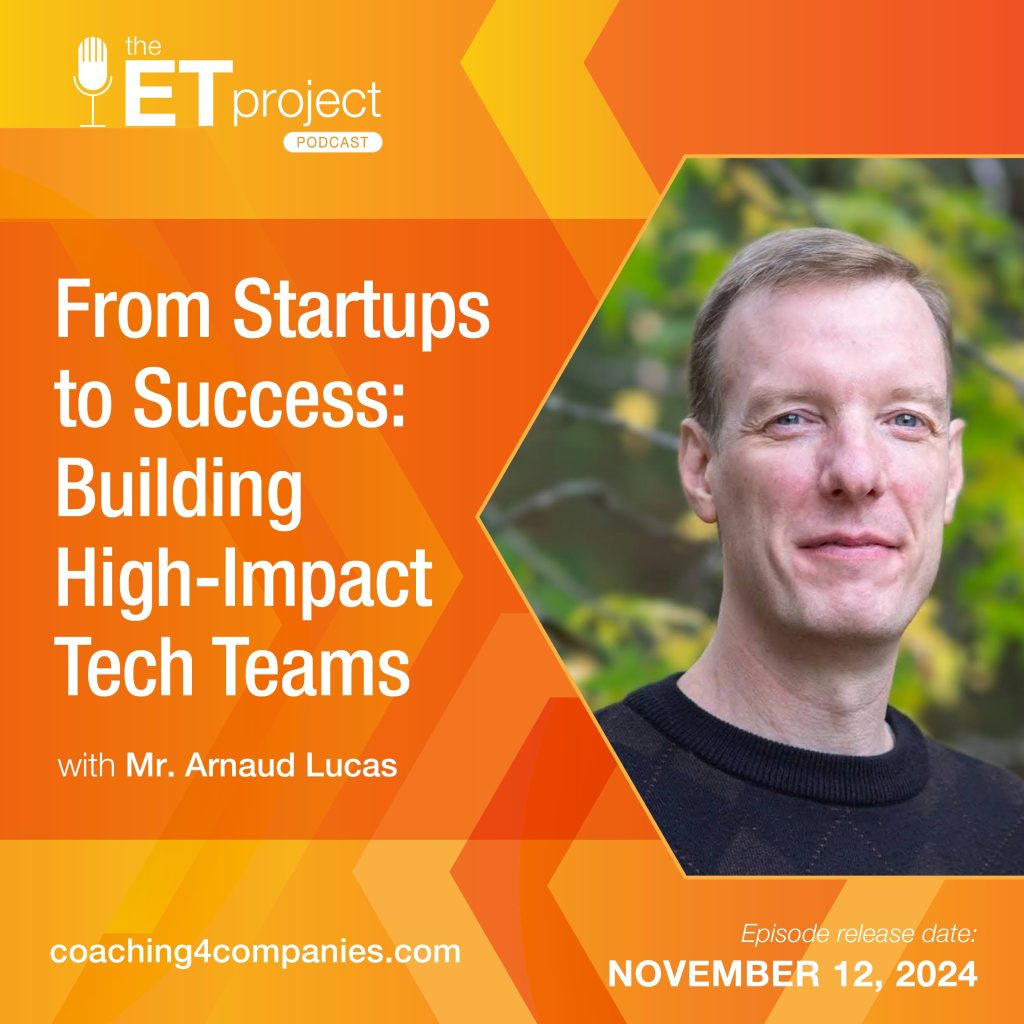
0:00:00.0 Wayne Brown: Hello, I’m your host, Wayne Brown, and welcome to the ET Project. We’re delighted to be delivering this podcast for executive talent all over the world, who we’re affectionately referring to as Team ET. Today, we’re heading back to one of my favorite US cities, Boston, Massachusetts, visiting with technology expert, Mr. Arnaud Lucas.
0:00:21.2 WB: Arnaud is a seasoned leader who inspires and leads high-growth, forward-thinking, technology-first organizations, maximizing ROI and customer experience, while driving sustainable product, revenue, and business growth. He bridges the gap between strategic ambition and technical execution by providing unparalleled clarity to translate abstract business goals into tangible technology and organizational roadmaps.
0:00:49.0 WB: With a deep expertise in technology and architecture, he drives innovation, hires and scales diverse, high-performing, high-trust teams, and develops world-class products through strategic planning, operational development, and organizational excellence. During our conversation, we touch on many topics, from the significant changes that technology has led from before the turn of the century, to challenges many of these changes are creating as we try and strike a balance with maintaining operational efficiency.
0:01:19.7 WB: So team, today Arnaud and I explore the nuances of building and leading effective tech teams, uncover strategies for driving company growth through technological advancements, and discuss future trends set to shape the industry. Please get yourself ready to expand your professional horizon and consider becoming the next industry disruptor.
0:01:44.2 Speaker 2: Welcome to The ET Project, a podcast for those executive talents determined to release their true potential and create an impact. Join our veteran coach and mentor, Wayne Brown, as we unpack an exciting future together.
0:01:57.9 WB: Hello, welcome again team ET. Today’s episode, we’re diving into the dynamic world of technological leadership and innovation. We’re going to explore the nuances of building and leading effective tech teams, as well as uncover some strategies for driving company growth through technological advances, and discuss future trends that are likely to shape not only the tech industry, but business in general.
0:02:29.4 WB: And whether you’re a tech enthusiast, aspiring leader, or even just a seasoned professional, this conversation promises to provide valuable insights for inspiration to navigate our tech landscape. We’re joined by Arnaud Lucas, a gentleman who blends visionary leadership with cutting edge technology. So with that, Arnaud, welcome to The ET Project. Great to have you here.
0:02:57.5 Arnaud Lucas: Thank you so much for having me. It’s a pleasure.
0:03:01.1 WB: I believe that you’re sitting in or very close to the city of Boston in Massachusetts in the US. Is that right?
0:03:08.8 AL: That’s correct. I live in Newton, which is west of Boston, so a short trip away.
0:03:15.6 WB: And I’m guessing our listeners can already sense that your accent is not typical American. Where do you hail from?
0:03:24.0 AL: I’m kind of excited. So it’s funny ’cause I’ve been in the US now for 26 years. First I was in Texas. That was a big shock. And then after that, I stayed in the Boston area. But I’m originally from France, in the north of France, [0:03:41.5] ____ Roche. North of France tends to have their own strong accent, or even from a French standpoint. I guess I carry that to the English side. But yes, I’ve been in France. I was in France for a long time, but I feel like at this point I’ve spent even longer in the US, so.
0:04:01.7 WB: Right. So I can imagine there’s a great story behind how you came to be where you are right now in Boston. I wonder if you mind sharing a little bit about the journey, particularly in the tech industry, and how you ended up where you are at the moment as a CTO.
0:04:19.5 AL: So it’s funny because when I was in France, I was finishing my studies, had to do my military service. Most of my, had to do internships and most of my internships were in big companies, like Apostolic, Airbus, Honeywell. Very big, big companies in France. But then I fell in love with my now wife. We were studying in Dallas, in Texas. So I joined her in Texas, and we moved to Houston, ’cause that was my opportunity to work there. And in Texas, I did startups. Startups, like I was working from the carriage house, building stuff from the garage kind of startup.
0:05:09.3 AL: So which was an amazing experience, because what I learned very quickly is that you have to be able to do everything. I showed up the first day at work. The person said, well, the person in charge of this application left, and we have to do this tomorrow. Figure it out. Build it. Make it happen. It’s like, okay. We’ll do it another day. So, but yeah, it’s a great way to just figure it out, I guess. We work in Dallas and do a lot of things.
0:05:46.2 AL: So that turn of my life was very impactful. I think that was the best thing that could have happened early in my career, because it was really, okay, we have a problem. How do we solve it? Okay, let’s figure it out. And not be already in a big corporate mindset, if I shall say. So, and then when my wife finished her studies, which was eight years later, we were like, okay, we’d like to move. Obviously, we’re from France, so let’s get closer to France. It’s not like we go to France every week, but.
0:06:14.6 WB: Yeah.
0:06:17.3 AL: Showed up in Boston because a good friend of ours showed us the beauty of Boston, which beautiful city, for sure. And from there, we, I started doing slightly bigger companies. First at Iron Mountain, which was very interesting because it was just… Well, a building that next generation digital archiving system based on community hardware, these kind of things that are very peculiar where you want to be able to store information across multiple machines, but you want them to be encrypted in a way that even if somebody stole the machine that they can’t decrypt the content and you want that eventual consistency on the air, it’s super interesting. It’s super technical. So I love that.
0:07:04.3 WB: Right.
0:07:05.6 AL: I was an architect there. Then move really to TripAdvisor with very different field, exporting company at the time, to build. That’s really where my management and leadership, started growing. We were managing teams and really grew from there, we did a lot of hiring, staffing, organizational changes, transformations and so on. And then I was like, okay, I would love to, after eight years at TripAdvisor there, very long time doing very different things. I’m like, you know, it’ll be nice if I can, you know, see if I can be a leader in another company.
0:07:41.3 AL: And that’s how I ended up at Wayfair. So doing very different things at WayFair, doing internal for most of them. So that was super interesting. We loved the company and, but after three and a half years, kinda still the same, I said, okay, I need to do something else. And, at that point I’m like, Hmm, I used to do startup in Texas. We’d be nice if I do startup again, but as an executive. And that’s how I ended up at Wanderu for now, for the last two and a half years, basically being the CTO there. But what I love about Wanderu is the same thing I loved back in Texas, which is wearing many hats, figure things out that I was never exposed to before but, and owning everything Tech. So there is, tech is everywhere at this point in the business.
0:08:34.9 WB: Yeah. This is around the era where the internet is really starting to take hold. What are some of the biggest changes that you’ve observed in the tech industry?
0:08:48.0 AL: There is a lot of changes, for sure, because on a different level, I do believe that the internet bubble, Y2K was really a crazy time for technology because it meant that if you had even technology on your resume somewhere, then you would be hired to do technology effectively. And yeah, I remember working in startups and startups don’t have the biggest budget. And people there that were supposed to be software engineers that didn’t know how to code. Because crazy times, lack of people, companies would grab whatever they could grab effectively, which I think that has changed tremendously over the years.
0:09:41.5 AL: Well, I will argue now the job market for the tech side is tighter for sure. There are plenty of reasons for that. And, you know, everybody gets kind of caught in that. So that;s the major change. Now you could argue it’s very cyclical as well. I mean, at that time it was crazy time, then the bubble burst and it was a bad time. And then, you know, but, you know, I never… Because I felt like I had the right level of expertise, I’ve never been scared of losing my job effectively. Now I’m at the point like, yeah, I don’t know. Things are kind of crazy right now. Right between company assessing the upcoming election, interest rate being so high, so they just cut down a bit. And overall, you know, microeconomics things make it so that even the big companies that we thought would just keep on going forever are kind of downsizing or reprioritizing. I don’t know what the right word is, but there is definitely a shift from where it used to be for a very long time. The golden years of tech feel a bit behind us. And maybe they’ll come back. We’ll see. But one has… We have been in that position for a couple of years now.
0:11:11.1 WB: Yeah. I can imagine you, you’ve been in some really influential position in different companies and you mentioned startups, a few times. What are some of the biggest challenges that companies are facing with technology and scaling their organization? What are you coming across as you engage in these different companies?
0:11:36.0 AL: So for me, technology is a tool and you’re right, it’s a tool that’s everywhere in a user, in a company. A tool for collaboration, tool for forecasting, tool for delivering the product and what you want to do for the customer. But ultimately, I think what’s important is really the people that you have in a company and how you empower them, how you structure teams and how you support them, including with technology. And also, most importantly, making sure you do the right thing for the customer.
0:12:18.7 AL: I strongly believe, and that’s something I learned, especially with that if you do the right thing for the customer, the customer will buy. So that’s how you generate business. You support the customer. You do the right thing for the customer. The customer will come or not come, but that is bad. And then you need the customer to come in some ways, that’s marketing. And technology is just here to help out in any way we can. And so one of the big role as a technologist is not just technology as a result, because at the end of the day, it’s how the technology organization can deliver the biggest impact for the business. And the technology organization will have the biggest impact by using technology to do so. And so, and as a technical or technologist leader, my goal is to have the best team…
0:13:17.7 AL: Organized, structured, empowered, supporting in the best way so that they deliver the best results that have ultimately the best impact on the business. I’m very much a people first, because I’m an engineer at heart, but I believe it’s all about the people, right? Without the people, there is nothing. And both on the customer side and obviously on the employees of the company.
0:13:42.7 WB: Well, let’s dive into that a little bit further. I mean, do you have any guidance or approach that you use, particularly when it comes to scaling high performing teams? I mean, what are some of the qualities perhaps that you look for in top engineering talent?
0:14:01.3 AL: Yeah, no, that’s a great question. For me obviously there is some technical attribute. Like do they know at least the minimum, because, yeah, we could train people and we do all the time ’cause it’s not like in technology you cannot know everything. I would argue in any job you can learn everything, but especially in technology it’s not possible. Technology is moving too fast. Like there are always some areas. So sometimes you are, most of the time you have to take risks with somebody that you hire ’cause it’s not like they’ve been there or done that.
0:14:30.9 AL: But there are some fundamentals that you assess. And this is the easy part, right? ‘Cause usually you can have a very technical discussion, you can do a technical exercise, you can do something to assess that. That’s the easy part. The most difficult part in my opinion is that what we call the soft scales or the cultural component or will that person be a good cultural add to the company? There are definitely some attributes that I like to see in people, no matter what the company is. Part of that is ’cause I have strong values as well. And I like people that share those values, right? Values physically about transparency, meaning that I’ve worked with managers, managed managers, for example, that didn’t wanna tell me what was going on with their team.
0:15:19.7 AL: That’s a problem for me ’cause yeah, it’s not that I would feel everybody has problems, right? Every team has problems. But if you don’t tell me, I can’t help you. And that’s a problem. I cannot support you. I cannot brainstorm how to best deal with those concerns, right? And just ’cause they are definitely, they are tired of preventing them from doing that. And I think that’s a bad place to be. I always make a mistake, but I love getting feedback. One, sometimes I can fix a mistake, two, and make sure I don’t do it again. But if people don’t tell me that, that’s a problem. So I think that transparency on both sides, I think is very important.
0:16:04.2 AL: So when something goes wrong, I have no problem telling my boss, the CEO, that something went wrong. But I also learned that it’s good to have somebody else to fix it at the same time. This went wrong. This is what I’m doing now. And this is how I believe we can deal with it. And then I started having that discussion. I think that’s super important. That’s a strong value I have of transparency. Then there is a potential for ownership. Ownership can mean very different things. People kind of tend to see that as passion or being motivated. But for me, it’s more than that. Yes, I like people that are motivated, that feel like they are passionate about their work.
0:16:55.4 AL: But more importantly, what I like is people that have no concern taking ownership over something. They wanna take ownership over something. Whatever you give them, they are like, yes, give it to me. And then they wanna figure it out. Just like I did in my early startup journey where I don’t know what I’m doing, but I’ll figure it out. Give it to me, and I’ll learn, and I’ll improve, and I’ll make it better and better and better and drive to our success. So that’s what I like to see as well. And I believe it’s half of the battle. If somebody is motivated, if somebody wants to take that ownership, I believe that that person, even if they have gaps somewhere else, will do what they need to do certainly.
0:17:42.6 WB: You mentioned about the technological industry is changing so rapidly that the skill level or the skillsets of the people needs to be constantly evolving as well. And I’m wondering, we talk about upskilling, we talk about reskilling. How do you, as a leader of a tech organization, ensure that the people in the business are doing that or doing what is needed?
0:18:13.5 AL: That’s a great question because you’re right, it’s very easy for people to fall behind when they take care of a thing that’s, it’s on both sides. I think the company should promote and enable people to upskill in different ways. And the employees need to take advantage of that, but ultimately don’t force somebody to do what they don’t want to do. Now, there are multiple ways to get people to upskill. And I think it depends on how people learn, definitely. People learn in different ways. I learn a lot by reading. I know when YouTube and other trainings, video platform trainings, are very popular. That’s not how I learn. I like to skim through blogs and articles and books. That’s my way of learning. There’s another way of learning as well that I’ve employed since 2000, and that’s through collaboration. In 2000, I created a lot of guilds. These are these informal networks where people share, right?
0:19:22.6 AL: They meet once a while, they share on different topics. Then, at Wayfair, I decided to introduce something called Leagues, which is like Guilds, but for a specific discipline. That came from the fact that, originally, I was distributing the mobile engineer’s different popularizations.
0:19:41.0 AL: So, how can the mobile engineer keep on growing from a tech aspect and keep on strategizing together about the future of mobile? So, be able to create these groups, effectively, of people that can effectively learn from each other and then come up with different ideas about what to push next together. I think, for me, that’s one of the best ways I found to upskill. And then, obviously, you have different kinds of trainings that people can do on their own, they can do in classes, they can do in groups.
0:20:20.0 AL: A big issue is actually, honestly, to provide that platform, which, because there are multiple platforms that exist that people can use at their leisure, the bigger issue is for them to have time to do so. And so, for example, at Wayfair, we established learning time. There is a certain amount of time every week that we’re dedicated to that. And if people want to do more, they can do more. But at least that there is this kernel of flow. Because people say, oh, I don’t have time for that.
0:20:51.2 AL: Well, let’s make the time, right? So that you have the ability to actually do that and learn and then kernel flow. And there are other ways too, for example, I did a learning budget where I was like, here is some amount of money you can use to learn, but if you don’t use it, it’s gone at the end of the year. So just like you mentioned at the beginning, there are so many things to do in this kernel. Well, same thing, you have that budget, you don’t use it, you lose it. So it’s kind of this notion of, oh, I don’t want to lose that budget, right? They’re giving me money to learn, I need to use it now. So this kind of stuff. So if you don’t have a platform, but you have a budget instead, then you kind of incentivize that with people to use it.
0:21:38.0 WB: Right. You also spoke a little bit earlier about customers and being customer centric for one of a term.
0:21:48.4 AL: Yes.
0:21:49.2 WB: How do you go about that in looking at it from a strategic point of view and looking at the technology that needs to be introduced in a company, how do you ensure that the technology is supporting that customer centric ideal?
0:22:05.4 AL: Well, first of all, before you even talk technology, you have to have a good sense of your business vision and mission. And yes, a lot of companies say, well, we want to be the leading meta search engine or whatever. That’s not really a vision and mission, because it’s too abstract, it’s too far away, it doesn’t tell you anything.
0:22:25.7 AL: So I like to center it down, especially in startups, for something that’s within a year or two time frame, something fairly short. And in that case, the vision and mission is more like, as a company, we believe we can solve a problem that the customer has. And then, because it’s much more concrete, meaning that you could actually identify a co-op of customers that you are really looking after, identify a certain set of problems that you believe you can solve.
0:22:58.0 AL: And so that’s where it starts. Because without doing that, then you can’t come up with the proper technology vision. That’s not possible. So when you understand what are the customer problems, which ones you plan to tackle as a company, and then once you have that defined, then you can start planning on how to solve those. So you can do, like I like to do OKRs on the quarterly aspect of quarterly planning, but you can set yourself objectives every quarter.
0:23:25.1 AL: Okay, what to do after this, okay, how do we measure that we’re being successful, we measure that, and so on. And we keep on iterating and iterating and iterating, while solving that customer problem. Because we never, and we should not, solve it in one big shot, like, you know. I remember early in my career, in some of the big companies, they would say, oh, it’s going to take nine months to release a new version of our software. That’s not a thing anymore.
0:23:53.1 AL: So, you know, usually, especially when you’re online, you have a SaaS application or a website, a B2C website, but you deliver things every day, you release things every day. So it’s all about iterating and iterating and iterating. And yes, you understand where you want to be, but you iterate around that, and along the way you learn, you look at your metrics, you look at the feedback from the customer. And so on, and you learn, and you may end up in a different direction, different spot than when you want it to be, but that’s okay, that’s actually a better spot.
0:24:31.6 AL: So I think that’s how you address the customer issue, which is less about technology and more about knowing what problems you want to solve, and then going after them in a very iterative way. And then technology as a tool is here to support that, because you need to develop new features, you need to change how you’re doing things. Sometimes it’s because, well, the customer is complaining that we’re not moving fast enough. Okay, how do we move faster? So things like that.
0:25:06.5 WB: There’s a lot of impetus in what you’re saying there, leading towards data-driven decision-making. My experience working with small, even medium-sized companies, is that many are not taking full advantage of their data, and therefore the decisions they’re making often are not the smartest decisions. How would you advise those sorts of companies? How could they leverage software technology to help them with better decision-making?
0:25:38.1 AL: Not just decision-making, right? When something goes wrong, you want something to tell you. And the first thing that will tell you is not just by looking somewhere, it’s if the system tells you. If you get an error, you get paged, because something goes wrong. So data is critical throughout both on the technology side and the business side to understand where we are, and then further to make clear point-based decisions on how to get where we want to be. There are two aspects, well, there are more than two, but it’s a multiple-step process. Right. First of all, companies have a lot of data, always.
0:26:15.6 AL: I’ve never been in a company that don’t have enough data, even small companies, right, because you get data of all kinds of places. The first step, though, is to grab that data and put it in one place. That’s the first step. People talk about data lake, but the point is that you use your snowflake or your red sheet or whatever you like, and you put that in one place. It doesn’t mean that that’s your source of truth. It’s just a matter of that, okay, you have all this data across all these systems, all these partners of this data that you can collect.
0:26:49.3 AL: You take that, you put it in one place, so that’s the first step. The plan after that becomes, okay, now I have all the data, what in one place? I have so much data, what do I do with it? A lot of times, too much data. But the question becomes, how do you make it actionable? Who do you want to make it actionable for? My belief is that every, and that comes back to my belief of what others have said, is every employee should have access to the data they need, preferably in a self-service fashion.
0:27:27.8 AL: I mean, if they need data, they can just look at it. They don’t need somebody else to go through, like a data analysis or anybody to gather that data. Now, it’s very idealistic, I know, but what I’m always shooting for is that 80% of the time, people should just be able to get the data they need, and then 20%, sure, they need additional help. But then the big question, well, how do you make that 80% happen? There are two aspects to that. One is to be able to, it’s a lot of data, is there a way to create a data model in a way that’s simple enough to interrogate? Which means sometimes you want to extract information from multiple tables and put it into one, like denormalizing and other things. That’s one way.
0:28:13.1 AL: Two is you want to have the tool to make it easy, because if you need people to write SQL, even people that know SQL, like I do, it’s already a friction point if you have to write a SQL for any data you are trying to get. So if you have tools, like great UI tools that you can go to click, click, click, and get the data you need, that’s how you reduce the friction. That’s how you make sure that people grab the data. Because what happens in a lot of companies is that they have the data, but because it’s so hard to get it in a way that, to get the right data that you can act on, people could ask others for help, but most of the time, they just give up. They say, yeah, too hard. I’m just going to go with my gut.
0:28:55.4 AL: There’s a place for gut thinking, but usually, even when you have a gut feel about what you should be doing next, you always want to back it up with some data. You say, actually, there is something there that I can see from the data. So I think at the end of the day, it’s providing each employee the right tools that they feel confident that they can grab the data as they need to, at least most of the time.
0:29:23.3 WB: And that highlights potentially another question I hear, particularly from maybe the small business leaders. They seem to freeze because the technology is advancing so rapidly in their mind, at least, and they’re concerned that if they choose something now, in six months, it’s going to be out of date, and they will have invested the time and the effort to install it to get everyone on board with it. And then there may be some new shiny object on the horizon that they could install. What is the process for staying current?
0:30:02.0 AL: I think it’s less of a problem than it used to be, because now a lot of the applications we are using are effectively SaaS, so they are online. Now, it brings other consequences from security and other aspects, but ultimately, what that means is that it’s like a horse race. You need to bet on the right horse at first, or at least a good enough horse that that horse will not be last in the race.
0:30:33.6 AL: But if you bet on the right horse, then you believe that that horse will keep on going, and they will finish the race, then that’s okay, because what that means for SaaS applications, they will keep on improving their products. It’s their interest to keep on improving the product, so you pay a subscription and pay usage of some kind, and then on their side, they use that money, or they should be using that money to keep on improving the product, so that they keep on leveling up with their competitors and the rest of the ecosystem in different ways. I’ve seen that in a lot of products that we are using, SaaS products that we are using, where they keep on doing that, and then it’s an interesting feature that we didn’t know we needed at first.
0:31:20.1 AL: Like oh, that’s interesting. Yeah, I could use that, especially visibility fraud. So I think it’s that. Therefore, the question becomes how to bet on the right horse. And that’s more of an art than a science, to be able to look at reviews, what people are saying about these reviews and other aspects that are important to you, but also what are the company’s footings? If you go with a startup that has been around for three months and have this product, that sounds interesting, it sounds great, but it’s like they are three months old.
0:31:57.2 AL: What do you think would be the likelihood that they will be around for another couple of years? We all know that a lot of startups fail in their first couple of years, so that’s something to assess as well. When you use open source, because there are plenty of great open source tools, it’s the same thing. You tend to look at the activity in the open source projects to say, okay, is there a community behind it? Or will it get deprecated in three months because nobody wants to work on it anymore? I think that’s the story. If a software is not getting updated, it’s dead. You don’t want dead software. That’s the thing.
0:32:37.5 WB: So, I mean, you’ve got a lot of experience and therefore you’ve probably been able to get a lot more clarity around how to, how to do this. I’m wondering what, or would you have any advice for younger leaders in the technology industry who are just coming into a similar role to you, and how can they advise their senior management team about the right direction with setting technology strategy within the company?
0:33:09.6 AL: There are a couple of principles I think that are important. There is a couple of anti-patterns that have noticed in the past that believe people should try to avoid. There’s one big anti-pattern that’s very known, especially one for leaders that are not as experienced, which is kind of going after the latest buzz, right? So no, once you have a lot of experience, right? You can see this latest buzz when we talk about the internal bubble, we talk about Y2K, but there are others that are much more recent, like crypto and AI. Now these, technologies are here to stay, don’t get me wrong, but you, there is also this period where things are much bigger and this big bubble that ultimately is gonna burst at some point. Right?
0:33:57.5 AL: And then the question is, well, when this bubble burst, what’s left. How are you gonna fall from that? And so I think that’s one anti-pattern, is going after the latest buzz, looking at the latest buzz, saying this is our big hammer that’s going to solve everything. I guarantee you, it won’t. Now we saw something, I’m sure it’ll, so it’s trying to figure out, Okay, what we, what it can solve and what it will not solve. And always do that in the perspective of the business. Meaning that you don’t just use technology for the sake of technology, right? So use technology because it’s going to help you solve a business need, right? Or make a business impact. So that’s one anti-pattern I’ve seen, right? The other anti-pattern is to make it more complicated, it needs to be, right, your cars, oh yeah, in 10 years from now we’re going to have a million customers. And you’re like, but you don’t even have one customer. Yeah.
0:34:53.1 AL: So why do you want to create this big architecture with all the systems, perfectly decoupled, blah, blah, blah. Well, you don’t have, you don’t, haven’t even proven yet that you have a product, right? So I think that’s something I’ve seen as well. In that case, no, you start very small, right? Everything can fit on the copper machines. That’s cool. Right? And then you start there, and then once you prove that there is a need, then you scale your architecture plan to the next level, next level, next level, right. You know, that’s, you know, the architecture. I think what’s important is to keep your architecture flexible so that you can actually do that. You can extend if you want the architecture as you go. So extensibility is very important, so that you don’t also get the other anti-pattern where, oh, we’re a startup. We’re a startup, but you have been around for 15 years and at this point you, you have, you are not the size of a startup anymore. And yet they still do things like they were a startup. The praise that what happened in that case is that you have a lot of people working on the messy code base, to say the least, and that is slowing everybody down, right? So there are all these anti-pattern I have seen over the years. So I don’t have a good direction for you, but I know what not to do.
[laughter]
0:36:19.3 WB: Is there anything that you see on the horizon that’s got you excited in terms of technology, potentially the near future? Let’s not go too far into the future, but in the near future, do you have anything that’s got you excited?
0:36:33.6 AL: I mean, AI, obviously, is the latest and greatest and you know, personally I’m much more excited about LLMs and GPTs than I was about crypto. See, because, and the reason for that is I believe that the tool like, GPT or LLM or generative AI overall can just like technologies everywhere, I believe that technology, you know, generative AI can be used in a lot of different places. Right?
0:37:08.5 AL: So some ways it can be used, I believe, is in automation, right? You know, be able to automate task, repeated task and people talk about replacing white, white collar workers and things that I’m not sure the technology is there yet. I’m not sure it’ll ever be, I don’t know, right? But I can see not technology replacing them, but more augmenting them, right? Making sure that there are something that they were doing that were very repetitive among them that now the AI can do for them. And so, which is why for those white collar, including myself, I’d be able to use those tools is important because that’s, that’s what would, that’s some, that’s where the world is going, definitely. So that’s one. There is, although a great process optimization, but the fact that, you know, AI can analyze data and come up with, potentially gaps, inefficiencies and things that you didn’t notice before, or it’ll take a long time for you to notice.
0:38:15.2 WB: Yes.
0:38:15.4 AL: Right. So there is a way for the AI to, to start putting these things in, in your data set in a way that you, it will have been very difficult to do before. We need something very specialized and focusing a lot of time on, and AI can also help with decision making, right? You know, because they can ingest vast amount of data, right?
0:38:47.8 AL: They can summarize that data in a way that say, Oh, okay, now I understand. And then, and then you can, to your point, they can help with the people making data driven decision even so they’re not directly looking at the data because it’s just too much, too complicated. That’s one. The other side is more to enable a more customized experience. So a lot of B2C business, actually that I have been at have a lot of customers, so be able to give them the proper experience is actually hard because it means that too, that you’ll need a lot of people, which usually the company is not investing. So things like customer service, proper recommendations for their needs to solve their problem and their needs…
0:39:22.5 AL: I think that AI can help with, especially the recommendation side because it really is something that we’re doing with machine learning anyway. I think AI can boost that to the next level, customer service as well. Even, so I’m not a big fan of… I’m very much a proponent of responsible AI. So where there are multiple tenets to that. But one tenet I care about is making sure that the human being looks at the input and the output of the AI, right? I don’t trust the technology enough, data is already on us, right? It’s what you ingest in, right? Because AI is all about the training data, right? So what you’re ingesting, you’re sure you’re ingesting the right thing into the AI, and you know, what kind of output is it giving and do you value that, that yes, that’s the right output that you want?
0:40:12.7 WB: Right.
0:40:14.3 AL: And then innovation, right? So I think AI can find new ideas on coreset based on a lot that amount of data can do, create stuff, like I know designers using generative AI to create splendid images or layout and so on. So, but yeah, the premise is that with AI as well, that’s why I want to be careful. There are plenty of considerations that I want to be very careful about that title because it could put companies in a very bad place. One that we start talking about is bias, right? The fact that AI is trained on data available in your own dataset or on the internet, depending on how you train your AI, and the data is bias built into it.
0:41:05.5 WB: Yeah.
0:41:06.5 AL: And so, yeah, whatever input is, that’s what you get us an output. So that’s something to be careful for you about. Yeah. We talk about, already mentioned job displacement, so why not, don’t see this AI doing that? Even so, there has been reports from Amazon or others saying, oh, we replaced the workers with AI. I haven’t seen that first hand. I see more AI segmenting with us, but at some point, maybe the AI will be pretty, would be good enough that you can just try to trust AI to own something, [laughter] which seems scary to me, but we’ll get there. I don’t know. And then obviously, I think we’re gonna need privacy and security. I think it’s clear. Like, I’ve already seen, for example, specific prompts and obviously even more input data like a virus quoting the AI. I see that. And so that’s one aspect. And obviously the privacy aspect, when, yeah…
0:42:06.8 AL: I mean, that AI disclosing data that was not meant to be public or not meant public in a fair way. Some because they were corporate IDs, or because they were just personal information that no one really has access to. So there are a lot of things to consider as well, which is why I believe that one, for me, the most effective use on AI is really use AI to look at your own data. I talk about companies having too much data, right? So, putting AI on a trained AI on your own data. That way you don’t have problem of copyright. And hopefully the, your data is, you have to do some validation of false entry something, like very problematic. Train your AI on your data and get insight, new insights, faster insights from you on data. I think that’s one I’m very excited about.
0:43:02.2 WB: Well, thanks for being a guest on The ET Project. Been a great conversation.
0:43:11.0 S2: Thank you for joining us on The ET Project, a show for executive talent development. Until next time, check out our site for free videos, eBooks, webinars and blogs at coaching4companies.com.