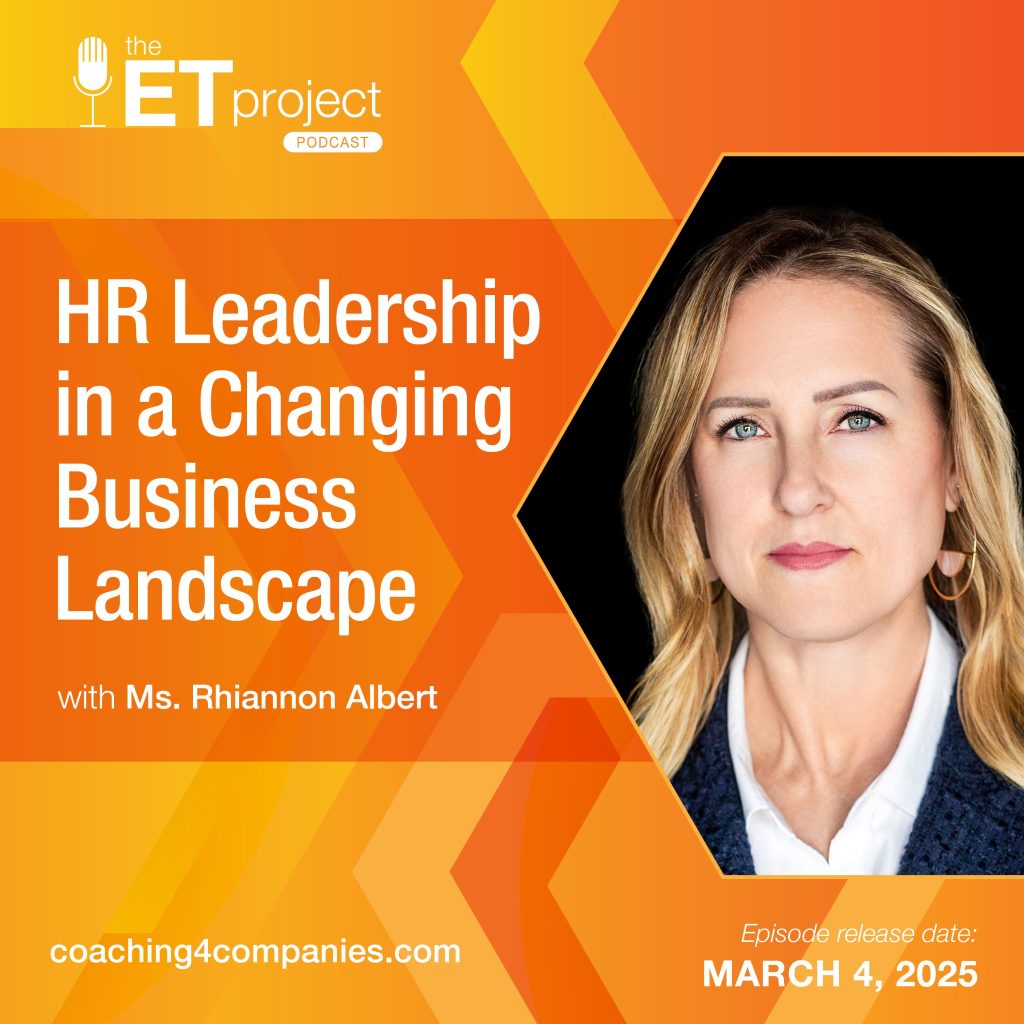
WAYNE BROWN: Hello, I’m your host Wayne Brown and welcome to The ET project. We’re delighted to be delivering this podcast for executive talent all over the world, whom we’re affectionately referring to as ‘Team ET.’ Today we’re in the capital city of Boise, Idaho, located in the northwest of the United States, and we’re here to connect and chat with Ms. Rhiannon Albert, founder of My Trusted HR. Rhiannon offers executives and HR teams tailored HR strategies, leadership and training. With more than 23 years experience serving multiple industries, Rhiannon is passionate about people being proactive in guiding positive partnerships with leaders to strengthen their ability to create lasting change. Rhiannon is certified with both the Society for Human Resources Management and the Human Resources Certification Institute. She currently serves as a trusted advisor with Vistage, is also a Board of Advisors member of the Idaho Chamber of Commerce, and served three years advancing the profession of HR as a board member for the Human Resources of Treasure Valley. Rhiannon holds a bachelor’s degree in Human Resources Management from the University of Idaho, where she served as a VP of Administration for the SHRM, and years later she was asked to serve on the University of Idaho’s Department of Business Advisory Board, where she served for seven years, affecting curriculum. Team, you may be guessing as you listen in to what I’m saying today that given the current business environment in the US, the difficulty level of working as a fractional CHRO might have just gone up a notch or two, and you would certainly be correct. On top of that challenge, Rhiannon offers her services across all states of the country, so if you know anything about the legislative and administrative nightmare that would hold, you could get some scale for the degree of complexity that her role is holding. Today’s conversation is sure to be greeted by many interested listeners keen to understand a little something about how we can all be handling these modern-day hurdles. Please grab your notebook and your pen and get yourself ready to learn and grow through the considerable experience and insights of our guest, Ms. Rhiannon Albert.
INTRO: Welcome to The ET project, a podcast for those executive talents determined to release their true potential and create an impact. Join our veteran coach and mentor, Wayne Brown, as we unpack an exciting future together.
WAYNE BROWN: Hello, team. It’s a pleasure to be back with you this week. And of course, having the opportunity to discuss some of the more pressing issues happening around the world, in particular in the workplace, and I’m guessing regardless of where you are on this global environment at the moment, there’s a high probability that you’re facing some challenges right at this present minute. We’re going to talk about all things people today. We’re going to be diving into the dynamic world of HR, exploring many of the key challenges that we are facing, but perhaps also some opportunities that are helping to shape our workplaces, whether that’s driven through the politics, whether it’s technology or even the corporate sector perhaps, we’ll be examining what I see as a rapidly evolving landscape. So as always, to guide us through this journey, I’m not going to do it alone. Our guest, Rhiannon Albert, is with us all the way from Boise, Idaho. Rhiannon, welcome to the ET Project.
RHIANNON ALBERT: Thank you. Thank you for having me.
WAYNE BROWN: We’re going to definitely have to touch on the politics a little bit that’s happening in the US. We won’t go very deep at all, but I’m sure everyone is interested to hear a little bit of perspective from you. But let’s start with your company, ‘My Trusted HR,’ what was the journey like leading up to founding the business?
RHIANNON ALBERT: I founded this business after I had spent 18 years in the corporate landscape, serving a multitude of industries, and really just felt like executives and leaders were looking for a more flexible option for their human resources needs. And so that’s what made me launch into this. I’ve been doing this almost six years on my own, 23 years in HR, I’ve seen a lot of things.
WAYNE BROWN: I can well imagine, probably not many as what’s happening at the moment. What are some of the values and missions within the company? Like what is your purpose? What are you out to try and achieve?
[00:05:00]
RHIANNON ALBERT: Yeah, so my purpose is really to educate, mitigate risk. Like as you spoke about, there’s a lot of risk in the world of compliance. And I do a lot of investigations, workplace investigations.
WAYNE BROWN: Yeah.
RHIANNON ALBERT: And as we see, there’s just a lot of worry. A lot of executives don’t want to be doing this kind of work. They’re looking for a trusted partner that can help walk them through that.
WAYNE BROWN: Right. Well, I’m sure given where you are at the moment, you’re having a lot of discussions around compliance. So, we won’t go too deep onto that, but I can only imagine how that’s going to unfold in the future. Is there any particular experience in different industries that have helped you shape the services that you offer?
RHIANNON ALBERT: I think that for me it has been kind of a learning process. You know, fractional HR leadership is really kind of my specialty.
WAYNE BROWN: Right.
RHIANNON ALBERT: It’s stepping in to serve as a leader, coaching and mentoring the existing HR team. I just find that that’s the best way for me to drive a lot of value because it’s such a cycle, you know, suddenly finding that you need to terminate your VP of HR or you suddenly find yourself without leadership. And so, you know, stepping into that role, providing immediate value, providing the executive team that comfort, that don’t worry we’ve got this taken care of. We’ve got someone in the spot. We’ve got someone to answer those regulatory questions about what do we do now? We’ve got a tough FMLA case or a really, you know, unfortunate incident with work comp. How do we navigate that?
WAYNE BROWN: Mm-hmm.
RHIANNON ALBERT: You know, so, and then also, you know, being there to support the process while you’re navigating your search for that next incumbent, and then also supporting the team while that incumbent comes on board, meets all the important shareholders within the organization, and then, you know, starting to phase out so that they can sail the ship on their own.
WAYNE BROWN: I can imagine one of the key attributes that you must bring is communication. It sounds like you’re coming into an environment that is going through its own upheaval, that probably extreme uncertainty, and somehow you have to come in and steady the ship. How do you go about that? Like from a practical point of view, when you come on board with these companies, how do you start that process?
RHIANNON ALBERT: Yeah, the process, I don’t know. It feels very natural to me. Maybe it’s the years of experience. Maybe it’s the start of my career. I started out by… I loved to temp. Do you know what that is? Like being a temporary worker and being thrown into any situation and providing value and learning the job and, you know, helping the teammates do whatever needed to be done. But that’s some of my favorite parts of what I do. Just, I have a knack for stepping in and recognizing the priorities, recognizing what seems to be the biggest issue that we’ll want to tackle first, but then also navigating all of the other pieces and parts. And then just bringing that peace of mind to the team that I do know my stuff and I am able and capable of, you know, leading them through it.
WAYNE BROWN: Yeah. In doing a little bit of background research, you talk about compliance audit. So how do you apply those when you move into this type of role? Like I can imagine through my own experience with compliance audits, it takes quite a bit to set up and to work through the process. Is there a particular approach?
RHIANNON ALBERT: So, I typically like to do that in unison with all of the other pieces that need to be dealt with right away.
[00:10:00]
RHIANNON ALBERT: But that compliance piece, you know there’s a lot of people that conduct audits, it’s nothing unique to me, but I really love the process that I’ve developed over the years because it really does give a beautiful snapshot of the entire organization as in regards to the 27 facets of HR, you know, and really highlights the areas of the most weakness. So, if I do jump into an organization and, you know, hit the ground running, we’re usually building as we’re flying, right? But as we navigate that and as I’m learning from the team and seeing things play out in front of me, it becomes very obvious where we are. And I always like to encourage companies too, don’t take it to mean too much. It is really a snapshot in time. So, if this is where you’re at now, that doesn’t mean you’re failing at anything or that you’re a terrible organization. It just means that we need to think through some of these other pieces and find a smarter way to proceed, but it’s a great tool.
WAYNE BROWN: Yeah, I think that’s a great piece of advice as well, because I mean, the company state just operates on the straight linear progression.
RHIANNON ALBERT: Yeah.
WAYNE BROWN: It’s like looking at a stock chart, right? It’s going to have its peaks, its troughs, and you come in and you look at something at that moment in time could just be because something else has triggered that to happen, it doesn’t mean you throw the baby out with the bathwater. So that’s true.
RHIANNON ALBERT: Exactly. And there’s just so much value in that outside perspective.
WAYNE BROWN: For sure. When you’re looking at these organizations, I can imagine there’s from time to time, a number of tough decisions that you have to make as well, particularly with the senior executives. Do they give you that freedom to come in and make those types of suggestions typically? Or, you know, is it more of a, because you’re coming as a fractional CHRO, are you typically putting together a report that is then decided whether they’re going to pursue that? Like, what do you find is your experience?
RHIANNON ALBERT: In my experience, we navigate a lot of these conversations ahead of time and I get a really good sense of what it is that they’re wanting and needing.
WAYNE BROWN: Mm-hmm.
RHIANNON ALBERT: And as we know, serving clients, what they think they need, isn’t always what we might think they need, right? So, serving their desires first is always kind of my plan. And by way of that, I can start showing them more and then… because you know, there’s no way to know really, I never know exactly what I’m walking into.
WAYNE BROWN: Sure.
RHIANNON ALBERT: But, you know, having that partnership, I would say that partnership, you know, you start building it from day one and then everything becomes, I wouldn’t say a negotiation, but a conversation, you know? Here’s something that I see and I think that this warrants a discussion or this warrants a further look. But I like to do it, you know, via that relationship, a partnership, a trusted partnership. And, you know, if there are certain things they feel strongly about we can navigate those but I don’t find too much resistance just because it is that outside perspective that you’re seeking when you are typically hiring a consultant such as myself.
WAYNE BROWN: And I think that’s a very smart approach because I know in my own case and in many of my colleagues’ case over my career, we used to have a tendency to look at HR as the external body to the operation and have the belief that they didn’t really understand the operation and therefore, why would we listen to their suggestion? So, I think basically what you’ve said, you’re coming at it with the angle of not trying to portray that you understand their business, but to look at it from a different set of eyes and give some input that may or may not be, you know, what they’re ready to buy into.
[00:15:00]
RHIANNON ALBERT: Well, and this is a touchy topic for me because HR, you know, there’s a stereotype and it isn’t necessarily a good one. And, you know, if I am struggling to fight this until the day I die, so be it. But I want to be seen as more of a strategic partner, somebody that does understand the business and that is a perfect resource to work hand in hand with all of the other departments of the organization to make things better. I mean, we’re used to working with marketing, you know, recruiting and, you know, all the different tie-ins, but some of us are very experienced in working with finance and operations and, you know, the right kind of partners are working in conjunction with everything else. And you couldn’t imagine trying to do it without any one piece.
WAYNE BROWN: Yeah, for sure. It is, you know, the… some of the pieces are bigger than the whole, right? So, I think HR definitely has a valuable input, they should be where they are, they should be at the table on board and maybe it’s not perceived that way all the time. And I’m with you in that concept, so, yeah. We can’t have our conversation without touching on a little bit of what’s happening in America at the moment. I don’t want to go too deep. You know, it’s still very new. We’re not 100% sure what direction everything is going, but topics such as DEI, immigration, you know, the things that are happening right at the moment through the policy changes, I can only imagine the uncertainty that people are feeling right at the moment.
RHIANNON ALBERT: Yes. Uncertainty is an understatement. I think, you know, those of us in HR, those of us in leadership positions, those of us running companies and making… needing to continue to make important decisions on the daily. I think everybody is a little tentative about what do we do now? You know, so many businesses rely on the shipment of goods from here to there and across country borders and all of it is an unknown. But…
WAYNE BROWN: Sure.
RHIANNON ALBERT: Yeah, I was just going to say that the DEI space, you know, my thoughts on it is that, while I’m watching colleagues lose their jobs because they work in this space, to me, my message would just be that we are always going to be stronger with diversity, diversity in thought, diversity and inclusion. Fundamental to all of this is respect and workplaces without a solid understanding and expectation of respect, what is that? You know, yikes! That is a scary place to be if the fundamental items dissolve. So, when you are working in a place that doesn’t understand the value of respect for your colleagues, diverse or not, right? That’s when you have harassment, that’s when you have bigger, worse things. So, to me, I think we need to stay true to what we know is right and stay vigilant to conduct ourselves in a way that we’re proud of and despite what everything else is telling us.
WAYNE BROWN: Yeah. In your role, coming into an organization, as you mentioned earlier, you have a need to come in and give advice around legislative issues. How do you stay current yourself? Like, do you have a source or do you have a go-to location where you can stay up to date with all the latest changes?
RHIANNON ALBERT: Yeah, I mean, I am constantly reading and I serve all 50 states here in the US, so it keeps me busy, but…
[00:20:00]
WAYNE BROWN: It’s a big task because different states have different legislation, I believe, right?
RHIANNON ALBERT: And so, I do lean on certain resources and tools, but the society of human resource management is a global resource for HR professionals. You know, when I became certified with them many years ago, you know, we all kind of like agree to a creed that says that we’re going to leave workplaces better than we found them. So that’s a big tool for me. And then I use a multitude of other resources just to keep me up to date.
WAYNE BROWN: As you work in the HR, so my pedigree within the HR space is in the learning area. And I’m wondering how much do you get involved as you come in as a fractional CHRO or CIO or whatever role you’re playing? How much do you get involved with the learning side of the organization?
RHIANNON ALBERT: Personally, I am a big fan of this space just because I think it’s so critical for leadership development, for, you know, just providing opportunities within the organization. It’s such a critical piece. And I think businesses that invest in this space are always going to be better off, but it just depends on the needs of the leadership. So, if that piece is working and functioning and, you know, I still might offer some suggestions based on workflows and overarching processes and the strategy of the organization, where we need to grow, maybe where we’re needing to hire. So, I’ll always utilize the resources of the organization or make recommendations, but, you know, if it’s not something that is necessarily broken, it might take me a bit to get to that.
WAYNE BROWN: I was wondering, I guess, around the reskilling, the upskilling, you know, with the technological advances with the whole dynamics within business today and the need for all of us to be continually refreshing our skill levels and knowledge level, how are you seeing organizations approach that? Have you had any particular experience that you think is like a good example versus one where it has been ignored?
RHIANNON ALBERT: Yeah, I have experienced clients that make it a priority to invest in this space. They are on top of, you know, the advancements with AI. They’re on top of, or wanting to stay on top of, you know, what do we need to be doing to reskill and provide and simply just provide opportunities for growth or, you know, ladder changes or, you know, hopping over to another department.
WAYNE BROWN: Yeah.
RHIANNON ALBERT: So, I’ve gotten to work in those organizations and, you know, definitely, you know,
growth and opportunity and curiosity is alive and well, and there’s so many opportunities with that.
And then I’ve also worked for plenty of organizations where they just didn’t make it a
priority or it wasn’t on the, you know, short list of where our, you know, investments are
going to be headed.
So, you know, it really just differs with each organization.
There are certain industries that can afford it.
And then there’s other industries that are struggling, you know, to stay afloat with
all of the different factors, so.
WAYNE BROWN: That’s certainly our experience as well.
RHIANNON ALBERT: But that kind of sounds like an excuse too.
So, I don’t want that to sound like an excuse.
I think it’s such a critical thing that businesses should be investing in, but, you know, every
business leader is having to make important decisions on what needs to stay and what needs
to go.
So, I understand.
WAYNE BROWN: What we find is a lot of the leaders are a little bit paralyzed when it comes to making that decision, because it… the AI space is so rapid in its change, in its shift in direction in many instances.
[00:25:00]
WAYNE BROWN: Many of the leaders that we engage with are really a little bit frozen in there. They’re thinking about when they should jump in or when they should jump in. So, I guess, you know, particularly the smaller businesses who don’t have the funds like you suggest.
RHIANNON ALBERT: Yeah.
WAYNE BROWN: How do you see AI in the HR space? Like, do you see it bringing a wholesale change? I know we’ve seen it over the years start to really come into the recruitment side of the business. Do you see it broader than that at this stage?
RHIANNON ALBERT: I wish I had a quote available to me, but I was speaking to a college class recently, and there’s going to be huge effects with regard to all administrative tasks. You know, as we would expect, right? Certain tasks are going to probably be better done by AI and this automation, but I think there will be very lasting effects as far as, you know, certain work just going away. And more of the strategic roles are still going to be present. But, you know, I think it’s going to be, like you said, upskilling for everybody involved because there’s going to be a lot of jobs that are going to go away in the future. So, what do we all need to be doing to future-proof our own careers and make ourselves valuable regardless of the times?
WAYNE BROWN: Yeah. If we put a generational overview on that thought process, do you see the struggle with people like myself, baby boomer generation versus even the alphas who are maybe not in the workforce yet, but do you see that being a bigger issue in the immediate term for the older generation?
RHIANNON ALBERT: You know, I think there’s still so much power in the person-to-person connection, the skills that are required to build relationships, build and maintain relationships. And so, I would like to think that there are certain things that will stand the test of time because we as people are going to still hunger for that. But, you know, it’s not to say that AI can’t learn a little bit of that, too.
WAYNE BROWN: Yeah.
RHIANNON ALBERT: It’ll be interesting to see. And I don’t have a crystal ball, but…
WAYNE BROWN: I was speaking with one lady who was in HR recently in Australia, and she was talking about the Silver Fox movement. I guess not the word she used, but my take on it is that companies have started to recognize the value of having at least a portion of their leadership team, workplace in that over 50 bracket, based on the experience that they might still be able to bring, based on the communication, the conversations, the nucleus. Have you seen any movement in that direction?
RHIANNON ALBERT: I mean, I think you’re talking to somebody who very much values diversity. I value diversity of thought, I value diversity in generations and the different values that each generation brings, you know, there’s greatness in each of us, and I’d hate to see anybody like ousted because there’s so much value that can be learned from having us all working together. I think there’s… You know, a lot of companies now have, what? Is it five or six generations at work now? And does it pose problems? Yes, it does, there’s very different ways of thinking, but once we master how to work within that, it’s all good. It’s all good stuff. We can learn from each other.
WAYNE BROWN: The beauty comes out of the messiness quite often.
RHIANNON ALBERT: Mm-hmm.
WAYNE BROWN: The innovation, the creativity.
RHIANNON ALBERT: Nothing is easy, right?
[00:30:00]
WAYNE BROWN: Nothing is easy, particularly when we’re dealing with people. I mean, we’re all unique. We’re all unique, and that’s what makes HR such a vital ingredient. We haven’t spoken yet about one of my favorite topics, which is working from home or the hybrid environment. And I know we touched on it a little bit when we first connected.
RHIANNON ALBERT: Yeah.
WAYNE BROWN: And you see that space at the moment in terms of, will it stay? Will it be wound back to pre-COVID days? What’s your feeling?
RHIANNON ALBERT: I don’t think anything is going to ever go back to pre-COVID days. There are certain organizations and there are certain industries that are always going to need to be onsite, and they’re not going to have the work from home options like some of us do. And I also think there’s always going to be value in having people literally get to come together for whatever reason, whether it’s work or meetings or those things withstanding. There’s also a lot of growth and development that I’m proud to see where leaders are embracing the fact that their teams can still drive amazing results and they don’t have to be at the office. And we all remember the days where we were at the office, but that doesn’t necessarily mean you’re being effective or efficient. I like to see that there have been advancements in this space. There has been a lot of technology improvements that allow us to work remotely, really from anywhere, but feel like we get to work together. So, I don’t think we’re going back to pre-COVID times, but I also think businesses are going to have a really hard time all of a sudden demanding everybody come back to the office unless there’s a real significant reason why they can justify that.
WAYNE BROWN: Yeah.
RHIANNON ALBERT: I think the biggest push is going to be teaching leaders how best to motivate and stay connected with their teams and how to still drive results no matter where their people are.
WAYNE BROWN: As you said, technology is evolving to make this work-from-home hybrid environment more doable anyway, and it’s quite interesting to watch some of the companies that are suggesting return to work be the technology companies. So, it’s quite an interesting dynamic that’s happening. One of the things that I’m fascinated by is we see so many pictures in the media, on social media, of people working from home, and you look at it from an ergonomics point of view, you look at it from a safety point of view in terms of how they’re sitting, how they’re typing, how they have their eyesight to their small laptop, you know, the whole raft of different dynamics that we had and we take for granted when we work at home versus the struggle that we’ve been going through for the last hundred years in an office environment to make it as pristine as possible in terms of health and safety. I’m wondering how long it might be, if it hasn’t already happened, how long it might be before we see some sort of issues arise based on how people have forgotten to think about their own health and safety in that work-from-home environment.
RHIANNON ALBERT: Mm-hmm. Yeah, you can be all cuddled up on the couch with your cat and your dog and your laptop, you know, and you’re exactly right. I think we had a hard time really driving ergonomic perfection when we were in the office, but now it’s even harder and I know there have been work cases. I know there have been issues around this because we have even less control, even less visibility to how people are doing that. I think the companies that are being a little more proactive in their messaging and their training about ergonomics and safety and still keeping that top of mind when they’re working with their teams, I think they’re going to say are better.
[00:35:00]
WAYNE BROWN: Right. I mean, you bring up a good point there with workers’ compensation. It’s such a broad, we used to talk about workers’ compensation starts from the moment you start your journey to the office and then journey back home. Where’s the line now for people working from home? When does work start? When does it finish when it comes to a workers’ compensation claim?
RHIANNON ALBERT: I know. That’s a great question. And maybe there is like a technically sound answer to that, that I don’t know, but you’re exactly right. I mean, what are the bounds and how would we know? And yeah, you’re exactly right. It has muddied the line on a lot of things.
WAYNE BROWN: Yeah. I’m sure we’ll work through it as it evolves, but interesting times. What do you see as the biggest challenge right at the moment for the HR world? Putting politics and policy change to one side, but what do you see as the biggest challenge?
RHIANNON ALBERT: Good question. When we were going through COVID, there was almost a respect that came out of that for all of the pieces and parts that we hadn’t really thought about that we had to all of a sudden think about. You know? So that brought, I think, a good healthy appreciation for all that HR professionals do throughout the world. Now, I think we’re just being challenged once again by, I don’t know, there’s a lot of push still, in my opinion, to farther the bar, raise the bar on the stereotype of HR being considered more of a business partner, a respected, trusted part of the team that has a seat at the table, that’s something that I’m always pushing for. But I also think the onset of AI, what roles can be duplicated, how to stand out in a career such as this, how to be a good partner internally, externally, to help the leadership and drive results. I think we’ve got a lot of challenges ahead of us, but it’s also a very exciting time to be in this career. So, I don’t know, I’m excited. I’m choosing to be helpful about the future rather than dismal about it.
WAYNE BROWN: What’s next for Rhiannon? Where are you focused at the moment?
RHIANNON ALBERT: I’ve gotten to serve a lot of amazing clients in the years that I’ve been doing this, and I think I really want to continue to specialize in the area of fractional, interim, HR leadership. I love that space and getting to really drive value that way, getting to be a partner to the entire team and the managers throughout the organization, the executive team and their questions and concerns, but really just delivering that peace of mind. I’m usually met with a lot of fear, a lot of trepidation, a lot of concerns. It’s a pretty scary place to be for a lot of executives, but delivering the things that they need most to bring them peace of mind.
WAYNE BROWN: I can imagine one of the big values that you bring to an organization as somebody coming in from the external is the breadth of exposure and experience that you bring rather than somebody who has worked in the organization for the last 20 years might not have that same perspective.
RHIANNON ALBERT: Mm-hmm.
WAYNE BROWN: Yeah.
RHIANNON ALBERT: You know, I was just talking to somebody the other day about this, and it’s… that is so well said because when I’m working with clients all the time, they don’t realize that a lot of their fears and worries and frustrations are very, very similar, pretty much on point with other people in their industry, other business owners of their similar size.
[00:40:00]
RHIANNON ALBERT: And, you know, that’s a very true statement, and I think that there’s just so much value to having somebody that you trust from the outside be able to weigh in and give you that perspective. Because the other piece is that executive teams, all of the information they’re getting is kind of scrubbed. They’re going to be hearing kind of what they want to hear, and their teams are not going to be confident. They don’t want to lose their job, so they’re not going to be as confident to give them the reality of the big picture. So that outside trusted perspective is just huge.
WAYNE BROWN: Yeah.
RHIANNON ALBERT: Help you see what you can’t see.
WAYNE BROWN: Absolutely. I mean, we work as consultants, so we’re in the same borders as what you are with this, and I fully agree. Where can people find you? Where can they go to see what you’re doing and follow, if not engage with you?
RHIANNON ALBERT: Yes, so I can be found on LinkedIn, Rhiannon Albert, and my business is ‘mytrustedhr.com’ for my website. Yeah, I’d love to hear from everybody.
WAYNE BROWN: Great to connect with you. I look forward to staying in contact and seeing how things pan out in the near-term.
OUTRO: Thank you for joining us on The ET project, a show for executive talent development. Until next time, check out our site for free videos, eBooks, webinars, and blogs at ‘coaching4companies.com.’
[END OF TRANSCRIPT]